


People who often eat out spend more money on meals, waste more food and eat less healthily than people who frequently make their own lunch, according to a result of a survey released by the Taipei Medical University Hospital yesterday.
In order to understand the eating and consumption habits of the nation’s office workers, the hospital conducted a survey earlier this month of 1,400 people, with 90 percent of the respondents being office workers, 56 percent of which were between 25 and 35 years old.
Chief of the hospital’s department of nutrition, Su Hsiu-yueh (蘇秀悅), said 78 percent of the respondents said they frequently eat out. Using this percentage, the hospital estimated that there are more than 6.46 million office workers in Taiwan who often eat out.
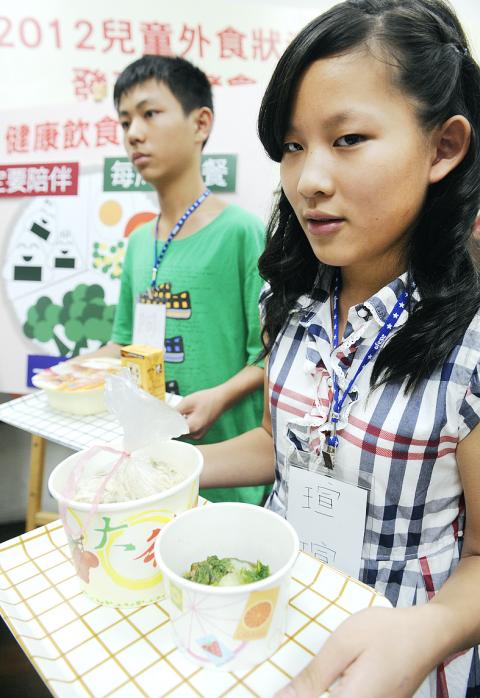
Photo: George Tsorng, Taipei Times
The survey results showed that people who mostly eat out spend an average of NT$5,517 (US$183) on meals per week, which is 24 percent more than those who take their own lunch to work spend — NT$4,416.
Comparing the monthly expenses of the two groups, people who often eat out spend an average of NT$13,371 per month, while people who make their lunch spend an average of NT$11,507 per month, Su said, adding that people who bring food from home can save about NT$2,000 more than those who eat out each month, which is approximately one month’s worth of a graduate’s wages a year.
The survey data also showed that 27.7 percent of people who make their lunch say they often cannot finish eating their meal, compared with up to 54.7 percent of those who frequently eat out, 86 percent of which tend to end up throwing the remaining food away.
However, the respondents who often eat out and do finish their meals have a tendency to eat much more than they should and consequently have a higher body mass index (BMI) ratio than those who often throw away the unfinished meals, the hospital said.
In addition, the survey results reflected the prevalence of those with imbalanced diets — less than 10 percent of the respondents said that they eat food from all six food groups on a daily basis, while 60 percent of people who frequently eat out said that they seldom eat food from all six food groups in one day.
Su said the survey results also showed that although 93 percent of people that frequent restaurants recognize that using disposable containers and utensils is harmful to the environment, 94 percent of them still often use the utensils and containers due to their convenience, showing an inconformity between their knowledge and behavior.
To make eating out healthier, people can split the food from a lunch box into two meals, keeping one-third of the meat and rice in tupperware containers for another meal, Su suggested, adding that this method could also cut meal costs and help maintain a healthier diet.

FUKUOKA SITUATION: Japanese media reported that the pathogen is expected to be identified by the summer, while the CDC downplayed the idea that it was hMPV A “mysterious cold-like illness” reported in Japan’s Fukuoka Prefecture does not seem to be a new disease, but Japanese authorities have been asked about the situation, the Centers for Disease Control (CDC) said yesterday. The Fukuoka Prefectural Medical Association on Wednesday told a news conference that a “mystery cold” that has become a hot topic on social media is “highly likely to be caused by some kind of viral infection,” Japan’s KBC News reported. “Many people are experiencing symptoms starting with a sore throat, followed by a runny nose, phlegm and a severe cough,” KBC News reported, citing association officials. Health authorities are

Nvidia Corp CEO Jensen Huang (黃仁勳) arrived in Taiwan yesterday ahead of upcoming AI and technology events, saying he plans to meet with clients and Taiwan Semiconductor Manufacturing Co Chairman C.C. Wei (魏哲家) during his visit. After landing at Taipei Songshan Airport, Huang posed for photos with fans and handed out Yakult drinks to reporters and supporters waiting at the scene, saying he has “a lot to do” during the trip. Asked about reports that Nvidia’s planned headquarters site in Taipei’s Beitou Shilin Technology Park could break ground on May 27, Huang said that if the company holds an event, he would

The Ministry of Finance this afternoon announced the winning numbers for the March-April uniform invoice lottery. The winning number for the NT$10 million (US$318,060) special prize is 19531471, and the winning number for the NT$2 million grand prize is 85941329. Three numbers were drawn for the NT$200,000 first prize: 07225810, 20231230 and 83518781. Those with receipts matching the last seven digits of any of the first-prize numbers will win the NT$40,000 second prize, while those matching the last six digits will win the NT$10,000 third prize. Those whose receipts match the last five digits of the first-prize numbers can claim the NT$4,000 fourth prize,
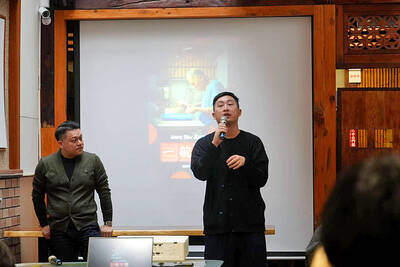
Taiwan Travelogue (臺灣漫遊錄), which earlier this week became the first Taiwanese novel to win the International Booker Prize, is to be adapted into a television series through a Taiwan-Japan coproduction, producer Chang Chen-yu (張辰漁) said yesterday. Chang, a producer at World Softest Production Film Co, wrote on Facebook that the company had been searching for projects with international appeal that retain a strong Taiwanese identity after colleagues and Japanese partners strongly recommended the novel. After reading the book, Chang said he immediately decided to pursue the screen rights. “A great story has the power to transcend time and borders, and connect countless people,”


 RSS
RSS