


Thanks to the application of an infrared surveillance camcorder with thermal sensors, the Forestry Bureau yesterday said it has recorded a number of rare images of protected wild animals, including clear footage of the endangered Formosan black bear, in the forests near Taitung County’s Luye (鹿野) and Guanshan (關山) townships.
The bureau said it began installing infrared cameras in national forests nationwide in the 1980s to gather information on the wildlife in protected areas. However, the cameras had mechanical limits and gathering long-term images of wild animals was difficult.
Two years ago, the bureau installed 12 infrared camcorders in mountainous areas in the hope of gathering more information about the behavior of wild animals. The camcorders were fitted with thermal sensors that cause the cameras to shoot footage automatically for periods of 10 seconds when triggered.
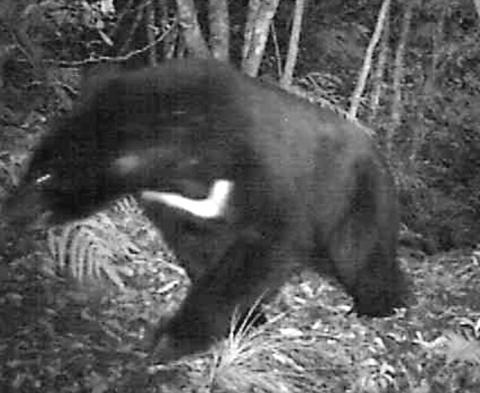
Photo: CNA, courtesy of the Taitung Forest District Office
“The camcorders use thermal sensors that automatically start recording when they sense heat within five meters,” said Lo Shuang-hsi (羅雙喜), an executive at the bureau’s Taitung Forest District Office. “We did have infrared cameras in the past, but they could not capture motion like the new ones.”
“In addition, the batteries in the old cameras did not last that long, so we had to go check on them very often,” he said. “They also needed film, so sometimes when we checked on the cameras, they had already run out of film, or their batteries had died before they ran out of film.”
Catching an image of a Formosan black bear walking past the camcorder for the first time in two years, the district office’s recreational section chief Huang Chium-tse (黃群策) said the bear was pictured at an altitude of about 850m, the lowest altitude at which a Formosan black bear has ever been sighted.
With a white “V” on its chest, a sturdy black body, round head, short neck and long snout, the Formosan black bear — the only native bear species in Taiwan — was listed as an endangered species by the Wildlife Conservation Act (野生動物保育法) in 1989.
Taiwan Black Bear Conservation chairperson Hwang Mei-hsiu (黃美秀) said the Formosan black bear is a very sensitive animal, often inhabiting deep -mountainous areas, adding that there are probably less than 1,000 bears left in Taiwan.
Aside from the bear, other rare wild animals were also recorded, including the Formosan serow, the Formosan sambar, the Formosan barking deer, the Formosan yellow-throated marten and the Swinhoe’s pheasant, the bureau said.

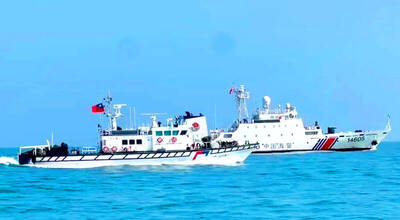
The military has spotted two Chinese warships operating in waters near Penghu County in the Taiwan Strait and sent its own naval and air forces to monitor the vessels, the Ministry of National Defense (MND) said. Beijing sends warships and warplanes into the waters and skies around Taiwan on an almost daily basis, drawing condemnation from Taipei. While the ministry offers daily updates on the locations of Chinese military aircraft, it only rarely gives details of where Chinese warships are operating, generally only when it detects aircraft carriers, as happened last week. A Chinese destroyer and a frigate entered waters to the southwest
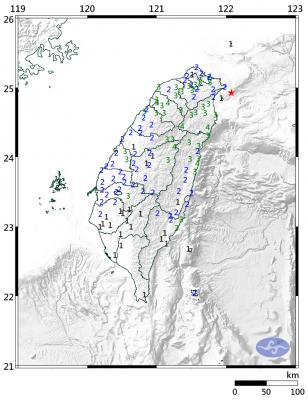
A magnitude 6.1 earthquake struck off the coast of Yilan County at 8:39pm tonight, the Central Weather Administration (CWA) said, with no immediate reports of damage or injuries. The epicenter was 38.7km east-northeast of Yilan County Hall at a focal depth of 98.3km, the CWA’s Seismological Center said. The quake’s maximum intensity, which gauges the actual physical effect of a seismic event, was a level 4 on Taiwan’s 7-tier intensity scale, the center said. That intensity level was recorded in Yilan County’s Nanao Township (南澳), Hsinchu County’s Guansi Township (關西), Nantou County’s Hehuanshan (合歡山) and Hualien County’s Yanliao (鹽寮). An intensity of 3 was

Japanese Prime Minister Sanae Takaichi’s comment last year on Tokyo’s potential reaction to a Taiwan-China conflict has forced Beijing to rewrite its invasion plans, a retired Japanese general said. Takaichi told the Diet on Nov. 7 last year that a Chinese naval blockade or military attack on Taiwan could constitute a “survival-threatening situation” for Japan, potentially allowing Tokyo to exercise its right to collective self-defense. Former Japan Ground Self-Defense Force general Kiyofumi Ogawa said in a recent speech that the remark has been interpreted as meaning Japan could intervene in the early stages of a Taiwan Strait conflict, undermining China’s previous assumptions
Instead of focusing solely on the threat of a full-scale military invasion, the US and its allies must prepare for a potential Chinese “quarantine” of Taiwan enforced through customs inspections, Stanford University Hoover fellow Eyck Freymann said in a Foreign Affairs article published on Wednesday. China could use various “gray zone” tactics in “reconfiguring the regional and ultimately the global economic order without a war,” said Freymann, who is also a nonresident research fellow at the US Naval War College. China might seize control of Taiwan’s links to the outside world by requiring all flights and ships entering or leaving Taiwan


 RSS
RSS