


Calligraphy is usually seen as an art form that cultivates learning and discipline, as well as a practical technique for writing. Deeply embedded in Chinese culture, Chinese calligraphy has a long history of evolution of characters and writing styles.
However, this ancient art has taken on a new look at this year’s Taipei World Design Expo.
Forty graphic designers from six Asian countries, including Taiwan, showcased how they have changed Chinese characters into designs like cute monsters and outfits for robots at the month-long event, which opened on Sept. 30.
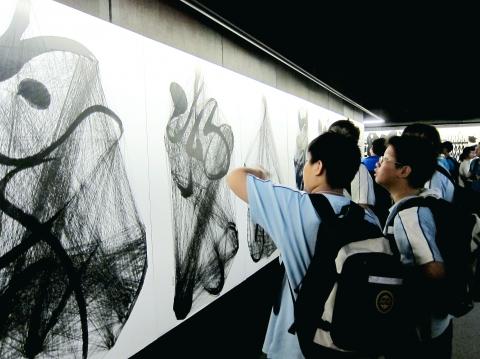
Photo: CNA
The designers were called together by world-renowned Taiwanese calligrapher Tong Yang-tze (董陽孜) to each create a six-piece graphic design using calligraphy characters or words written by Tong.
In his work, Japanese designer Kazumasa Nagai depicted animals running vigorously in nature to express his admiration for life. The inspiration came from the Chinese characters that mean “to grow and prosper.”
The character “love” was also shown between a large rabbit and a small frog, as well as a large whale and a small rat in the 82-year-old’s work, to symbolize his hope for a peaceful world where all things love each other.
In another work, dancing robots with spiraling horns on their heads were shown wearing outfits with patterns of calligraphy to show a contrast between the industrial and the artistic.
Other works showed characters cut into paper snowflakes, expressed in the form of wispy smoke curling upward and cocooned in thousands of thin lines.
All of these designs are part of the 69-year-old Tong’s efforts to raise the younger generation’s awareness of the ancient art.
Using ink and a brush was the most common way to write Chinese characters before pencils and pens. Chinese calligraphy later developed into an art form. However, many people in Chinese-speaking societies nowadays do not know how to write calligraphy and appreciation of the skill is not strong among younger people.
Chinese calligraphy is not a compulsory course in Taiwan’s educational system and is not even taught in many junior and senior-high schools. In addition, no higher education institution in Taiwan maintains a department of Chinese calligraphy or calligraphy teaching. This means few teachers know the skill, and are therefore unable to teach it to students.
Without the backing of the education system, it is no surprise that Tong expressed concern that many youngsters are no longer interested in the traditional Chinese art.
Tong said she hoped young people could see the wonders that a calligraphy brush can create through the exhibition and understand that it is no less fun than modern technology.
A prominent calligrapher, Tong’s works are characterized by their large and bold strokes, which often appear against an empty background.
Tong’s passion for calligraphy inspired Chen Pu, 25, the youngest participating designer, to give the ancient art a creative new twist.
In his work, Chen created a cute monster that is shaped like the Chinese character for “joy.”
The monster is shown doing things, such as listening to music, riding a bike, lifting weights and using a camera.
Chen Jun-liang, one of the curators of the exhibition, said the idea for organizing a creative calligraphy exhibit stemmed from a trip he took with Tong to Iran five years ago.
He said the calligraphy master was inspired by a display of ancient script in an Iranian museum and had since asked him to organize an exhibition that would showcase the beauty of Chinese calligraphy and, at the same time, appeal to a modern audience.
To many young visitors to the exhibition, the combination of calligraphy and graphic design was refreshing.
Fang Lee, a 16-year-old student, said a work that artfully blended calligraphy with Chinese landscape painting and another where the character “love” emerges from patterns of choppy, tangled lines, left an impression on him.
“I was surprised by the creativity,” he said. “I never thought calligraphy could be expressed this way.”
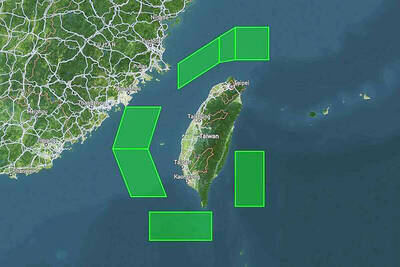
The disruption of 941 flights in and out of Taiwan due to China’s large-scale military exercises was no accident, but rather the result of a “quasi-blockade” used to simulate creating the air and sea routes needed for an amphibious landing, a military expert said. The disruptions occurred on Tuesday and lasted about 10 hours as China conducted live-fire drills in the Taiwan Strait. The Civil Aviation Administration (CAA) said the exercises affected 857 international flights and 84 domestic flights, affecting more than 100,000 travelers. Su Tzu-yun (蘇紫雲), a research fellow at the government-sponsored Institute for National Defense and Security Research, said the air
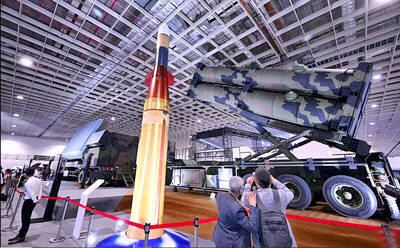
Taiwan is to commence mass production of the Tien Kung (天弓, “Sky Bow”) III, IV and V missiles by the second quarter of this year if the legislature approves the government’s NT$1.25 trillion (US$39.78 billion) special defense budget, an official said yesterday. Commenting on condition of anonymity, a defense official with knowledge of the matter said that the advanced systems are expected to provide crucial capabilities against ballistic and cruise missiles for the proposed “T-Dome,” an advanced, multi-layered air defense network. The Tien Kung III is an air defense missile with a maximum interception altitude of 35km. The Tien Kung IV and V
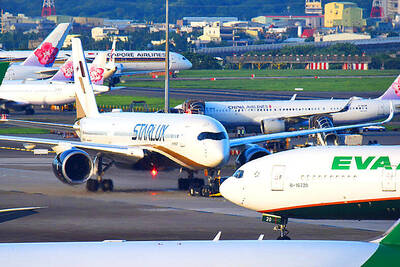
Trips for more than 100,000 international and domestic air travelers could be disrupted as China launches a military exercise around Taiwan today, Taiwan’s Civil Aviation Administration (CAA) said yesterday. The exercise could affect nearly 900 flights scheduled to enter the Taipei Flight Information Region (FIR) during the exercise window, it added. A notice issued by the Chinese Civil Aviation Administration showed there would be seven temporary zones around the Taiwan Strait which would be used for live-fire exercises, lasting from 8am to 6pm today. All aircraft are prohibited from entering during exercise, it says. Taipei FIR has 14 international air routes and
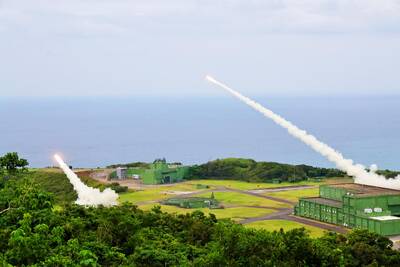
Taiwan lacks effective and cost-efficient armaments to intercept rockets, making the planned “T-Dome” interception system necessary, two experts said on Tuesday. The concerns were raised after China’s military fired two waves of rockets during live-fire drills around Taiwan on Tuesday, part of two-day exercises code-named “Justice Mission 2025.” The first wave involved 17 rockets launched at 9am from Pingtan in China’s Fujian Province, according to Lieutenant General Hsieh Jih-sheng (謝日升) of the Office of the Deputy Chief of the General Staff for Intelligence at the Ministry of National Defense. Those rockets landed 70 nautical miles (129.6km) northeast of Keelung without flying over Taiwan,


 RSS
RSS