


Many people who watched the US movie Pushing Tin walked away with a new-found respect for the work that air traffic controllers do on a daily basis, particularly how they manage to route planes and prevent traffic jams or worse.
However, to actual controllers who work at the North Air Traffic Service Park, the movie only partially portrayed what they deal with on a daily basis.
The North and South Air Traffic Service Parks, run by the Air Navigation and Weather Services, are in charge of regulating air traffic in the Taipei Flight Information Region (FIR), which is bordered by Fukuoka FIR in Japan, Manila FIR in the Philippines, Hong Kong FIR and Shanghai FIR in China.
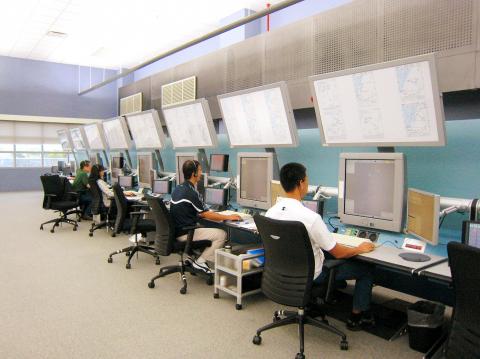
Photo courtesey of the Civil Aeronautics Administration
The Taipei FIR sees 1.2 million aircraft pass through its jurisdiction a year.
“The job of an air traffic controller is to accurately guide aircraft and to make sure they are safely spaced apart in terms of distance and altitude,” senior air traffic controller Genny Teng (鄧惠娟) said. “We have to make sure aircraft that have already taken off can smoothly enter the airspace and that those arriving at an airport can safely land on the runways.”
Aside from handling the pressure of routine work, Teng said air traffic controllers also need to react quickly in emergency situations.
“When Japan was struck by a powerful earthquake and the ensuing tsunami in March, we had to keep flights to Japan from taking off from Taiwan and tried to inform those that were already in the air to stop heading there,” Teng said.
Forty-year-old Mao Hsiu-ju (毛修如) decided to become an air traffic controller because she wanted to follow in the footsteps of her father, who was an flight controller for the air force.
The crash of a TransAsia Airways aircraft in 1995 was the worst experience in her career.
“I was 22. The crash happened only a year after I got my license as an air traffic controller,” Mao said. “I was working at the control tower at [Taipei’s] Songshan Airport [now Taipei International Airport] and the plane was returning from -Penghu to Taipei on Lunar Year’s Eve. I remember communicating with the pilot before the accident and I even told him they were clear for landing, but there was bad weather and I eventually lost contact with him.”
Mao said she had a feeling that something bad must have happened because the communication never resumed.
The plane was found the next day near Yingge (鶯歌) in then--Taipei County.
“It was so sad that I really don’t want to remember any of it,” she said.
Mao said Pushing Tin might have exaggerated the life of an air traffic controller a little, but she added that they are indeed under tremendous pressure whenever there is heavy air traffic.
She said they generally allow seven or eight aircraft to be in the same zone at a time.
When on duty, each controller must sit at a control seat for an hour and take a 30-minute break before resuming work. They must also take turns working the day shift and the night shift.
Prior to working in their new, spacious and well-lit office in Taoyuan, both Teng and Mao had to work in a dark air traffic control room because they had to be able to see the aircraft on the radar screen.
Jean Shen (沈啟), director of the Air Navigation and Weather Services, said she was a controller when the US was still engaged in the war in Vietnam. She said they had to work with people from the US Air Force to regulate flights from Vietnam.
“Back then, they were using still high-frequency radio to communicate with the pilots,” she said. “The reception was not good and you could hear the loud noises made by the aircraft.”
Despite the long hours and the stress, Teng and Mao say the life of an air traffic controller is not all work and no play.
“We are the first people to know exactly when and on which flights any celebrities are,” Teng said, adding that she had guided planes that had former NBA star Michael Jordan as well as “the King of Pop” Michael Jackson on board.
“We called Jordan’s plane ‘Nike One,’” she said.
Mao said her sister was also drawn to the work as an air traffic controller and eventually became one.
One of their colleagues has four siblings and all of them are air traffic controllers, she said.
“The work is stressful, no doubt, but you gain the sense of achievement after you safely guide the planes to land or to pass over Taiwan,” Mao said.

Considering that most countries issue more than five denominations of banknotes, the central bank has decided to redesign all five denominations, the bank said as it prepares for the first major overhaul of the banknotes in more than 24 years. Central bank Governor Yang Chin-lung (楊金龍) is expected to report to the Legislative Yuan today on the bank’s operations and the redesign’s progress. The bank in a report sent to the legislature ahead of today’s meeting said it had commissioned a survey on the public’s preferences. Survey results showed that NT$100 and NT$1,000 banknotes are the most commonly used, while NT$200 and NT$2,000

The Centers for Disease Control (CDC) yesterday reported the first case of a new COVID-19 subvariant — BA.3.2 — in a 10-year-old Singaporean girl who had a fever upon arrival in Taiwan and tested positive for the disease. The girl left Taiwan on March 20 and the case did not have a direct impact on the local community, it said. The WHO added the BA.3.2 strain to its list of Variants Under Monitoring in December last year, but this was the first imported case of the COVID-19 variant in Taiwan, CDC Deputy Director-General Lin Ming-cheng (林明誠) said. The girl arrived in Taiwan on

South Korea is planning to revise its controversial electronic arrival card, a step Taiwanese officials said prompted them to hold off on planned retaliatory measures, a South Korean media report said yesterday. A Yonhap News Agency report said that the South Korean Ministry of Foreign Affairs is planning to remove the “previous departure place” and “next destination” fields from its e-arrival card system. The plan, reached after interagency consultations, is under review and aims to simplify entry procedures and align the electronic form with the paper version, a South Korean ministry official said. The fields — which appeared only on the electronic form

The Ministry of Foreign Affairs (MOFA) is suspending retaliation measures against South Korea that were set to take effect tomorrow, after Seoul said it is updating its e-arrival system, MOFA said today. The measures were to be a new round of retaliation after Taiwan on March 1 changed South Korea's designation on government-issued alien resident certificates held by South Korean nationals to "South Korea” from the "Republic of Korea," the country’s official name. The move came after months of protests to Seoul over its listing of Taiwan as "China (Taiwan)" in dropdown menus on its new online immigration entry system. MOFA last week


 RSS
RSS