


The Control Yuan yesterday censured the Executive Yuan and the Government Information Office (GIO) for oversights in their management of state-owned media and urged both to improve their performance to achieve “good governance.”
Control Yuan members Chou Yang-shan (周陽山) and Ma Hsiu-ru (馬秀如), who investigated events that took place over the past few years, accused the GIO of disregarding problems with the Central News Agency (CNA) during the three years Chen Shen-ching (陳申青) was chairman of the agency, beginning in July 2008.
Describing Chen’s leadership style as “arbitrary,” the Control Yuan said CNA staffers worked “in a state of anxiety” and “suffered from low morale” under his leadership.
Although the agency only has 340 employees, the number of personnel reshuffles during Chen’s three-year term totaled 600, the Control Yuan members said.
Senior staffers were coerced into resigning during the recession and Chen also tried to force then-CNA president Joe Hung (洪健昭) to resign by making derogatory comments against him, but Hung refused to leave.
The Control Yuan said that then-Government Information Office minister Johnny Chiang (江啟臣) overlooked the internal disturbances at the agency and schemed with Chen to evict Hung.
The Control Yuan also accused CNA of not devoting more attention to international news.
“As an important state-owned news agency and a source that provides the public with international news, CNA is seriously understaffed in terms of its overseas correspondents, with only 20 reporters in 21 cities around the world,” it said.
Chiang denied the allegations, saying he had not inteferred with either the agency’s administration or personal arrangements.
State-owned Radio Taiwan International has also gone “in the wrong direction” as it continues to lay off its employees with expertise in foreign languages and Chinese dialects because of budget and personnel constraints, resulting in a loss of talent, the Control Yuan said.
The GIO was also found negligent in overseeing the Taiwan Broadcasting System, which is made up of the Public Television Service (PTS), Chinese Television System (CTS), Hakka TV, Taiwan Macroview TV and Taiwan Indigenous TV.
“It’s been eight months since the former PTS board members’ terms expired in December, but PTS hasn’t been able to bring legally elected new members to the board,” the Control Yuan members said.
The PTS has been embroiled in a management scandal since 2008, amid allegations of interference in the selection of its board members and operation by the Chinese Nationalist Party (KMT) government.
The two Control Yuan members also said the GIO failed to detect irregularities in the year-end performance bonuses given to then-CTS general manager Chen Jen-ran (陳正然) during his 2007 to 2009 term, when the company was in the red.
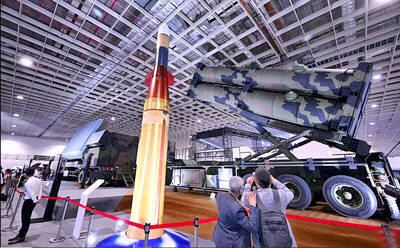
Taiwan is to commence mass production of the Tien Kung (天弓, “Sky Bow”) III, IV and V missiles by the second quarter of this year if the legislature approves the government’s NT$1.25 trillion (US$39.78 billion) special defense budget, an official said yesterday. Commenting on condition of anonymity, a defense official with knowledge of the matter said that the advanced systems are expected to provide crucial capabilities against ballistic and cruise missiles for the proposed “T-Dome,” an advanced, multi-layered air defense network. The Tien Kung III is an air defense missile with a maximum interception altitude of 35km. The Tien Kung IV and V
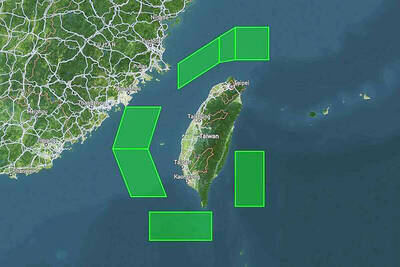
The disruption of 941 flights in and out of Taiwan due to China’s large-scale military exercises was no accident, but rather the result of a “quasi-blockade” used to simulate creating the air and sea routes needed for an amphibious landing, a military expert said. The disruptions occurred on Tuesday and lasted about 10 hours as China conducted live-fire drills in the Taiwan Strait. The Civil Aviation Administration (CAA) said the exercises affected 857 international flights and 84 domestic flights, affecting more than 100,000 travelers. Su Tzu-yun (蘇紫雲), a research fellow at the government-sponsored Institute for National Defense and Security Research, said the air
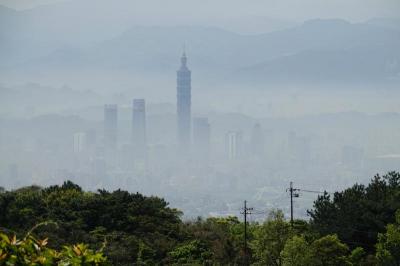
A strong continental cold air mass is to bring pollutants to Taiwan from tomorrow, the Ministry of Environment said today, as it issued an “orange” air quality alert for most of the country. All of Taiwan except for Hualien and Taitung counties is to be under an “orange” air quality alert tomorrow, indicating air quality that is unhealthy for sensitive groups. In China, areas from Shandong to Shanghai have been enveloped in haze since Saturday, the ministry said in a news release. Yesterday, hourly concentrations of PM2.5 in these areas ranged from 65 to 160 micrograms per cubic meter (mg/m³), and pollutants were
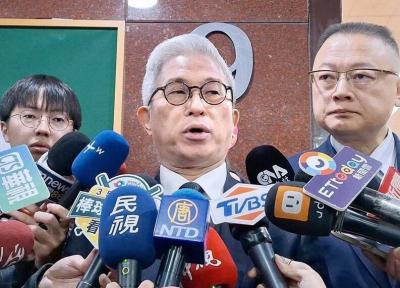
Taiwan’s armed forces have established response protocols for a wide range of sudden contingencies, including the “Wan Chun Plan” to protect the head of state, the Ministry of Defense (MND) said today. After US President Donald Trump on Saturday launched a series of airstrikes in Venezuela and kidnapped Venezuelan President Nicolas Maduro, concerns have been raised as to whether China would launch a similar “decapitation strike” on Taiwan. The armed forces regularly coordinate with relevant agencies and practice drills to ensure preparedness for a wide range of scenarios, Vice Minister of National Defense Hsu Szu-chien (徐斯儉) told reporters before a


 RSS
RSS