


The Banciao District Court yesterday sentenced former baseball star Chen Chih-yuan (陳致遠) to a two-and-a-half-year prison sentence for game-fixing.
The court also sentenced former baseball player Tsai Fong-an (蔡豐安) to one year and fined him NT$2 million (US$69,500) for the same offense. Former player Yang Po-jen (楊博任) was sentenced to two years and fined NT$1 million. The three were found guilty of harming the image of the professional league, having an unrepentant attitude after committing a crime and wasting judicial resources.
Their case can be appealed.

Photo: Wang Ting-chuang, Taipei Times
The game-fixing case erupted after the 20th championship game in Oct. 2009, involving star players such as Chen, Chang Chih-chia (張誌家), Tsao Chin-hui (曹錦輝) and Liao Yu-cheng (廖于誠) among others.
Last year, the district court indicted Chen, Chang and Tsai on charges of fraud, but Tsao and Hsieh Chia-hsien (謝佳賢) were not indicted because of a lack of evidence.
During the trial in April, the prosecution accused Chen and Tsai, both well paid and trained using state resources, of not only failing to avoid involvement in the scandal but also of denying their criminal activities and misleading the public.
The court said it decided to increase the sentences’ severity because of Chen and Tsai’s unrepentant attitude.
According to the court ruling, Chuang Yu-lin (莊侑霖) gave testimony that after a game on March 25, 2006, Chen and Tsai took a ride in Yu Tse-bin’s (余則彬) car, where Chuang gave Chen a shoebox containing NT$1 million in cash.
Yu was an alleged member of the Windshield Wipers gang, an syndicate accused of placing bets on professional baseball games and recruiting players to manipulate the outcome of those games.
Yesterday’s ruling said that Chen received cash payment days after he had fixed a game.
However, the district court did not have strong enough evidence regarding accusations that Chen also received sexual favors.
TRANSLATED BY JAKE CHUNG, STAFF WRITER
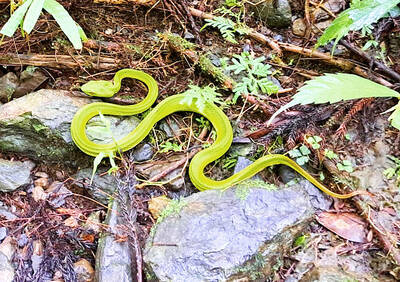
More than half of the bamboo vipers captured in Tainan in the past few years were found in the city’s Sinhua District (新化), while other districts had smaller catches or none at all. Every year, Tainan captures about 6,000 snakes which have made their way into people’s homes. Of the six major venomous snakes in Taiwan, the cobra, the many-banded krait, the brown-spotted pit viper and the bamboo viper are the most frequently captured. The high concentration of bamboo vipers captured in Sinhua District is puzzling. Tainan Agriculture Bureau Forestry and Nature Conservation Division head Chu Chien-ming (朱健明) earlier this week said that the

NAMING SPAT: The foreign ministry called on Denmark to propose an acceptable solution to the erroneous nationality used for Taiwanese on residence permits Taiwan has revoked some privileges for Danish diplomatic staff over a Danish permit that lists “Taiwan” as “China,” Eric Huang (黃鈞耀), head of the Ministry of Foreign Affairs’ Department of European Affairs, told a news conference in Taipei yesterday. Reporters asked Huang whether the Danish government had responded to the ministry’s request that it correct the nationality on Danish residence permits of Taiwanese, which has been listed as “China” since 2024. Taiwan’s representative office in Denmark continues to communicate with the Danish government, and the ministry has revoked some privileges previously granted to Danish representatives in Taiwan and would continue to review
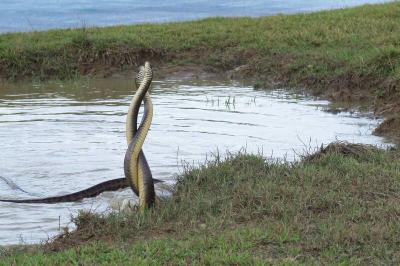
Kenting National Park service technician Yang Jien-fon (楊政峰) won a silver award in World Grand Prix Photography Awards Spring Season for his photograph of two male rat snakes intertwined in combat. Yang’s colleagues at Kenting National Park said he is a master of nature photography who has been held back by his job in civil service. The awards accept entries in all four seasons across six categories: architectural and urban photography, black-and-white and fine art photography, commercial and fashion photography, documentary and people photography, nature and experimental photography, and mobile photography. Awards are ranked according to scores and divided into platinum, gold and
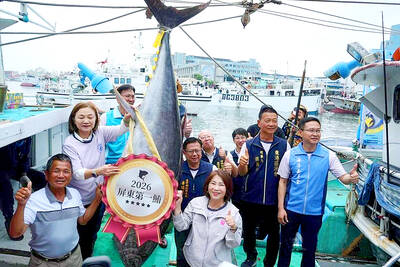
The first bluefin tuna of the season, brought to shore in Pingtung County and weighing 190kg, was yesterday auctioned for NT$10,600 (US$333.5) per kilogram, setting a record high for the local market. The auction was held at the fish market in Donggang Fishing Harbor, where the Siaoliouciou Island-registered fishing vessel Fu Yu Ching No. 2 delivered the “Pingtung First Tuna” it had caught for bidding. Bidding was intense, and the tuna was ultimately jointly purchased by a local restaurant and a local company for NT$10,600 per kilogram — NT$300 ,more than last year — for a total of NT$2.014 million. The 67-year-old skipper


 RSS
RSS