


Democratic Progressive Party (DPP) presidential candidate Tsai Ing-wen (蔡英文) told a discussion at the University of London on Thursday that maintaining cross-strait stability and peace was Taiwan’s responsibility to the international community.
However, improving cross-strait ties “could not come at the expense of Taiwan’s democracy,” which provides the country with a “foundation and security,” and Taiwan should include more of the international community in its dealings with Beijing, she said.
Tsai visited the university’s School of Oriental and African Studies (SOAS) as well as her alma mater, the London School of Economics and Political Science (LSE), in the British capital on Thursday during the second leg and final stop of her European trip.
She sat down at a forum discussing security in the Asia-Pacific region at the SOAS, a change in focus for Tsai who has largely trumpeted her sustainable energy and anti-nuclear policies during her week-long trip.
According to a transcript provided by the DPP, she said she believed China’s rise has posed “significant challenges” to -Western-style democracies like Taiwan, the US, Japan and the EU.
“But I also believe that economic development and international interactions will help promote Chinese freedom and democratization. Taiwan must also play a part in supporting these [ideals],” she said.
On Taiwan’s international space, Tsai said Taiwanese “sincerely hope” the international community could accept Taiwan and include it as part of the increasingly interconnected global framework. Taiwan needed “international support to progress in its interactions with Beijing,” she said.
The DPP chairperson also let slip a remark that the DPP would focus on “social justice” and “economic renewal” as two main points in the upcoming presidential and legislative campaigns.
The remarks on cross-strait issues are largely a repeat of statements she has previously made in Taipei, with her pledging that a future DPP administration would maintain more “stable” and “consistent” relations with China.
Tsai is on an LSE--maintained list of world leaders, having graduated from the school with a doctorate in law 27 years ago.
According to members of the delegation that accompanied Tsai on the trip, LSE’s interim director Judith Rees expressed optimism that Tsai, 54, could become Taiwan’s first female president. They were said to have spoken on pressing environmental and sustainable energy issues.
According to DPP spokesperson Chen Chi-mai (陳其邁), Tsai met with more than 10 British MPs, including members of a Taiwan friendship group. Yesterday morning, UK time, she also spoke with members of the Chinese-speaking press in London.
Tsai is expected to return to Taiwan this afternoon.

The military has spotted two Chinese warships operating in waters near Penghu County in the Taiwan Strait and sent its own naval and air forces to monitor the vessels, the Ministry of National Defense (MND) said. Beijing sends warships and warplanes into the waters and skies around Taiwan on an almost daily basis, drawing condemnation from Taipei. While the ministry offers daily updates on the locations of Chinese military aircraft, it only rarely gives details of where Chinese warships are operating, generally only when it detects aircraft carriers, as happened last week. A Chinese destroyer and a frigate entered waters to the southwest

A magnitude 6.1 earthquake struck off the coast of Yilan County at 8:39pm tonight, the Central Weather Administration (CWA) said, with no immediate reports of damage or injuries. The epicenter was 38.7km east-northeast of Yilan County Hall at a focal depth of 98.3km, the CWA’s Seismological Center said. The quake’s maximum intensity, which gauges the actual physical effect of a seismic event, was a level 4 on Taiwan’s 7-tier intensity scale, the center said. That intensity level was recorded in Yilan County’s Nanao Township (南澳), Hsinchu County’s Guansi Township (關西), Nantou County’s Hehuanshan (合歡山) and Hualien County’s Yanliao (鹽寮). An intensity of 3 was

Japanese Prime Minister Sanae Takaichi’s comment last year on Tokyo’s potential reaction to a Taiwan-China conflict has forced Beijing to rewrite its invasion plans, a retired Japanese general said. Takaichi told the Diet on Nov. 7 last year that a Chinese naval blockade or military attack on Taiwan could constitute a “survival-threatening situation” for Japan, potentially allowing Tokyo to exercise its right to collective self-defense. Former Japan Ground Self-Defense Force general Kiyofumi Ogawa said in a recent speech that the remark has been interpreted as meaning Japan could intervene in the early stages of a Taiwan Strait conflict, undermining China’s previous assumptions
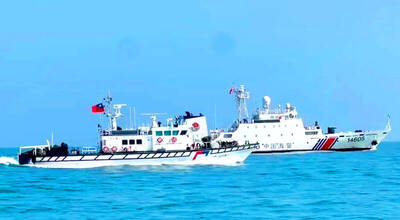
Instead of focusing solely on the threat of a full-scale military invasion, the US and its allies must prepare for a potential Chinese “quarantine” of Taiwan enforced through customs inspections, Stanford University Hoover fellow Eyck Freymann said in a Foreign Affairs article published on Wednesday. China could use various “gray zone” tactics in “reconfiguring the regional and ultimately the global economic order without a war,” said Freymann, who is also a nonresident research fellow at the US Naval War College. China might seize control of Taiwan’s links to the outside world by requiring all flights and ships entering or leaving Taiwan


 RSS
RSS