


Professor Hsu Yu-feng (徐堉峰), who teaches life sciences at National Taiwan Normal University, stands head and shoulders above his fellow lepidopterists in Taiwan, having written extensively on more than one type of recently discovered butterfly and being the first Taiwanese academic to receive the Hayashi award from the Japanese Society of Entomology.
Born in Miaoli County, Hsu said his childhood playmates were insects rather than other children his own age. At one point, his infatuation with insects caused his school grades to slip and forced him to do an additional year in high school after getting an F in his college English qualification exams.
“I’m a professor because I like butterflies, not the other way around,” Hsu said.
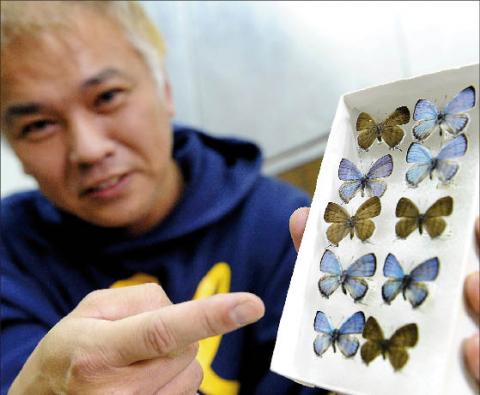
Photo: George Tsorng, Taipei Times0
His motivation stems from a passion for insects, which forced him to learn English so he could read the original texts.
It is also this passion that led him to apply to study in the Department of Entomology at the University of California at Berkeley, where he spent seven years.
This is a story that Hsu often uses to motivate his students.
“If I can go from an F in English to getting a doctorate in the US, so can you,” he tells them.
Hsu was also the first to discover the presence of Sibataniozephyrus kuafui in Taiwan. Because the Sibataniozephyrus fujisanus in Japan feeds off the Fagus longipetiolata, a plant species found at higher altitudes, the same kind of butterfly would likely be found in Taiwan, Hsu said, as the plant is present on Beichatian (北插天) mountain.
Hsu’s search for the Sibataniozephyrus kuafui, which occupied seven years of his life, began in his college days and turned into what he half-jokingly calls “chasing Will--o’-the-Wisps.”
It wasn’t until one summer, while he was still working on his doctorate that he finally found his dream, perched in the mountains of Taiwan.
An entomologist must trek through wild terrain to gather data for research, Hsu said, thinking back to an exploration in Guizhou Province, China, that would have deterred all but the most devoted. After being bitten by a mosquito, Hsu contracted something akin to dengue fever that caused his throat to swell, his joints to ache and even made him cough up blood.
Even doctors had no idea what was wrong with him, Hsu said, so they resorted to prescribing painkillers, anti-inflammatory and -antipyretic medication. The unidentified illness plagued Hsu for three weeks.
Illness notwithstanding, Hsu’s passion for insects did not die. Three years of research led him to discover the egg-laying habits of a particular genus of butterfly and determine that the Teratozephyrus elatus, a butterfly inhabiting high-altitude forest areas, was closely related to a species of butterfly found in Gansu Province, China.
Hsu wrote the Illustrated Handbook for Taiwanese Butterflies, subsequently discovering six species of butterflies native to Taiwan and naming or identifying 10 other species. He has also helped discover and name 30 species of foreign butterflies and moths.
Taiwan has also become home to new butterflies that had emigrated as a result of global warming, Hsu said, with more than seven species of tropical butterflies settling in Taiwan after 1985. Whether changes in weather have an impact on the butterflies’ ecosystem is a subject that needs further research, Hsu said.
Although Taiwan developed somewhat slowly and still has a high number of forests that are home to 400 species of butterfly — of which 50 are native to Taiwan — industrial development during the early 1950s and 1960s killed off between 30 million and 500 million butterflies.
Though such development provided a significant boost to Taiwan’s economy, Hsu said most Taiwanese were unaware that this caused such a sharp drop in the butterfly population, as well as the extinction of the Euploea phaenareta juvia and the Ypthima norma posticalis, mostly through land development.
Many people think butterflies are pretty because of their size and colors, but there is more to them than that, Hsu said. For example, to increase their chances of mating, female butterflies are usually dull and unattractive.
Aside from an aesthetic point of view, we should also regard butterflies from the vantage point of what their existence means to the ecosystem, he said. The Kallima inachis formosana, for example, is adept at camouflaging itself as a withered leaf.
“My life’s wish is to study Taiwanese butterflies and hopefully, in time, document and research the basic biology of every Taiwan butterfly species,” Hsu said.

FUKUOKA SITUATION: Japanese media reported that the pathogen is expected to be identified by the summer, while the CDC downplayed the idea that it was hMPV A “mysterious cold-like illness” reported in Japan’s Fukuoka Prefecture does not seem to be a new disease, but Japanese authorities have been asked about the situation, the Centers for Disease Control (CDC) said yesterday. The Fukuoka Prefectural Medical Association on Wednesday told a news conference that a “mystery cold” that has become a hot topic on social media is “highly likely to be caused by some kind of viral infection,” Japan’s KBC News reported. “Many people are experiencing symptoms starting with a sore throat, followed by a runny nose, phlegm and a severe cough,” KBC News reported, citing association officials. Health authorities are

Nvidia Corp CEO Jensen Huang (黃仁勳) arrived in Taiwan yesterday ahead of upcoming AI and technology events, saying he plans to meet with clients and Taiwan Semiconductor Manufacturing Co Chairman C.C. Wei (魏哲家) during his visit. After landing at Taipei Songshan Airport, Huang posed for photos with fans and handed out Yakult drinks to reporters and supporters waiting at the scene, saying he has “a lot to do” during the trip. Asked about reports that Nvidia’s planned headquarters site in Taipei’s Beitou Shilin Technology Park could break ground on May 27, Huang said that if the company holds an event, he would

The Ministry of Finance this afternoon announced the winning numbers for the March-April uniform invoice lottery. The winning number for the NT$10 million (US$318,060) special prize is 19531471, and the winning number for the NT$2 million grand prize is 85941329. Three numbers were drawn for the NT$200,000 first prize: 07225810, 20231230 and 83518781. Those with receipts matching the last seven digits of any of the first-prize numbers will win the NT$40,000 second prize, while those matching the last six digits will win the NT$10,000 third prize. Those whose receipts match the last five digits of the first-prize numbers can claim the NT$4,000 fourth prize,
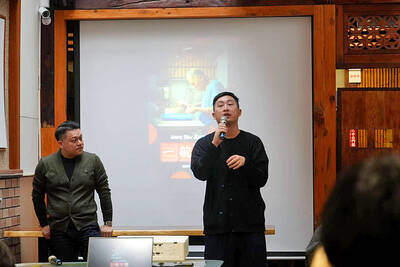
Taiwan Travelogue (臺灣漫遊錄), which earlier this week became the first Taiwanese novel to win the International Booker Prize, is to be adapted into a television series through a Taiwan-Japan coproduction, producer Chang Chen-yu (張辰漁) said yesterday. Chang, a producer at World Softest Production Film Co, wrote on Facebook that the company had been searching for projects with international appeal that retain a strong Taiwanese identity after colleagues and Japanese partners strongly recommended the novel. After reading the book, Chang said he immediately decided to pursue the screen rights. “A great story has the power to transcend time and borders, and connect countless people,”


 RSS
RSS