


Many visitors to Penghu know that the Hsiyu Hsitai (西嶼西臺), or Hsiyu Western Battery (西嶼西砲臺), is one of its principal tourist attractions. However, very few know the history behind it, or the relationship between the site and President Ma Ying-jeou (馬英九).
Hsiyu (西嶼), or Fisher Island (漁翁島), is the second-biggest atoll of the Penghu Island chain. Hsiyu Island belongs to Hsiyu Township, which makes up 14.3 percent of Penghu County. The Hsiyu Hsitai was designated a class-one historic relic in 1983 and was opened to the public in 1990 after four years of renovation.
Yang Jen-chian (楊仁江), a professor of the Graduate Institute of Architecture and Historic Preservation at the Taipei National University of the Arts, said Pengu had strategic importance during the Ming Dynasty.
During that period, general Chen Kuo-hsuan (陳國軒) built 15 batteries in Penghu to guard against Shih Lang (施琅), a military strategist. Many of the batteries were destroyed during the Sino-French War of 1884 and 1885, when northern Taiwan and Penghu were the main battlefields.
A Qing Dynasty governor of Taiwan, Liu Ming-chuan (劉銘傳), began to build and repair 10 batteries in Penghu, Keelung, Huwei (滬尾, the old name for Tamsui) and Anping (a port in Tainan) in 1886. Four batteries were built in Penghu in 1887, including the Hsiyu Western Battery and Hsiyu Eastern Battery. However, the guns did not arrive until 1888, Yang said.
The batteries played an important role in holding back the Japanese during the Sino-Japanese war of 1894 and 1895. However, the Qing Dynasty lost the battle and they dismantled the guns at Hsiyu Western Battery and buried them.
The batteries were abandoned during the Japanese colonial era, which lasted for half a century after the Japanese Imperial Army built a garrison on Penghu.
As there were only batteries, but no guns or ammunition, President Ma Ying-jeou (馬英九), who was minister without portfolio at the time (1996-1997), asked the Ministry of the Interior whether they could purchase guns — a request that was turned down.
“I was shocked and disappointed,” he would say years later.
Ma did not get his wish until 2008, when the Penghu County Government obtained NT$20 million (US$681,000) in government funding to purchase guns from British manufacturer Armstrong Gun. They were installed in November last year under Yang’s supervision.
Ma, who visited the Hsiyu Western Battery on Dec. 12, said he was happy to see the restoration of the guns, adding that he did not think the Republic of China military had ever had such heavy-caliber cannons.
Ma said he paid great importance to restoration of the gun batteries because he wanted future generations to know their history. His eyes sparkled when he talked about his role in the project. He was eager to share his understanding of history with others — an understanding that places Taiwan as a province of China long ago.
When Liu built the batteries in Taiwan and Penghu, Ma said, the guns were used to fend off the Japanese rather than the French. The Japanese had desired Taiwan since 1870 and sent troops to Mutan (牡丹) in 1874, an operation that eventually came to be known as the Mutanse Incident (牡丹事件), he said. During the incident, which occurred before the Japanese colonization of -Taiwan in 1895, Japan took punitive action against Aborigines over the murder of Okinawan sailors.
The Japanese then annexed the Ryukyu Islands in 1879 and developed an interest in the Diaoyutai Islands (釣魚台) during the 1880s, Ma said.
As part of efforts to defend Taiwan, Li Hongzhang (李鴻章), then viceroy of the Qing Dynasty (who would later sign the Treaty of Shimonoseki with Japan to cede Taiwan to the empire) requested Empress Dowager Cixi (慈禧太后) in 1885 to establish Taiwan as a province and build a navy there, Ma said. The two requests were granted, he said.
The Japanese interior minister intended to seize the Diaoyutai Islands and two neighboring islands, but an Okinawan official told the interior minister the three island atolls had been documented in official Chinese records as part of its territory for 500 years, dating back to the Ming Dynasty, Ma said. Therefore, the time was not ripe to take over those three islands, he said.
However, with the Qing Dynasty’s power continuing to decline, the Japanese empire gained strength, eventually winning the Sino-Japanese war in 1895. China and Japan signed the Treaty of Shimonoseki the same year and the Japanese also took over the Diaoyutai Islands, but the Japanese government did not make it official until 1902, Ma said.
Tai Pao-tsun (戴寶村), a professor at the Graduate Institute of Taiwan History at Taiwan Normal University, offers a different account of those events.
Ma’s argument that the batteries erected by Liu were built to defend against the Japanese rather than the French is risible, Tai said.
The Japanese attacked Taiwan in 1874, motivating then-Taiwan governor Shen Pao-zhen (沈葆楨) to construct walls around Hengchun (恆春) in Pingtung and the Eternal Golden Castle (億載金城) in Tainan. The French raided Keelung and Tamsui and occupied Penghu. That was why the batteries were built, he said.
Because of the French assault on Taiwan, Tai said the Qing Dynasty felt it was necessary to strengthen Taiwan’s defenses, at which point Liu suggested Taiwan should be established as a province, Tai said.
Li may have been an influential politician at the time, but he did not have a full or first-hand understanding of the situation in Taiwan as Liu did, Tai said. Besides, Li was also not in charge of the affairs of southern China, though Zhang Zhidong (張之洞) was, he said.
Tai said talks about establishing Taiwan as a province began on or around 1884 and it did not happen until 1887. The matter was unlikely to be decided by Empress Dowager Cixi and Li alone because Qing Emperor Guangxu (光緒) still had a say on state matters.
On Ma’s assertion that the Diaoyutais fell to the Japanese in 1902, Tai said it would require further research to confirm the claim. However, he was certain the Diaoyutais were not mentioned in the Treaty of Shimonoseki.
It would nevertheless make sense for Japan to declare in 1902 that the Diaoyutais were part of its territory, he said. Since the islands are geographically close to Taiwan and were not inhabited, Tai said the Japanese government would have thought it logical to let Taiwan manage the islands. Because Taiwan was ceded to Japan in 1895 and became part of the Japanese empire, if the Diaoyutais were managed by Taiwan and Taiwan belonged to Japan, then ipso facto the islets were part of Japan’s territory, Tai said.
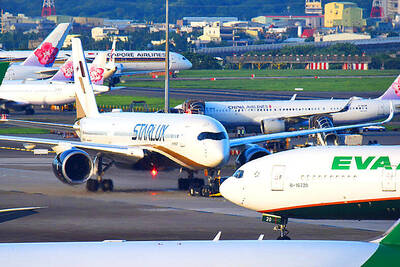
Trips for more than 100,000 international and domestic air travelers could be disrupted as China launches a military exercise around Taiwan today, Taiwan’s Civil Aviation Administration (CAA) said yesterday. The exercise could affect nearly 900 flights scheduled to enter the Taipei Flight Information Region (FIR) during the exercise window, it added. A notice issued by the Chinese Civil Aviation Administration showed there would be seven temporary zones around the Taiwan Strait which would be used for live-fire exercises, lasting from 8am to 6pm today. All aircraft are prohibited from entering during exercise, it says. Taipei FIR has 14 international air routes and
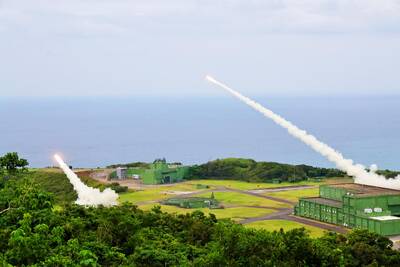
Taiwan lacks effective and cost-efficient armaments to intercept rockets, making the planned “T-Dome” interception system necessary, two experts said on Tuesday. The concerns were raised after China’s military fired two waves of rockets during live-fire drills around Taiwan on Tuesday, part of two-day exercises code-named “Justice Mission 2025.” The first wave involved 17 rockets launched at 9am from Pingtan in China’s Fujian Province, according to Lieutenant General Hsieh Jih-sheng (謝日升) of the Office of the Deputy Chief of the General Staff for Intelligence at the Ministry of National Defense. Those rockets landed 70 nautical miles (129.6km) northeast of Keelung without flying over Taiwan,
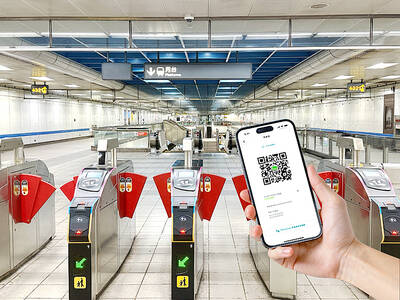
City buses in Taipei and New Taipei City, as well as the Taipei MRT, would on Saturday begin accepting QR code payments from five electronic payment providers, the Taipei Department of Transportation said yesterday. The new option would allow passengers to use the “transportation QR code” feature from EasyWallet, iPass Money, iCash Pay, Jkopay or PXPay Plus. Passengers should open their preferred electronic payment app, select the “transportation code” — not the regular payment code — unlock it, and scan the code at ticket readers or gates, General Planning Division Director-General Liu Kuo-chu (劉國著) said. People should move through the
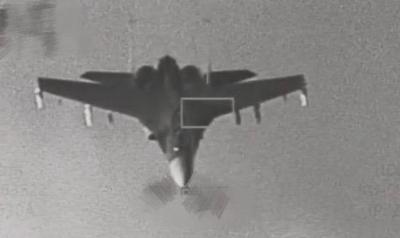
The Ministry of National Defense (MND) today released images of the military tracking China’s People's Liberation Army (PLA) movements during the latest round of Chinese drills around Taiwan. The PLA began "Justice Mission 2025" drills today, carrying out live-fire drills, simulated strikes on land and maritime targets, and exercises to blockade the nation's main ports. The exercises are to continue tomorrow, with the PLA announcing sea and air space restrictions for five zones around Taiwan for 10 hours starting from 8:30am. The ministry today released images showing a Chinese J-16 fighter jet tracked by a F-16V Block 20 jet and the


 RSS
RSS