


Preceded by an impressive performance of traditional Sediq warrior dance, film director Wei Te-sheng (魏德聖) announced at a press conference yesterday that filming for a movie on a large-scale war of resistance led by a Sediq chieftain Mona Rudao was completed.
Feeling that they could not tolerate the repression and exploitation of the Japanese colonial government, more than 1,000 Sediq warriors from six villages around Wushe (霧社) in present day Renai Township (仁愛), Nantou County, launched a fierce resistance against the Japanese under the leadership of one of the chieftains, Mona Rudao.
Although they gained the upper hand in the beginning, the Sediq resistance was later defeated when the Japanese persuaded a rival Sediq sub-tribe to join their side and used poison gas against the Sediqs.
Mona Rudao, along with hundreds of other Sediq — including women and children — committed suicide after realizing they could not fight back, while about 500 surrendered.
However, about 300 of those who surrendered were later killed in a massacre, while the remaining survivors were forced to resettle to a new location.
“I never thought I could really finish this movie in the beginning, but we finally got it done,” Wei told the press conference. “The shooting of the movie was completed thanks to the hard work of all the crew members and actors, as well as those who provided all kinds of assistance — and I felt that it was also because we had some luck.”
The news conference took place at one of the movie sets of the movie Seediq Bale in Linkou Township (林口), Taipei County: a reconstructed scene of the main street in Wushe in the 1930s.
Lack of funding was the major problem for Wei and his team.
“At one point, I was unable to pay my crew members for three months, but I am really grateful that they trusted in me and continued to work,” Wei said.
Media have reported that more than NT$600 million (US$18 million) was spent in the making of the movie. Wei did not confirm the number at the press conference, saying he hoped the movie would sell well enough to cover the costs after it’s released next summer.
Aside from the 400-member crew from Taiwan, South Korea and Japan, as many as 15,000 actors took part in the making of the movie — many were not professional actors and members of the Sediq, Truku and Atayal tribes.
“I wanted to take part in the movie because I’ve always been proud to be a Truku,” Halong Ikuy, who played the role of both a Sediq warrior and a Japanese soldier, told the Taipei Times.
“Before, I always thought movies are only for entertainment, and acting is just bringing the story to life, but now I have a different understanding,” he said. “By acting in Seediq Bale, I began to feel how miserable Aborigines have been treated historically. It also made me start to wonder how we keep our own culture, tribe and everything when facing a more dominant culture from the outside — be it the Japanese, the Han or other Aboriginal tribes.”
Halong Ikuy’s younger sister, Sayun Ikuy, who played the role of Mona Rudao’s wife, said she now knows more about the history and it made her more proud to be an Aborigine.

VIGILANCE: The military is paying close attention to actions that might damage peace and stability in the region, the deputy minister of national defense said The People’s Republic of China (PRC) might consider initiating a hack on Taiwanese networks on May 20, the day of the inauguration ceremony of president-elect William Lai (賴清德), sources familiar with cross-strait issues said. While US Secretary of State Anthony Blinken’s statement of the US expectation “that all sides will conduct themselves with restraint and prudence in the period ahead” would prevent military actions by China, Beijing could still try to sabotage Taiwan’s inauguration ceremony, the source said. China might gain access to the video screens outside of the Presidential Office Building and display embarrassing messages from Beijing, such as congratulating Lai
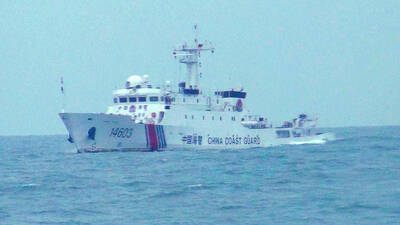
Four China Coast Guard ships briefly sailed through prohibited waters near Kinmen County, Taipei said, urging Beijing to stop actions that endanger navigation safety. The Chinese ships entered waters south of Kinmen, 5km from the Chinese city of Xiamen, at about 3:30pm on Monday, the Coast Guard Administration said in a statement later the same day. The ships “sailed out of our prohibited and restricted waters” about an hour later, the agency said, urging Beijing to immediately stop “behavior that endangers navigation safety.” Ministry of National Defense spokesman Sun Li-fang (孫立方) yesterday told reporters that Taiwan would boost support to the Coast Guard

GLOBAL: The slogan would be advertised in popular tourist destinations in North America and Europe, such as Champs-Elysees and Times Square, the agency said “Taiwan: Waves of Wonder” is to be the country’s new tourism slogan for the next 10 years, the Tourism Administration said yesterday, adding that it would be showcased in commercials at the Olympic Games in Paris and other major cities and travel fairs around the world. The new slogan, logo and theme song, which were unveiled at a news conference in Taipei, marked the agency’s latest effort to attract 10 million international visitors to Taiwan this year, a goal that it readjusted earlier this year, as China has yet to lift its travel ban to Taiwan. The administration created the “Taiwan: Touch

BOOST TO SPORTS? The Executive Yuan said that the amendment was introduced to attract professionals to Taiwan, and increase the incentives for naturalization The Legislative Yuan yesterday passed on third reading an amendment to the Nationality Act (國籍法) that would reduce the minimum residency period required for highly skilled professionals to apply for naturalization from three to two continuous years, with a minimum of 183 days in Taiwan each year. The 183-day requirement does not apply if an eligible applicant has lived legally in the territory of the Republic of China for more than five continuous years. Taiwan’s professional basketball leagues are expected to benefit from the amendments, which would allow them to recruit more players from overseas. Prior to the passage of the amendment, the


 RSS
RSS