


“Taiwan: Waves of Wonder” is to be the country’s new tourism slogan for the next 10 years, the Tourism Administration said yesterday, adding that it would be showcased in commercials at the Olympic Games in Paris and other major cities and travel fairs around the world.
The new slogan, logo and theme song, which were unveiled at a news conference in Taipei, marked the agency’s latest effort to attract 10 million international visitors to Taiwan this year, a goal that it readjusted earlier this year, as China has yet to lift its travel ban to Taiwan.
The administration created the “Taiwan: Touch Your Heart” slogan in 2001 and rebranded to “Taiwan: the Heart of Asia” in 2011.
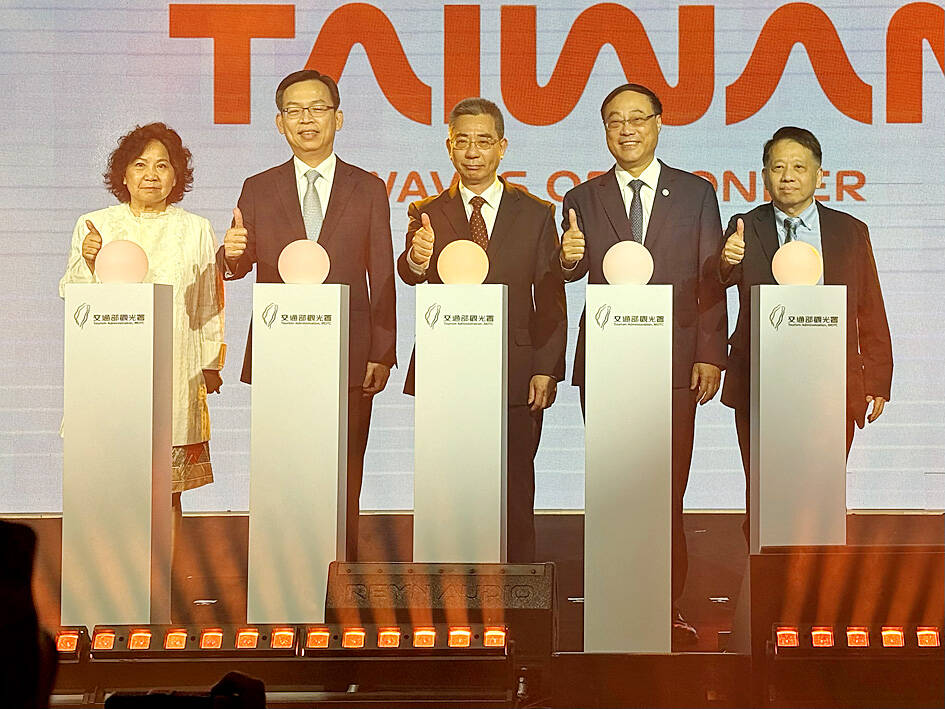
Photo: Tsai Yun-rong, Taipei Times
The new slogan was created to market Taiwan as a travel destination in the post-COVID-19 era, administration Director-General Chou Yung-hui (周永暉) said.
“Taiwan is a diverse and beautiful place, and would surely bring waves of wonder to tourists with its mountains and seas,” he said. “The slogan is to be publicized in major cities and travel fairs around the world, and we will work with local tourism officials in Taiwan to promote tours in different regions around the nation.”
The administration aims to use the slogan to promote tours to Taiwan by showcasing it on the Champs-Elysees in Paris during the Summer Olympic Games, Chou said.
The slogan would also be advertised at other popular tourist destinations and transport hubs in North America and Europe, including Times Square in New York and train stations in Frankfurt, Germany, he said.
Ads containing the slogan would be broadcast in Osaka, Japan, when the city hosts the World Expo next year, as well as in Southeast Asian nations, Chou said.
The administration also plans to increase the budget for the next fiscal year by nearly NT$200 million (US$6.18 million) to boost tourism marketing efforts, he added.
The new tourism logo was designed by Bito Studio founder and creative director Liu Keng-ming (劉耕名), who received the Presidential Innovation Award last month.
The design was inspired by the sea, rolling mountains, meandering highways and railways that people see when they travel around Taiwan. Like the previous two logos, the new one is orange to convey the warmth and vitality of Taiwanese.
The new theme song was created by Chris Hou (侯志堅), who has won Golden Melody, Golden Horse and Golden Bell awards for the music he has produced for singers, movies and TV series.
In other news, the administration defended its use of Weibo, WeChat and Xiaohongshu (小紅書, Little Red Book) to promote tours to Taiwan in China, saying that it must be done, because Beijing has been blocking people from accessing Facebook, Instagram and other US-based social media.
Its use of Chinese social media was yesterday scrutinized by Chinese Nationalist Party (KMT) lawmakers, who asked why the Democratic Progressive Party government paid a huge sum to promote tours on Chinese platforms they deem a threat to national security.
The administration said it has been promoting tours on its Sina Weibo and WeChat accounts since 2011 and 2014 respectively, and plans to open a Xiaohongshu account this year.
“Countries seeking to attract young travelers from China, such as Japan, South Korea and Thailand, all have accounts on popular Chinese social media,” it said. “The content that we put on these platforms are travel destinations in Taiwan and special offers that are available for travelers, and have nothing to do with politics.”

Considering that most countries issue more than five denominations of banknotes, the central bank has decided to redesign all five denominations, the bank said as it prepares for the first major overhaul of the banknotes in more than 24 years. Central bank Governor Yang Chin-lung (楊金龍) is expected to report to the Legislative Yuan today on the bank’s operations and the redesign’s progress. The bank in a report sent to the legislature ahead of today’s meeting said it had commissioned a survey on the public’s preferences. Survey results showed that NT$100 and NT$1,000 banknotes are the most commonly used, while NT$200 and NT$2,000

The Centers for Disease Control (CDC) yesterday reported the first case of a new COVID-19 subvariant — BA.3.2 — in a 10-year-old Singaporean girl who had a fever upon arrival in Taiwan and tested positive for the disease. The girl left Taiwan on March 20 and the case did not have a direct impact on the local community, it said. The WHO added the BA.3.2 strain to its list of Variants Under Monitoring in December last year, but this was the first imported case of the COVID-19 variant in Taiwan, CDC Deputy Director-General Lin Ming-cheng (林明誠) said. The girl arrived in Taiwan on

South Korea is planning to revise its controversial electronic arrival card, a step Taiwanese officials said prompted them to hold off on planned retaliatory measures, a South Korean media report said yesterday. A Yonhap News Agency report said that the South Korean Ministry of Foreign Affairs is planning to remove the “previous departure place” and “next destination” fields from its e-arrival card system. The plan, reached after interagency consultations, is under review and aims to simplify entry procedures and align the electronic form with the paper version, a South Korean ministry official said. The fields — which appeared only on the electronic form

The Ministry of Foreign Affairs (MOFA) is suspending retaliation measures against South Korea that were set to take effect tomorrow, after Seoul said it is updating its e-arrival system, MOFA said today. The measures were to be a new round of retaliation after Taiwan on March 1 changed South Korea's designation on government-issued alien resident certificates held by South Korean nationals to "South Korea” from the "Republic of Korea," the country’s official name. The move came after months of protests to Seoul over its listing of Taiwan as "China (Taiwan)" in dropdown menus on its new online immigration entry system. MOFA last week


 RSS
RSS