

Chinese Nationalist Party (KMT) Sinbei City mayoral candidate Eric Chu (朱立倫) yesterday attended the first large-scale campaign event organized by the party’s Taipei County branch, targeting attacks at his rival, Democratic Progressive Party (DPP) Chairperson Tsai Ing-wen (蔡英文).
Accompanied by Taipei County Commissioner Chou Hsi-wei (周錫瑋), who was persuaded to withdraw from the competition by senior party officials, Chu promised to establish Sinbei as a competitive city with the construction of several MRT lines over the next 10 years.
“Sinbei City will be as competitive as Taipei City. I will devote all my effort to the development of the city, and will be a mayor who cooperates with both central and local governments,” he said in Taipei County’s administrative capital, Banciao.
Chu also promised not to use the position of Sinbei mayor as a springboard for the presidential election in 2012, something he said Tsai was certain to do.
“We do not want a mayor who leaves to campaign in 2012, and we do not want a mayor who will confront the central government and refuse to cooperate with our neighbors in Taipei City and Taoyuan City,” he added.
Tsai announced her intention to run in Sinbei City last night. Since former premier Su Tseng-chang (蘇貞昌) declared his intention to run in the Taipei City mayoral race, many DPP figures had urged Tsai to represent the party in the Sinbei race.
Chou cited municipal projects in Taipei County, including the dredging of the Danshui River and assured supporters that Chu would continue such programs and work hard to improve the competitiveness of the county after it is upgraded into Sinbei City in December.
The outgoing commissioner declined to confirm whether or not he would serve as campaign manager for Chu’s election team, but said he will continue to work as a “volunteer” and campaign for Chu.
Chu thanked Chou for his full support and putting party unity first. He also said the two men would unite during the election campaign to stop rivals from using their previous competition as a smear campaign against him.
Elections for the heads of five special municipalities will take place on Nov. 27 in Taipei City, Sinbei City (the upgraded Taipei County), Greater Taichung (a merger of Taichung City and Taichung County), Greater Tainan (a merger of Tainan City and Tainan County) and Greater Kaohsiung (a merger of Kaohsiung City and Kaohsiung County).
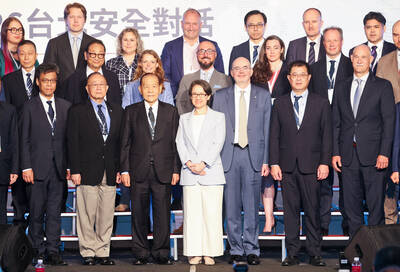
Taiwan’s growing defense preparations might be sending a stronger signal to the US than to Beijing, highlighting the need for Taipei to tailor its deterrence efforts to different audiences, a US security academic said yesterday. Stanford University Freeman Spogli Institute for International Studies fellow Oriana Skylar Mastro made the comment during a Taipei Security Dialogue panel examining lessons Taiwan could draw from the wars in Ukraine and the Middle East. Mastro said she was impressed by Taiwan’s increased defense spending, emphasis on asymmetric capabilities and efforts to prepare society for conflict, but questioned whom those initiatives were influencing. She said when she asked
A total of 400 foreign “high- level” professionals have been naturalized as Republic of China (Taiwan) citizens over the past decade as the government has eased nationality rules to attract talent from a wider range of fields, the Ministry of the Interior said yesterday. The 400th high-level professional, who works in the electronics industry, was approved for ROC citizenship on Aug. 26, the MOI said. The MOI quoted the newly naturalized citizen as saying that Taiwan is a leader in fields such as semiconductors, electronics manufacturing, artificial intelligence development and energy technology. He also said
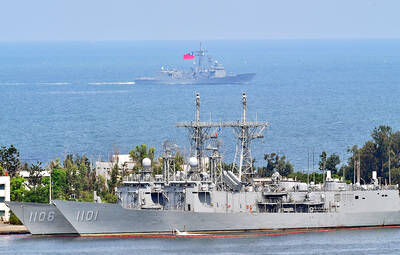
SIZE MATTERS: Large ships are politically attractive as visible symbols of national defense, but small surface combatants are more likely to survive an initial strike Taiwan needs to restructure its naval fleet from focusing on large warships, which are “sitting ducks” for China’s advanced tracking technology, to smaller, stealthy corvettes that are harder to detect but retain sufficient firepower to deter a Chinese invasion, a Taiwanese academic and a former US military commander said in an article published on Friday in the journal Foreign Affairs. Taiwan does not need a fleet capable of competing with the Chinese navy for traditional control of the Taiwan Strait, but rather “sea denial” capabilities that would prevent China from freely using the waterway, Taiwanese aerospace and security expert Holmes Liao
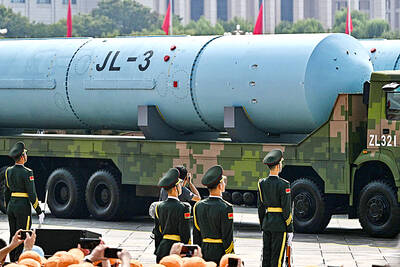
SUB-LAUNCHED SUBOPTIMAL: The JL-3, an upgraded version of the missile test-fired earlier in the summer, would have the range to strike at much of the country Refits to Chinese nuclear submarines to carry JL-3 intercontinental ballistic missiles would put much of the US in striking distance, Taiwanese defense analysts said in a report commissioned by the Mainland Affairs Council. Researchers from National Defense University’s Graduate Institute of China Military Affairs Studies said that the Chinese People’s Liberation Army Navy (PLAN) in July test-fired a missile with a training warhead. Chinese state media reported without elaborating that a PLAN nuclear-powered ballistic missile submarine (SSBN) launched a missile with a training warhead, which accurately hit the designated target area in the Pacific, the report said. The launch was a rare display


 RSS
RSS