


For Peter Morehead, cooking a meal does not require the use of natural gas. Sunlight is good enough.
Morehead, who first came to Taiwan in 1990 from Wisconsin as an exchange student, has been teaching Taiwanese how to cook with what he calls a “solar cooker.”
The solar cooker can be as simple as a small paper box covered in aluminum foil. One can put a black pot in the middle of the box and the sunlight’s reflection off the aluminum foil will create enough heat to cook the food in the pot.
“People should make good use of energy,” he told the Central News Agency during a recent interview. “Never waste energy.”
On cloudy days, Morehead uses what he calls his “rocket broiler” instead. Made of iron cans, the broiler relies on the burning of small branches and twigs that can generate high heat in a short time, and the contraption does not release smoke if handled properly.
In addition to providing tips on how to use energy efficiently, Morehead has also been promoting the concept of urban farming.
On Earth Day in 2008, he taught people how to grow corn or pumpkins in the square outside the National Taiwan Museum in Taipei.
Growing edible plants can both beautify the environment and reduce pollution caused by the transportation of food, the environmentalist said.
Morehead, a space-planning expert, believes that vegetable gardens can be set up between city buildings or on rooftops in Taiwan’s densely populated urban areas.
“There must be space that can be used,” he said in Mandarin.
Morehead began raising public awareness on conserving energy in 2000. Five years ago, he and his wife established a studio to educate the public about leading an environmentally friendly life.
They named the studio “Earth Passengers” to convey the idea that Earth is like a spacecraft circling the sun, with humans along for the ride.
“Humans are not the controllers of the Earth. Instead, they should live in harmony with other living creatures,” Morehead said.

FUKUOKA SITUATION: Japanese media reported that the pathogen is expected to be identified by the summer, while the CDC downplayed the idea that it was hMPV A “mysterious cold-like illness” reported in Japan’s Fukuoka Prefecture does not seem to be a new disease, but Japanese authorities have been asked about the situation, the Centers for Disease Control (CDC) said yesterday. The Fukuoka Prefectural Medical Association on Wednesday told a news conference that a “mystery cold” that has become a hot topic on social media is “highly likely to be caused by some kind of viral infection,” Japan’s KBC News reported. “Many people are experiencing symptoms starting with a sore throat, followed by a runny nose, phlegm and a severe cough,” KBC News reported, citing association officials. Health authorities are

Nvidia Corp CEO Jensen Huang (黃仁勳) arrived in Taiwan yesterday ahead of upcoming AI and technology events, saying he plans to meet with clients and Taiwan Semiconductor Manufacturing Co Chairman C.C. Wei (魏哲家) during his visit. After landing at Taipei Songshan Airport, Huang posed for photos with fans and handed out Yakult drinks to reporters and supporters waiting at the scene, saying he has “a lot to do” during the trip. Asked about reports that Nvidia’s planned headquarters site in Taipei’s Beitou Shilin Technology Park could break ground on May 27, Huang said that if the company holds an event, he would

The Ministry of Finance this afternoon announced the winning numbers for the March-April uniform invoice lottery. The winning number for the NT$10 million (US$318,060) special prize is 19531471, and the winning number for the NT$2 million grand prize is 85941329. Three numbers were drawn for the NT$200,000 first prize: 07225810, 20231230 and 83518781. Those with receipts matching the last seven digits of any of the first-prize numbers will win the NT$40,000 second prize, while those matching the last six digits will win the NT$10,000 third prize. Those whose receipts match the last five digits of the first-prize numbers can claim the NT$4,000 fourth prize,
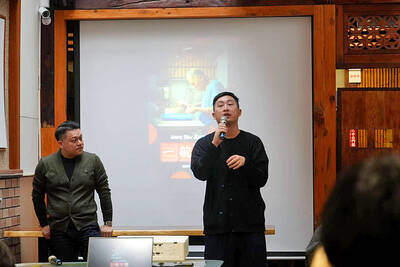
Taiwan Travelogue (臺灣漫遊錄), which earlier this week became the first Taiwanese novel to win the International Booker Prize, is to be adapted into a television series through a Taiwan-Japan coproduction, producer Chang Chen-yu (張辰漁) said yesterday. Chang, a producer at World Softest Production Film Co, wrote on Facebook that the company had been searching for projects with international appeal that retain a strong Taiwanese identity after colleagues and Japanese partners strongly recommended the novel. After reading the book, Chang said he immediately decided to pursue the screen rights. “A great story has the power to transcend time and borders, and connect countless people,”


 RSS
RSS