


New research has shed some light on the development of the human brain, scientists said yesterday.
While the mechanism by which human brain size is determined is still relatively unknown, a study of gene abnormality in primary microcephaly (MCPH) patients has revealed how cell organelle centrioles may affect the thickness of the cerebral cortex, said Tang Tang (唐堂), a Research Fellow at Academia Sinica’s Institute of Biomedical Sciences.
“MCPH patients are characterized by a head circumference that is three standard deviations smaller than the norm,” Tang told a press conference at the National Science Council yesterday.
In addition to having a substantially smaller cerebral cortex and central nervous system than healthy individuals, “in most cases, MCPH patients also have mild to severe mental retardation,” Tang said.
Though the exact reason people develop MCPH is unknown, so far a total of seven genes have been found to lead to MCPH. Four of them, named MCPH1, MCPH3, MCPH5 and MCPH6 [called centrosomal P4.1-associated protein (CPAP), a gene discovered by Tang’s lab in 2000], have been singled out already, Tang said.
Of the four workable genes the researchers have found, three (MCPH3, 5, and 6) are located on the centriole, he said.
“In higher order animals, cell division includes DNA duplication as well as centriole duplication, but so far little is known about the latter,” Tang said.
What is known now is that centrioles assist the centrosomal protein recruiting process and in turn help promote the cell mitosis [cell division] process, he said.
In their study on MCPH patients, Tang’s team identified a mechanism in which centriole duplication is governed by CPAP, Tang said.
“[Our lab] discovered CPAP in 2000 and in 2005 another group of researchers found mutation of the gene leads to MCPH,” Tang said.
“In our new research, we found that insufficient CPAP protein levels in cells inhibited the duplication of the centrioles during neurogenic mitosis and in turn we deduce that the phenomenon causes a reduced number in the afflicted individual’s brain cells,” he said.
In other words, by having depleted CPAP proteins, people have smaller brains.
The team’s finding was published in this month’s edition of Nature Cell Biology.
While clinically almost all MCPH cases caused by CPAP abnormality demonstrate a CPAP deficiency, Tang’s team discovered that an excess level of CPAP in the cells also cause centriole replication to be abnormal.

LOW RISK: Most nations do not extradite people accused of political crimes, and the UN says extradition can only happen if the act is a crime in both countries, an official said China yesterday issued wanted notices for two Taiwanese influencers, accusing them of committing “separatist acts” by criticizing Beijing, amid broadening concerns over China’s state-directed transnational repression. The Quanzhou Public Security Bureau in a notice posted online said police are offering a reward of up to 25,000 yuan (US$3,523) for information that could contribute to the investigation or apprehension of pro-Taiwanese independence YouTuber Wen Tzu-yu (溫子渝),who is known as Pa Chiung (八炯) online, and rapper Chen Po-yuan (陳柏源). Wen and Chen are suspected of spreading content that supported secession from China, slandered Chinese policies that benefit Taiwanese and discrimination against Chinese spouses of
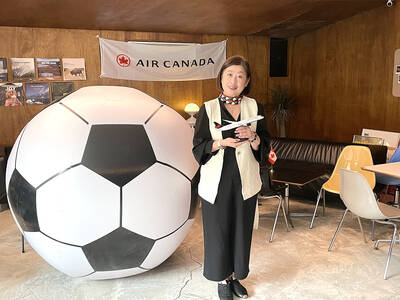
PROMOTION: Travelers who want a free stopover must book their flights with designated travel agents, such as Lion Travel, Holiday Tours, Cola Tour and Life Tours Air Canada yesterday said it is offering Taiwanese travelers who are headed to North America free stopovers if they transit though airports in Japan and South Korea. The promotion was launched in response to a potential rise in demand for flights to North America in June and July next year, when the US, Canada and Mexico are scheduled to jointly host the FIFA World Cup, Air Canada said. Air Canada offers services to 13 of the 16 host cities of the tournament’s soccer games, including Toronto and Vancouver; Mexico City, Guadalajara and Monterrey in Mexico; Atlanta, Georgia; Boston; Dallas; Houston;

ALIGNED THINKING: Taiwan and Japan have a mutual interest in trade, culture and engineering, and can work together for stability, Cho Jung-tai said Taiwan and Japan are two like-minded countries willing to work together to form a “safety barrier” in the Indo-Pacific region, Premier Cho Jung-tai (卓榮泰) yesterday said at the opening ceremony of the 35th Taiwan-Japan Modern Engineering and Technology Symposium in Taipei. Taiwan and Japan are close geographically and closer emotionally, he added. Citing the overflowing of a barrier lake in the Mataian River (馬太鞍溪) in September, Cho said the submersible water level sensors given by Japan during the disaster helped Taiwan monitor the lake’s water levels more accurately. Japan also provided a lot of vaccines early in the outbreak of the COVID-19 pandemic,

The US approved the possible sale to Taiwan of fighter jet spare and repair parts for US$330 million, the Pentagon said late yesterday, marking the first such potential transaction since US President Donald Trump took office in January. "The proposed sale will improve the recipient's capability to meet current and future threats by maintaining the operational readiness of the recipient's fleet of F-16, C-130," and other aircraft, the Pentagon said in a statement. Trump previously said that Chinese President Xi Jinping (習近平) has told him he would not invade Taiwan while the Republican leader is in office. The announcement of the possible arms


 RSS
RSS