


Kuo Hsing-chung (郭興忠) owns two popular Thai restaurants in Taipei that serve dishes meticulously prepared by Kuo and his team of cooks.
At first glance, the restaurants are just two more of the city’s many Thai restaurants.
It’s only when clients enter Kuo’s restaurant on Guangfu South Road and meet the owner that they notice he is missing his left hand — a condition he was born with — and invariably wonder how he manages to cook.
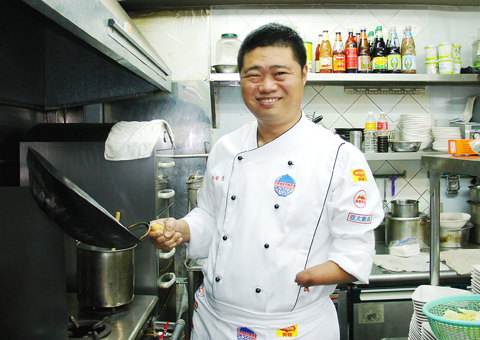
PHOTO: CNA
Kuo is just one of many individuals who have had to overcome a physical disability, but his acquired profession is one that does not lend itself easily to working with only one hand, as he has discovered during his 16-year career.
Some of the simplest kitchen tasks, such as cutting vegetables or stir-frying dishes in a wok, nearly drove Kuo away from the profession more than once, but he persevered and now the chef, known as the “one-handed knife king,” treats his missing hand as nothing more than an inconvenience.
“I have only one hand, but I can do things that a normal person cannot do with two,” the 32-year-old said.
Originally from the Thai-Burmese border town of Mae Salong and moving to Taiwan with his family when he was 12, Kuo was reduced to tears on numerous occasions during his quest for success.
“Fortunately, I didn’t give up in the early years of my apprenticeship. I have accomplished what others may have believed I could never achieve,” he said.
In retrospect, Kuo said he isolated himself from others after he came to Taipei.
“Back then, I was at a loss about the future. From a primitive Thai-Burmese border town to a city like Taipei, I was afraid of strangers’ gaze or glares. Walking in public, I instinctively hid my deformed hand and did not like to show it to others. I feared they would talk about me behind my back,” he said.
The turning point came when he was 16. His uncle, who had opened a Thai restaurant, recruited him as an apprentice.
“I was assigned to work in the kitchen. At first, I thought it was good as I didn’t need to face customers. But my deformity, coupled with my inability to interact with others, discouraged cooks from teaching me anything,” he said.
“They even told my uncle I was unlikely to become a cook or chef. I was enraged. Since they didn’t want to teach me, I told myself I didn’t want to learn,” Kuo said.
After working in the kitchen for half a year, Kuo still could not hold a knife properly and was ready to give up.
But thanks to the repeated encouragements of his father and uncle, and the shock of seeing others get promoted ahead of him, Kuo finally saw the light.
“I couldn’t throw in the towel so easily. I was determined to learn by myself if nobody would teach me,” he said.
He began to observe how cooks cut different foods. During breaks, he would practice cutting discarded carrots and cabbage, using his left elbow to keep things in place as he chopped. It was not easy and he often cut himself.
After several months of “groping in the dark,” he gradually mastered cutting skills, slicing vegetables to a consistent size. Fellow cooks began calling him the “one-handed knife king.”
Then came the equally difficult challenge of stir-frying or sauteing food.
“Woks tend to be heavy. Every step — stirring, seasoning or flavoring and heating — must be perfectly timed for a stir-fried dish to be perfect,” Kuo said.
He remembers throwing away the first sauteed dish he prepared after four months of practice because other workers at his uncle’s restaurant complained that it had a “burnt smell.”
His lack of progress left him downcast and despairing. Worse was to come, as by using one hand to do everything, he suffered severe back ligament injuries.
“The debilitating pain frequently made me cry in the middle of the night. At one point, I thought of giving up,” Kuo said.
“But realizing that I didn’t have many options prevented me from giving up. Even though I had to endure more hardship and adversity, I couldn’t afford to declare defeat,” Kuo said.
After three years of hard work and study, Kuo emerged as a skilled chef of Thai cuisine who can prepare a wide variety of dishes.
In all, it took him eight years to climb to the position of chief chef at his uncle’s restaurant. He did so at the age of 24.
To perfect his culinary art, Kuo has traveled to Thailand many times to study with noted Thai chefs.
Kuo said he was lucky to have had such opportunities.
“They repeatedly encouraged me to take part in culinary contests and they often reminded me that I should never lose confidence because I can do with one hand what others do with two,” Kuo said.
“Their words acted as a wake-up call, boosting my self-confidence and letting me understand that I’m not weak,” he said.
Kuo opened his own restaurant at the age of 28.
“Over the years, my disability has become my strength. Having recognized this, I’m confident I can cope with life’s challenges,” he said.

FUKUOKA SITUATION: Japanese media reported that the pathogen is expected to be identified by the summer, while the CDC downplayed the idea that it was hMPV A “mysterious cold-like illness” reported in Japan’s Fukuoka Prefecture does not seem to be a new disease, but Japanese authorities have been asked about the situation, the Centers for Disease Control (CDC) said yesterday. The Fukuoka Prefectural Medical Association on Wednesday told a news conference that a “mystery cold” that has become a hot topic on social media is “highly likely to be caused by some kind of viral infection,” Japan’s KBC News reported. “Many people are experiencing symptoms starting with a sore throat, followed by a runny nose, phlegm and a severe cough,” KBC News reported, citing association officials. Health authorities are

Nvidia Corp CEO Jensen Huang (黃仁勳) arrived in Taiwan yesterday ahead of upcoming AI and technology events, saying he plans to meet with clients and Taiwan Semiconductor Manufacturing Co Chairman C.C. Wei (魏哲家) during his visit. After landing at Taipei Songshan Airport, Huang posed for photos with fans and handed out Yakult drinks to reporters and supporters waiting at the scene, saying he has “a lot to do” during the trip. Asked about reports that Nvidia’s planned headquarters site in Taipei’s Beitou Shilin Technology Park could break ground on May 27, Huang said that if the company holds an event, he would

The Ministry of Finance this afternoon announced the winning numbers for the March-April uniform invoice lottery. The winning number for the NT$10 million (US$318,060) special prize is 19531471, and the winning number for the NT$2 million grand prize is 85941329. Three numbers were drawn for the NT$200,000 first prize: 07225810, 20231230 and 83518781. Those with receipts matching the last seven digits of any of the first-prize numbers will win the NT$40,000 second prize, while those matching the last six digits will win the NT$10,000 third prize. Those whose receipts match the last five digits of the first-prize numbers can claim the NT$4,000 fourth prize,
Taiwan Travelogue (臺灣漫遊錄), which earlier this week became the first Taiwanese novel to win the International Booker Prize, is to be adapted into a television series through a Taiwan-Japan coproduction, producer Chang Chen-yu (張辰漁) said yesterday. Chang, a producer at World Softest Production Film Co, wrote on Facebook that the company had been searching for projects with international appeal that retain a strong Taiwanese identity after colleagues and Japanese partners strongly recommended the novel. After reading the book, Chang said he immediately decided to pursue the screen rights. “A great story has the power to transcend time and borders, and connect countless people,”


 RSS
RSS