


Australia has welcomed President Ma Ying-jeou’s (馬英九) diplomatic initiative to avoid competing with China for allies, openly lauding for the first time Ma’s attempts to end so-called “checkbook diplomacy” in the South Pacific.
“We are very encouraged by statements by Taiwan officials, including the president, that Taiwan intends to provide aid that is transparent and accountable and has humanitarian and practical focus,” Alice Cawte, representative of the Australian Commerce and Industry Office (ACIO) in Taiwan, said during an interview.
A senior career officer with Australia’s Department of Foreign Affairs and Trade (DFAT) and assistant secretary at the department’s East Asia branch from 2005 until earlier this year, Cawte is familiar with the situation in the Taiwan Strait.
Cawte has also served in Beijing and studied Chinese in Taiwan.
“It will benefit the region as a whole because without the previous tug-of-war for recognition in the Pacific ... [Taiwan] will be able to focus more on government systems that support good governance in the region and are transparent and accountable,” Cawte said.
‘FLEXIBLE’
Since assuming the presidency on May 20, Ma has followed a modus vivendi, or “flexible” diplomatic strategy, which attempts to set aside Taipei’s differences with Beijing to find a mutually beneficial equilibrium on the diplomatic front.
He is also seeking a “diplomatic truce” to end a longstanding tug-of-war with China in which both countries try to lure each other’s allies to switch diplomatic allegiance by offering large sums of foreign aid.
In a visit to Taiwan’s International Cooperation and Development Fund on Sept. 18, Ma affirmed that the government’s approach to foreign aid is strictly based on three key principles: the purpose must be legitimate, the process must be legal and the assistance must be effective and efficient.
INFLUENTIAL
Being the biggest benefactor of countries in the South Pacific, Australia has significant influence in the area. It has long criticized Taiwan and China for conducting “checkbook diplomacy” in the South Pacific region, saying that such a hostile competition for influence fuels corruption and political divisions.
In a report to the legislature on Sept. 25, Foreign Minister Francisco Ou (歐鴻鍊) said that for the modus vivendi strategy, Australia and New Zealand had expressed their intention to work with Taiwan on foreign aid programs in the South Pacific region.
Cawte said, however, that there were no specific projects on which the two countries are working together, adding that Australia was committed to consulting with Taiwan and sharing its experiences.
“We are very happy to share these experiences with donors who share our values of providing dual assistance that leads to good governance and long-term sustainable development,” she said.
“We certainly can consult with Taiwan to ensure that we both understand what we are intended to achieve and through consultation to ensure that we are both doing the best we can for the foreign assistance in the region,” Cawte said.
SIGNS
Cawte said that the signs were encouraging regarding relations between Canberra and Taipei, as they each had new leaders come into office last December and May respectively.
She agreed that bilateral ties seemed to have entered a new stage as the battle between Taiwan and China for diplomatic recognition seemed to be abating.
“I think relations are very good and they are evolving,” Cawte said. “We are tracking well and we are very optimistic and positive about the future.”
She said that Australia was also “encouraged” by the Ma administration’s efforts to improve relations between Taiwan and China.
“We believe this will improve regional security and regional stability,” she said.
SPACE
Speaking about Taiwan’s international space, Cawte said Australia’s position is very clear, and that is to support Taiwan’s participation in regional and international organizations where that participation and consensus is possible.
“We certainly understand Taiwan’s desire to participate in international organizations and believe Taiwan has much to contribute,” Cawte said.
She said that while the precise formulation for Taiwan’s participation in the WHO had yet to be determined, “Taiwan should play the key role in determining the consensus.”

FUKUOKA SITUATION: Japanese media reported that the pathogen is expected to be identified by the summer, while the CDC downplayed the idea that it was hMPV A “mysterious cold-like illness” reported in Japan’s Fukuoka Prefecture does not seem to be a new disease, but Japanese authorities have been asked about the situation, the Centers for Disease Control (CDC) said yesterday. The Fukuoka Prefectural Medical Association on Wednesday told a news conference that a “mystery cold” that has become a hot topic on social media is “highly likely to be caused by some kind of viral infection,” Japan’s KBC News reported. “Many people are experiencing symptoms starting with a sore throat, followed by a runny nose, phlegm and a severe cough,” KBC News reported, citing association officials. Health authorities are

Nvidia Corp CEO Jensen Huang (黃仁勳) arrived in Taiwan yesterday ahead of upcoming AI and technology events, saying he plans to meet with clients and Taiwan Semiconductor Manufacturing Co Chairman C.C. Wei (魏哲家) during his visit. After landing at Taipei Songshan Airport, Huang posed for photos with fans and handed out Yakult drinks to reporters and supporters waiting at the scene, saying he has “a lot to do” during the trip. Asked about reports that Nvidia’s planned headquarters site in Taipei’s Beitou Shilin Technology Park could break ground on May 27, Huang said that if the company holds an event, he would

The Ministry of Finance this afternoon announced the winning numbers for the March-April uniform invoice lottery. The winning number for the NT$10 million (US$318,060) special prize is 19531471, and the winning number for the NT$2 million grand prize is 85941329. Three numbers were drawn for the NT$200,000 first prize: 07225810, 20231230 and 83518781. Those with receipts matching the last seven digits of any of the first-prize numbers will win the NT$40,000 second prize, while those matching the last six digits will win the NT$10,000 third prize. Those whose receipts match the last five digits of the first-prize numbers can claim the NT$4,000 fourth prize,
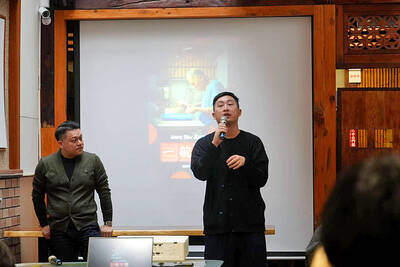
Taiwan Travelogue (臺灣漫遊錄), which earlier this week became the first Taiwanese novel to win the International Booker Prize, is to be adapted into a television series through a Taiwan-Japan coproduction, producer Chang Chen-yu (張辰漁) said yesterday. Chang, a producer at World Softest Production Film Co, wrote on Facebook that the company had been searching for projects with international appeal that retain a strong Taiwanese identity after colleagues and Japanese partners strongly recommended the novel. After reading the book, Chang said he immediately decided to pursue the screen rights. “A great story has the power to transcend time and borders, and connect countless people,”


 RSS
RSS