


The government should be as transparent as possible in providing food safety information, rather than withhold knowledge that it assumes might be too complex for the general public to comprehend, pundits said yesterday.
The analysts made the remarks in response to government plans for melamine testing to only label content “detectable” or “non-detectable” and not specify how many parts per million (ppm) of the toxin are contained in products.
“The most important elements should ... make very clear the approach to be adopted in evaluating food safety, its detection limits and the possible consequences of consuming tainted foods,” said Winston Dang (陳重信), a professor of National Taipei University.
“Detection limits are especially important, because melamine is something that is not supposed to be included in foodstuffs, just like it is illegal to put dioxin in food,” said Dang, who previously served as an ombudsman at the US Food and Drug Administration.
On Wednesday, the Department of Health (DOH) surprised many with its announcement raising the allowable melamine content in foods from zero ppm to 2.5ppm. Department of Health minister Lin Fang-yu (林芳郁) resigned the next day under heavy criticism.
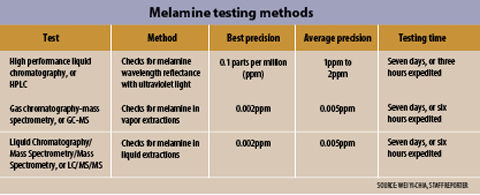
The eased standards came as the DOH struggled to standardize instruments used to test for melamine, with high-performance liquid chromatography (HPLC) chosen over gas chromatography-mass spectrometry (GC-MS).
However, compared with GC-MS — which can detect melamine content as low as 0.002ppm — the HPLC method is not nearly as sensitive, with its lower limits between 2ppm and 2.5ppm.
Lin had said the standardization was meant to make sure all items were examined equally, but he did not explain why the HPLC method was chosen.
The decision was made at a committee meeting chaired by Lin and attended by DOH Deputy Minister Sung Yeh-jen (宋晏仁) among others.
When the change made headlines on Thursday and was met with strong criticism, Executive Yuan Spokeswoman Vanessa Shih (史亞平) said that “2.5ppm is an international standard” and the HPLC method had been adopted in the US and Europe for the analysis of melamine in human food.
Shih told reporters that the DOH shouldn’t have said how many ppm of melamine is permissible in foodstuff or which method was to be adopted, saying that the general public could misinterpret the decision “because following the issue required specialized knowledge.”
The DOH should simply tell people the testing is in line with international standards and foods found to include melamine would not be allowed to enter the market, she said on Thursday.
On Friday, Premier Liu Chao-shiuan (劉兆玄) and Lin’s successor Yeh Ching-chuan (葉金川) both said that the authorities would use a “zero detection” method, but they stopped short of saying whether the results would be based on HPLC or GC/MS testing.
“The way the government addressed the issue has turned the problem of whether melamine is allowed in food into a matter for rhetoric, and this is unacceptable,” Dang said.
“According to the US, EU and the WHO, the permissible level of melamine is zero, not ‘zero detection.’ Considering the lower limits of detection, of course we should go for the best available technology [one that offers the most precision] — the GC/MS or LC/MS/MS [liquid chromatography mass spectrometry] and not the HPLC, which is the method that was used in 1970s,” he said
Secretary-general of the EU Study Association Wu Chih-chung (吳志中) slammed officials for putting a spin on its position, saying that the government followed international standards yet failed to tell the public what kind of international standard it referred to.
“Apparently there is no such international standard of 2.5ppm, at least in the EU, US and Japan. Only Honk Kong has adopted that standard,” Wu said.
Yeh’s remarks that the DOH had to consult with international experts to decide on testing methods for melamine runs contrary to statements made by Shih, who said that the HPLC method met international standards, Wu said.
“The government should reveal all the information, including the person responsible for deciding on the testing method, the reasons why the approach was chosen and its limitations, because the people have the right to challenge the government’s decision and they need the information,” he said.

FUKUOKA SITUATION: Japanese media reported that the pathogen is expected to be identified by the summer, while the CDC downplayed the idea that it was hMPV A “mysterious cold-like illness” reported in Japan’s Fukuoka Prefecture does not seem to be a new disease, but Japanese authorities have been asked about the situation, the Centers for Disease Control (CDC) said yesterday. The Fukuoka Prefectural Medical Association on Wednesday told a news conference that a “mystery cold” that has become a hot topic on social media is “highly likely to be caused by some kind of viral infection,” Japan’s KBC News reported. “Many people are experiencing symptoms starting with a sore throat, followed by a runny nose, phlegm and a severe cough,” KBC News reported, citing association officials. Health authorities are

Nvidia Corp CEO Jensen Huang (黃仁勳) arrived in Taiwan yesterday ahead of upcoming AI and technology events, saying he plans to meet with clients and Taiwan Semiconductor Manufacturing Co Chairman C.C. Wei (魏哲家) during his visit. After landing at Taipei Songshan Airport, Huang posed for photos with fans and handed out Yakult drinks to reporters and supporters waiting at the scene, saying he has “a lot to do” during the trip. Asked about reports that Nvidia’s planned headquarters site in Taipei’s Beitou Shilin Technology Park could break ground on May 27, Huang said that if the company holds an event, he would

The Ministry of Finance this afternoon announced the winning numbers for the March-April uniform invoice lottery. The winning number for the NT$10 million (US$318,060) special prize is 19531471, and the winning number for the NT$2 million grand prize is 85941329. Three numbers were drawn for the NT$200,000 first prize: 07225810, 20231230 and 83518781. Those with receipts matching the last seven digits of any of the first-prize numbers will win the NT$40,000 second prize, while those matching the last six digits will win the NT$10,000 third prize. Those whose receipts match the last five digits of the first-prize numbers can claim the NT$4,000 fourth prize,
Taiwan Travelogue (臺灣漫遊錄), which earlier this week became the first Taiwanese novel to win the International Booker Prize, is to be adapted into a television series through a Taiwan-Japan coproduction, producer Chang Chen-yu (張辰漁) said yesterday. Chang, a producer at World Softest Production Film Co, wrote on Facebook that the company had been searching for projects with international appeal that retain a strong Taiwanese identity after colleagues and Japanese partners strongly recommended the novel. After reading the book, Chang said he immediately decided to pursue the screen rights. “A great story has the power to transcend time and borders, and connect countless people,”


 RSS
RSS