


A former National Security Bureau (NSB) chief returned to the post yesterday after he was tapped by President Ma Ying-jeou (馬英九) on Thursday to take over the helm of the country’s top intelligence body.
Tsai Chao-ming (蔡朝明), first non-Mainlander to hold the country’s top intelligence post, succeeded Shi Hwei-yow (許惠祐) as the NSB director-general after Shi’s resignation on Tuesday.
Media reports said Ma chose Tsai because of his knowledge of intelligence affairs and his belief that illegal wiretapping must not be allowed.
Tsai was first promoted to the top NSB post in 2001 by then-president Chen Shui-bian (陳水扁).
shooting
He resigned in 2004 to take responsibility for the March 19 shooting of Chen and then vice president Annette Lu in Tainan City on the eve of their re-election.
Shi confirmed on Wednesday that he had tendered his resignation a day earlier to facilitate Ma’s efforts to rearrange his administration’s lineup.
He said he did not tender his resignation until a month after Ma’s inauguration because he was waiting to pass his job to his successor.
Also yesterday, new National Police Agency (NPA) Director-General Wang Cho-chiun (王卓鈞) assumed office in a changeover ceremony presided over by Minister of the Interior Liao Liao-yi (廖了以) at the NPA headquarters in Taipei City.
Wang, a former director-general of the Taipei City Police Department, took control of the nation’s top police post from Hou You-yi (侯友宜), who has been appointed as the new president of the Central Police University.
Speaking at the ceremony, Liao praised Hou for his outstanding performance as NPA chief, noting that the public’s level of satisfaction with public order increased dramatically during his two-plus years in the post.
morale
Liao also lauded Hou’s success in boosting the morale of the police force and securing salary raises.
Liao expressed the hope that Wang will be able to build on the foundation laid down by Hou and lead the 70,000-strong police force in making Taiwan the safest country in Asia.
For his part, Wang said that his task as new head of the NPA will focus on the four goals of improving human rights, boosting the police force’s effectiveness, increasing discipline and improving the force’s image.
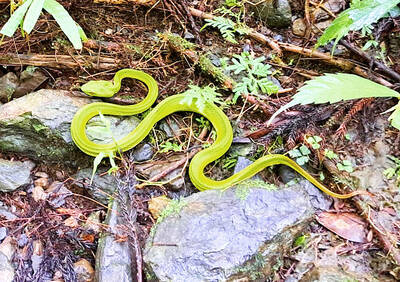
More than half of the bamboo vipers captured in Tainan in the past few years were found in the city’s Sinhua District (新化), while other districts had smaller catches or none at all. Every year, Tainan captures about 6,000 snakes which have made their way into people’s homes. Of the six major venomous snakes in Taiwan, the cobra, the many-banded krait, the brown-spotted pit viper and the bamboo viper are the most frequently captured. The high concentration of bamboo vipers captured in Sinhua District is puzzling. Tainan Agriculture Bureau Forestry and Nature Conservation Division head Chu Chien-ming (朱健明) earlier this week said that the

NAMING SPAT: The foreign ministry called on Denmark to propose an acceptable solution to the erroneous nationality used for Taiwanese on residence permits Taiwan has revoked some privileges for Danish diplomatic staff over a Danish permit that lists “Taiwan” as “China,” Eric Huang (黃鈞耀), head of the Ministry of Foreign Affairs’ Department of European Affairs, told a news conference in Taipei yesterday. Reporters asked Huang whether the Danish government had responded to the ministry’s request that it correct the nationality on Danish residence permits of Taiwanese, which has been listed as “China” since 2024. Taiwan’s representative office in Denmark continues to communicate with the Danish government, and the ministry has revoked some privileges previously granted to Danish representatives in Taiwan and would continue to review

Kenting National Park service technician Yang Jien-fon (楊政峰) won a silver award in World Grand Prix Photography Awards Spring Season for his photograph of two male rat snakes intertwined in combat. Yang’s colleagues at Kenting National Park said he is a master of nature photography who has been held back by his job in civil service. The awards accept entries in all four seasons across six categories: architectural and urban photography, black-and-white and fine art photography, commercial and fashion photography, documentary and people photography, nature and experimental photography, and mobile photography. Awards are ranked according to scores and divided into platinum, gold and
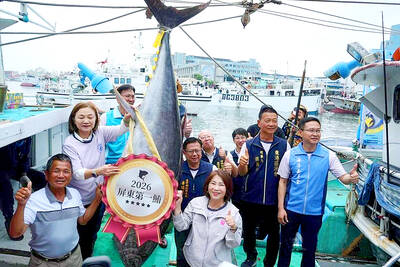
The first bluefin tuna of the season, brought to shore in Pingtung County and weighing 190kg, was yesterday auctioned for NT$10,600 (US$333.5) per kilogram, setting a record high for the local market. The auction was held at the fish market in Donggang Fishing Harbor, where the Siaoliouciou Island-registered fishing vessel Fu Yu Ching No. 2 delivered the “Pingtung First Tuna” it had caught for bidding. Bidding was intense, and the tuna was ultimately jointly purchased by a local restaurant and a local company for NT$10,600 per kilogram — NT$300 ,more than last year — for a total of NT$2.014 million. The 67-year-old skipper


 RSS
RSS