


The Democratic Progressive Party (DPP) began a new chapter as the senior members — dubbed the party’s princes and princesses by the media — have all refrained from entering the chairmanship election, DPP Chairman Frank Hsieh (謝長廷) said yesterday.
“It wasn’t easy for the princes and princesses to refrain from making a bid, which means it is agreed by all within the party that it should have a new beginning,” Hsieh said.
Addressing party members at a conference discussing the future of the DPP, which was badly beaten in the last three national elections, Hsieh said he expected the party could be completely transformed by a new leader.
Hsieh offered to resign as chairman after losing the presidential election to the Chinese Nationalist Party (KMT) candidate Ma Ying-jeou (馬英九) last month.
The party will hold the election for chairman on May 18.
Following the decision by former vice premier Tsai Ing-wen (蔡英文), 52, who many members consider a dream leader for the embattled party, to join the race at the last minute, the party will start coordination with Tsai and the other two candidates this week.
DPP Legislator Chai Trong-rong (蔡同榮), 73, and former senior presidential advisor Koo Kwang-ming (辜寬敏), 82, have also joined the race.
Tsai was selected as a legislator-at-large for the party in the 2005 legislative elections after she registered as a member of the 22-year-old DPP in September 2004.
Yesterday’s meeting concluded a series of eight conferences held around the country over the past two weeks that enabled supporters and party members to examine and suggest ways to solve the party’s problems.
Issues on the agenda at yesterday’s closed-door meeting included the lines the party should take when in power, the organizational development of the party and how the party should face national challenges surrounding the country internationally and domestically.
Conclusions pertaining to the DPP’s charter and platform will be sent to the party’s convention next month for full review, party Secretary-General Lee Ying-yuan (李應元) said.
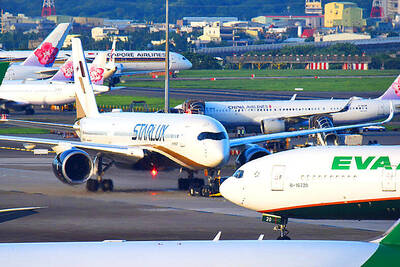
The disruption of 941 flights in and out of Taiwan due to China’s large-scale military exercises was no accident, but rather the result of a “quasi-blockade” used to simulate creating the air and sea routes needed for an amphibious landing, a military expert said. The disruptions occurred on Tuesday and lasted about 10 hours as China conducted live-fire drills in the Taiwan Strait. The Civil Aviation Administration (CAA) said the exercises affected 857 international flights and 84 domestic flights, affecting more than 100,000 travelers. Su Tzu-yun (蘇紫雲), a research fellow at the government-sponsored Institute for National Defense and Security Research, said the air
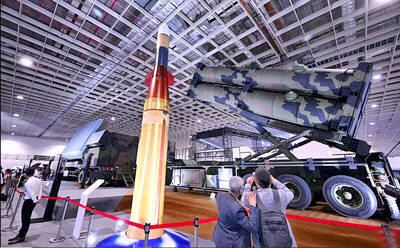
Taiwan is to commence mass production of the Tien Kung (天弓, “Sky Bow”) III, IV and V missiles by the second quarter of this year if the legislature approves the government’s NT$1.25 trillion (US$39.78 billion) special defense budget, an official said yesterday. Commenting on condition of anonymity, a defense official with knowledge of the matter said that the advanced systems are expected to provide crucial capabilities against ballistic and cruise missiles for the proposed “T-Dome,” an advanced, multi-layered air defense network. The Tien Kung III is an air defense missile with a maximum interception altitude of 35km. The Tien Kung IV and V
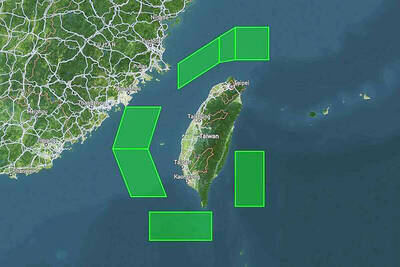
Trips for more than 100,000 international and domestic air travelers could be disrupted as China launches a military exercise around Taiwan today, Taiwan’s Civil Aviation Administration (CAA) said yesterday. The exercise could affect nearly 900 flights scheduled to enter the Taipei Flight Information Region (FIR) during the exercise window, it added. A notice issued by the Chinese Civil Aviation Administration showed there would be seven temporary zones around the Taiwan Strait which would be used for live-fire exercises, lasting from 8am to 6pm today. All aircraft are prohibited from entering during exercise, it says. Taipei FIR has 14 international air routes and
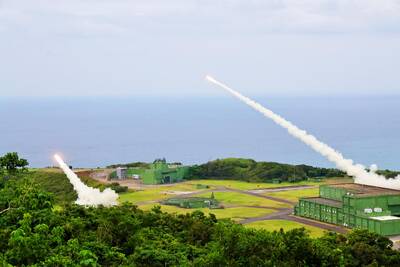
Taiwan lacks effective and cost-efficient armaments to intercept rockets, making the planned “T-Dome” interception system necessary, two experts said on Tuesday. The concerns were raised after China’s military fired two waves of rockets during live-fire drills around Taiwan on Tuesday, part of two-day exercises code-named “Justice Mission 2025.” The first wave involved 17 rockets launched at 9am from Pingtan in China’s Fujian Province, according to Lieutenant General Hsieh Jih-sheng (謝日升) of the Office of the Deputy Chief of the General Staff for Intelligence at the Ministry of National Defense. Those rockets landed 70 nautical miles (129.6km) northeast of Keelung without flying over Taiwan,


 RSS
RSS