


A campaign by Sediq Aborigines to be recognized as the nation's 14th Aboriginal tribe made significant progress yesterday when the Council of Indigenous Peoples agreed to submit their application to the Cabinet.
A group of more than 100 Sediq Aborigines led by Watan Diro, the Sediq Tribal Name Restoration Association's executive director, visited the council yesterday to turn in 2,600 signatures to show their determination to be granted official status.
They were received by top officials at the council -- including council Minister Icyang Parod.
The officials responded positively to the Sediq activists.
"We'll submit the application, along with a report and other documents to the Cabinet for final review," a council official told the Sediq representatives.
But the Sediq campaign has not been an easy one.
The Sediq, who live mostly in Nantou County, have been officially classified as Atayal Aborigines ever since a Japanese ethnologist listed them by the name when Japan ruled Taiwan. The proximity of the two tribes' homelands and similarities in customs contributed to the classification.
The Sediq can be further divided into three ethnolinguistic groups: the Toda, the Tgdaya and the Truku.
The Sediq campaign ran into controversy when the Truku, who moved to Hualien County several hundred years ago, were recognized as a separate tribe in 2004.
The Sediq of Nantou and the Truku of Hualien had debated for some time over whether they should be recognized as a single group or whether the Truku should be separate.
Before the two groups came to an agreement, then premier Yu Shyi-kun announced at a campaign rally for a Hualien County commissioner candidate that the Truku of Hualien would receive official recognition.
The Sediq were shocked by the news and also decided to seek recognition.
But the process was then stalled because the council and an ethnologist it had commissioned, Lim Siu-theh (林修澈), could not find evidence that the Sediq and the Truku were separate groups.
After repeated protests by the Sediq and several rounds of negotiations the council decided at a meeting on Friday to approve the application and submit it to the Cabinet -- the last step before recognition is granted -- for review.
The director of the council's office of planning, Calivat Gadu, declined to predict how long it would take for the Cabinet to approve the application, or whether it would be approved at all.
While congratulating the Sediq, Calivat also expressed concern.
"There are still many sub-tribes who are trying to gain official recognition," he told the Taipei Times in a brief interview in his office after the meeting. "The Sediq case is a special one -- but if all those tribes want to follow in the Sediq's footsteps, it'll be chaotic."

FUKUOKA SITUATION: Japanese media reported that the pathogen is expected to be identified by the summer, while the CDC downplayed the idea that it was hMPV A “mysterious cold-like illness” reported in Japan’s Fukuoka Prefecture does not seem to be a new disease, but Japanese authorities have been asked about the situation, the Centers for Disease Control (CDC) said yesterday. The Fukuoka Prefectural Medical Association on Wednesday told a news conference that a “mystery cold” that has become a hot topic on social media is “highly likely to be caused by some kind of viral infection,” Japan’s KBC News reported. “Many people are experiencing symptoms starting with a sore throat, followed by a runny nose, phlegm and a severe cough,” KBC News reported, citing association officials. Health authorities are

Nvidia Corp CEO Jensen Huang (黃仁勳) arrived in Taiwan yesterday ahead of upcoming AI and technology events, saying he plans to meet with clients and Taiwan Semiconductor Manufacturing Co Chairman C.C. Wei (魏哲家) during his visit. After landing at Taipei Songshan Airport, Huang posed for photos with fans and handed out Yakult drinks to reporters and supporters waiting at the scene, saying he has “a lot to do” during the trip. Asked about reports that Nvidia’s planned headquarters site in Taipei’s Beitou Shilin Technology Park could break ground on May 27, Huang said that if the company holds an event, he would

The Ministry of Finance this afternoon announced the winning numbers for the March-April uniform invoice lottery. The winning number for the NT$10 million (US$318,060) special prize is 19531471, and the winning number for the NT$2 million grand prize is 85941329. Three numbers were drawn for the NT$200,000 first prize: 07225810, 20231230 and 83518781. Those with receipts matching the last seven digits of any of the first-prize numbers will win the NT$40,000 second prize, while those matching the last six digits will win the NT$10,000 third prize. Those whose receipts match the last five digits of the first-prize numbers can claim the NT$4,000 fourth prize,
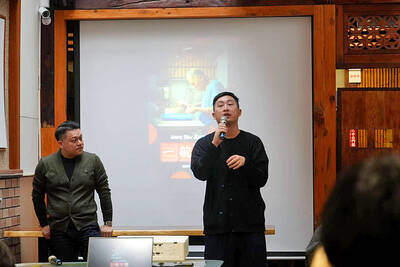
Taiwan Travelogue (臺灣漫遊錄), which earlier this week became the first Taiwanese novel to win the International Booker Prize, is to be adapted into a television series through a Taiwan-Japan coproduction, producer Chang Chen-yu (張辰漁) said yesterday. Chang, a producer at World Softest Production Film Co, wrote on Facebook that the company had been searching for projects with international appeal that retain a strong Taiwanese identity after colleagues and Japanese partners strongly recommended the novel. After reading the book, Chang said he immediately decided to pursue the screen rights. “A great story has the power to transcend time and borders, and connect countless people,”


 RSS
RSS