


Chinese Nationalist Party (KMT) Chairman Wu Poh-hsiung (吳伯雄) yesterday pledged to campaign for pan-blue legislative candidates recommended by the KMT-People First Party (PFP) alliance regardless of their party affiliation.
The KMT-PFP alliance joined to nominate six legislative candidates and is planning to register legislator-at-large candidates under the KMT, Wu said.
"The six candidates were nominated by the KMT and by the PFP. Regardless of their party affiliations, the KMT will treat them the same and campaign for them," Wu said yesterday.
The six PFP legislative candidates nominated by the alliance are Ko Shu-ming (
Hwang yesterday confirmed that he joined the KMT last month.
Hwang said he made the decision to meet the expectations of his supporters, adding that PFP Chairman James Soong (宋楚瑜) was aware of the matter and understood his position.
Chung, who was jointly recommended by both the KMT and the PFP to run for the legislature in January in the first district in Kaohsiung County, said Hwang's move "reflected the political reality" and was "understandable."
Chung said PFP members running on behalf of the two parties all face the same situation as Hwang because "supporters want to see us run under the banner of the KMT."
According to the consensus the KMT and PFP reached on the joint candidates in April, the legislative candidates will be registered under the KMT, and the two parties will negotiate on the nomination mechanism of the legislator-at-large candidates.
With the registrations for the legislative election to be held from Nov. 16 to Nov. 20, it is believed that the two parties will officially merge in November.
Wu said his party would discuss the further details with Soong, such as whether or not legislator-at-large candidates should be officially registered by the KMT.
When asked to comment on the rumors that the KMT and PFP would merge in November, KMT presidential candidate Ma Ying-jeou (馬英九) yesterday said the two parties have been cooperating in many ways and an official merger would benefit the pan-blue camp and make it easier for pan-blue supporters to cast their votes during elections without having to think about which party they should support.
Tseng Yung-chuan (曾永權), executive director of the KMT's Central Policy Committee, said he was looking forward to the formal merger of the two pan-blue parties by Nov. 16, the deadline to register as a legislative candidate in the election.
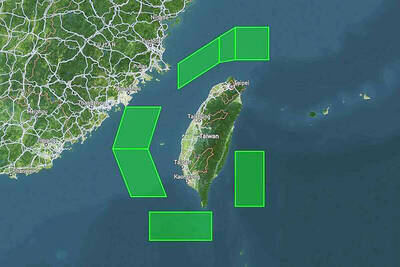
The disruption of 941 flights in and out of Taiwan due to China’s large-scale military exercises was no accident, but rather the result of a “quasi-blockade” used to simulate creating the air and sea routes needed for an amphibious landing, a military expert said. The disruptions occurred on Tuesday and lasted about 10 hours as China conducted live-fire drills in the Taiwan Strait. The Civil Aviation Administration (CAA) said the exercises affected 857 international flights and 84 domestic flights, affecting more than 100,000 travelers. Su Tzu-yun (蘇紫雲), a research fellow at the government-sponsored Institute for National Defense and Security Research, said the air
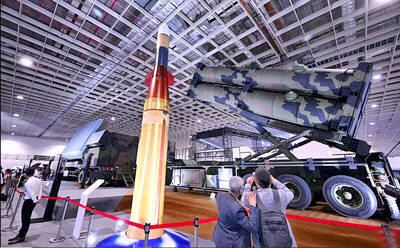
Taiwan is to commence mass production of the Tien Kung (天弓, “Sky Bow”) III, IV and V missiles by the second quarter of this year if the legislature approves the government’s NT$1.25 trillion (US$39.78 billion) special defense budget, an official said yesterday. Commenting on condition of anonymity, a defense official with knowledge of the matter said that the advanced systems are expected to provide crucial capabilities against ballistic and cruise missiles for the proposed “T-Dome,” an advanced, multi-layered air defense network. The Tien Kung III is an air defense missile with a maximum interception altitude of 35km. The Tien Kung IV and V
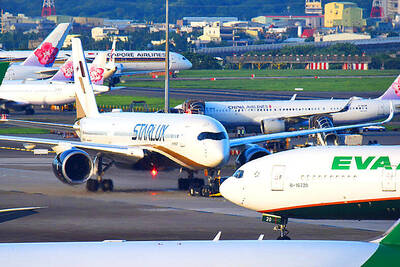
Trips for more than 100,000 international and domestic air travelers could be disrupted as China launches a military exercise around Taiwan today, Taiwan’s Civil Aviation Administration (CAA) said yesterday. The exercise could affect nearly 900 flights scheduled to enter the Taipei Flight Information Region (FIR) during the exercise window, it added. A notice issued by the Chinese Civil Aviation Administration showed there would be seven temporary zones around the Taiwan Strait which would be used for live-fire exercises, lasting from 8am to 6pm today. All aircraft are prohibited from entering during exercise, it says. Taipei FIR has 14 international air routes and
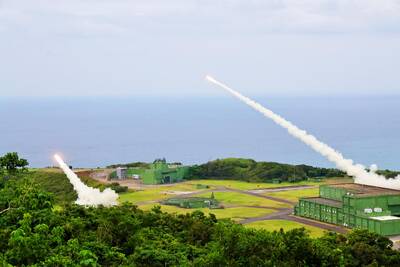
Taiwan lacks effective and cost-efficient armaments to intercept rockets, making the planned “T-Dome” interception system necessary, two experts said on Tuesday. The concerns were raised after China’s military fired two waves of rockets during live-fire drills around Taiwan on Tuesday, part of two-day exercises code-named “Justice Mission 2025.” The first wave involved 17 rockets launched at 9am from Pingtan in China’s Fujian Province, according to Lieutenant General Hsieh Jih-sheng (謝日升) of the Office of the Deputy Chief of the General Staff for Intelligence at the Ministry of National Defense. Those rockets landed 70 nautical miles (129.6km) northeast of Keelung without flying over Taiwan,


 RSS
RSS