


It might be too strong to interpret the cold shoulder Taiwan received from its allies during the voting in its bid for full WHO membership as a sign of deteriorating diplomatic relations, but it could become a real crisis if diplomats try to play down the result as just another instance of China's interference in Taiwan's struggle for international recognition, political analysts said.
This year, for the first time, Taiwan applied for full WHO membership using the name "Taiwan" at the World Health Assembly (WHA), the WHO's highest decision-making body.
Unsurprisingly, Taiwan was once again rejected. But to many people's surprise, several of Taiwan's allies did not support Taiwan when the WHA's General Assembly voted on whether to put Taiwan's application onto the agenda.
In addition to the Vatican, which is not a WHO member, seven of Taiwan's remaining 24 allies did not give their support to Taiwan's motion. Panama, Nicaragua, the Marshall Islands and St. Lucia were all absent from the vote while Haiti waived its voting right. The Dominican Republic forfeited its voting rights by not paying its membership fee. Costa Rica voted against Taiwan.
Several pan-blue legislators castigated the Ministry of Foreign Affairs for "making bad friends" and for being oblivious to its allies' ambiguous attitude toward the WHA vote. People First Party caucus whip Chao Liang-yen (
It has also been rumored that some of Taiwan's allies in Central America are planning to cut relations with Taiwan.
And although Foreign Minister James Huang (
But the ministry admitted that the foreign ministers of Costa Rica, Panama and Nicaragua would be absent from the meetings with Huang.
Lo Chi-cheng (羅致政), a political science professor at Soochow University, said that the voting behavior of the nation's allies at this kind of international conference should be seen as an indicator of their loyalty to Taiwan, but it is still not the fundamental problem in the nation's diplomatic predicament.
"It is likely that some of these nations would use such events to negotiate with Taiwan for things they want," Lo said. "But some of these allies are experiencing a change of regime and need to face their voters domestically."
Lo said that ministry officials need to conduct a review to see what went wrong during communications with its allies and find out why they voted as they did.
Secretary-general of the EU Study Association Wu Chih-chung (
But political analyst Hsu Yung-ming (

Fast food chain McDonald's is to raise prices by up to NT$5 on some products at its restaurants across Taiwan, starting on Wednesday next week, the company announced today. The prices of all extra value meals and sharing boxes are to increase by NT$5, while breakfast combos and creamy corn soup would go up by NT$3, the company said in a statement. The price of the main items of those meals, if ordered individually, would remain the same. Meanwhile, the price of a medium-sized lemon iced tea and hot cappuccino would rise by NT$3, extra dipping sauces for chicken nuggets would go up

Yangmingshan National Park’s Qingtiangang (擎天崗) nature area has gone viral after a park livestream camera observed a couple in the throes of intimate congress, which was broadcast live on YouTube, drawing large late-night crowds and sparking a backlash over noise, bright lights and disruption to wildlife habitat. The area’s livestream footage appeared to show a couple engaging in sexual activity on a picnic table in the park on Friday last week, with the uncensored footage streamed publicly online. The footage quickly spread across social media, prompting a tide of visitors to travel to the site to “check in” and recreate the

Minister of Digital Affairs Lin Yi-ching (林宜敬) yesterday cited regulatory issues and national security concerns as an expert said that Taiwan is among the few Asian regions without Starlink. Lin made the remarks on Facebook after funP Innovation Group chief executive officer Nathan Chiu (邱繼弘) on Friday said Taiwan and four other countries in Asia — China, North Korea, Afghanistan and Syria — have no access to Starlink. Starlink has become available in 166 countries worldwide, including Ukraine, Malaysia, the Philippines and Vietnam, in the six years since it became commercial, he said. While China and North Korea block Starlink, Syria is not
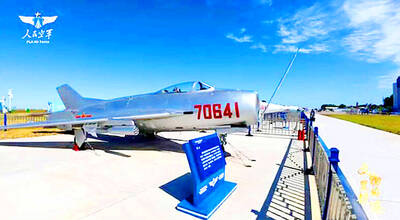
GROUNDED: A KMT lawmaker proposed eliminating drone development programs and freezing funding for counterdrone systems, despite China’s adoption of the technology China has deployed attack drones at air bases near the Taiwan Strait in a strategy aimed at overwhelming Taiwan’s air defense systems through saturation attacks, the Mainland Affairs Council (MAC) said. The council’s latest quarterly report on China said that satellite imagery and open-source intelligence indicate that the Chinese People’s Liberation Army (PLA) had converted retired J-6 fighter jets into J-6W drones, which the PLA has stationed at six air bases near Taiwan, five in China’s Fujian Province and one in Guangdong Province. The report cited J. Michael Dahm, a senior fellow at the US-based Mitchell Institute, as saying that China has


 RSS
RSS