


A group of university students, led by a legislator, protested yesterday against the low wages paid by on-campus jobs and demanded that the Labor Standards Law (
DPP Legislator Lin Shu-fen (林淑芬) said that many universities are lowering the hourly wages of on-campus jobs to cut expenses and violate student-labor rights by making already underpaid students work unpaid overtime.
Lin said that the Ministry of Education (MOE) was breaking the rules established by the Council of Labor Affairs (CLA) by setting their minimum hourly wage at NT$60, instead of the NT$66 required by the CLA. Although many universities pay student workers NT$70 to NT$75 per hour, which is higher than the CLA's minimum wage, the salary is still too low to cover students' expenses, Lin said.
According to Lin, the MOE provides universities with subsidies to enable students from poor families to work on campus and earn money, but in reality their salaries are even lower than those of foreign laborers.
Li Chun-ta (李俊達), a student at Soochow University, said that with the high costs of private tuition, expensive books and rising cost of living, students from poor families cannot afford to pay their way even with steady on-campus jobs.
"These jobs should provide an opportunity for poor students to become economically independent and pay their own expenses, but low wages make this impossible," Li said.
Other violations of student-labor rights include withholding wages if a student quits a job after working less than a month, which is in contravention of a Labor Standards Law regulation which states that employees have to pay employees for all days worked.
The required 180 hours work per month at some schools also caused discontent. According to the Labor Standards Law, the maximum hours of work cannot exceed 168 per month, Lin said.
In response to the accusations, Chung Hsin-chang (
Chung also said that on-campus jobs are learning opportunities for students and the money given should not be called "wages."
However, Chung said that the MOE is willing to make alterations to its rules.
According to Adam Hsieh (謝青雲) of the CLA, only certain on-campus jobs, such as those of technicians and drivers, are under the protection of the Labor Standards Law.
Hsieh said that the law does not apply to other students' jobs and therefore the minimum wages and hours proposed in the regulations do not apply either.
Lin Po-yi (
"We don't know what kind of jobs we would have on campus. It could be administrative work or it could be something more dangerous, like fixing equipment," Lin said. "If an accident happens while we're doing our jobs, does it mean we do not have protection under the Labor Standards Law?"

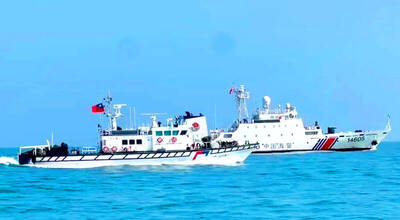
The military has spotted two Chinese warships operating in waters near Penghu County in the Taiwan Strait and sent its own naval and air forces to monitor the vessels, the Ministry of National Defense (MND) said. Beijing sends warships and warplanes into the waters and skies around Taiwan on an almost daily basis, drawing condemnation from Taipei. While the ministry offers daily updates on the locations of Chinese military aircraft, it only rarely gives details of where Chinese warships are operating, generally only when it detects aircraft carriers, as happened last week. A Chinese destroyer and a frigate entered waters to the southwest
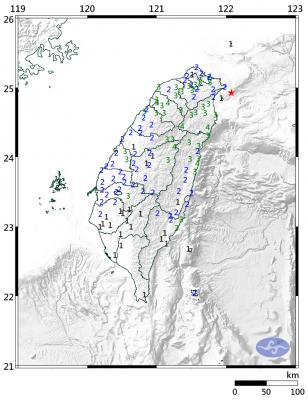
A magnitude 6.1 earthquake struck off the coast of Yilan County at 8:39pm tonight, the Central Weather Administration (CWA) said, with no immediate reports of damage or injuries. The epicenter was 38.7km east-northeast of Yilan County Hall at a focal depth of 98.3km, the CWA’s Seismological Center said. The quake’s maximum intensity, which gauges the actual physical effect of a seismic event, was a level 4 on Taiwan’s 7-tier intensity scale, the center said. That intensity level was recorded in Yilan County’s Nanao Township (南澳), Hsinchu County’s Guansi Township (關西), Nantou County’s Hehuanshan (合歡山) and Hualien County’s Yanliao (鹽寮). An intensity of 3 was

Japanese Prime Minister Sanae Takaichi’s comment last year on Tokyo’s potential reaction to a Taiwan-China conflict has forced Beijing to rewrite its invasion plans, a retired Japanese general said. Takaichi told the Diet on Nov. 7 last year that a Chinese naval blockade or military attack on Taiwan could constitute a “survival-threatening situation” for Japan, potentially allowing Tokyo to exercise its right to collective self-defense. Former Japan Ground Self-Defense Force general Kiyofumi Ogawa said in a recent speech that the remark has been interpreted as meaning Japan could intervene in the early stages of a Taiwan Strait conflict, undermining China’s previous assumptions
Instead of focusing solely on the threat of a full-scale military invasion, the US and its allies must prepare for a potential Chinese “quarantine” of Taiwan enforced through customs inspections, Stanford University Hoover fellow Eyck Freymann said in a Foreign Affairs article published on Wednesday. China could use various “gray zone” tactics in “reconfiguring the regional and ultimately the global economic order without a war,” said Freymann, who is also a nonresident research fellow at the US Naval War College. China might seize control of Taiwan’s links to the outside world by requiring all flights and ships entering or leaving Taiwan


 RSS
RSS