


A standardized phonetic system for Taiwanese will be introduced by the end of August, Minister of Education Tu Cheng-sheng (杜正勝) announced yesterday at a conference of educational professionals at the National Institute for Compilation and Translation (國立編譯館).
The conference on "mother tongue" education reviewed the quality of teaching materials that are being used for teaching Taiwanese, Hakka and Aboriginal languages around the nation, and considered actions that could be taken to improve the current confused situation in the area of phonetic systems.
Romanization
Romanization has been a controversial issue in Taiwan, with concurrent use of Tungyung Pinyin, Hanyu Pinyin and variations of the Wade-Giles system for Mandarin Chinese.
The situation for Taiwanese is equally complex, with Tungyung, Taiwanese Language Phonetic Alphabet (TLPA) and Taiwanese Roman Orthography -- as well as several variations of these -- ?currently being used in the educational system.
Last month, the Ministry of Education initiated a study of Taiwanese "mother tongue" education at the primary and secondary school level. The results, which were released yesterday, commended the diversity of teaching materials that had been produced by teachers around the country. However, the ministry said the lack of a standardized system within the education system creates problems for both teachers and students, especially when transferring from one institution to another.
According to Liang Jung-mao (
Selection criteria
Tu emphasized that "ease of teaching, ease of learning" would be the main criteria for selection, and hoped the choice could avoid any controversy over purely academic issues.
Tu pointed out at the conference that the debate over "mother tongue" education tends to focus exclusively on language, at the expense of history, culture and geography.
Tu added that while the public and media tended to see a standardized phonetic system as central to "mother tongue" education, it was not greatly significant for teachers in the classroom.
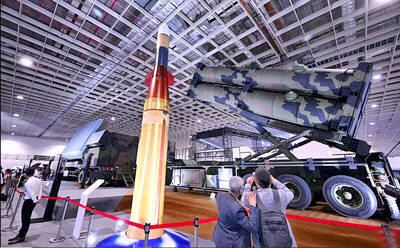
Taiwan is to commence mass production of the Tien Kung (天弓, “Sky Bow”) III, IV and V missiles by the second quarter of this year if the legislature approves the government’s NT$1.25 trillion (US$39.78 billion) special defense budget, an official said yesterday. Commenting on condition of anonymity, a defense official with knowledge of the matter said that the advanced systems are expected to provide crucial capabilities against ballistic and cruise missiles for the proposed “T-Dome,” an advanced, multi-layered air defense network. The Tien Kung III is an air defense missile with a maximum interception altitude of 35km. The Tien Kung IV and V
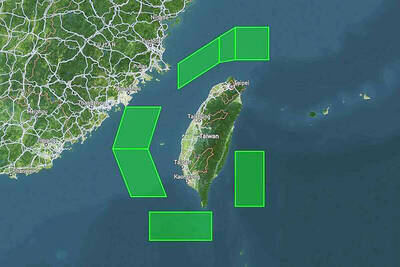
The disruption of 941 flights in and out of Taiwan due to China’s large-scale military exercises was no accident, but rather the result of a “quasi-blockade” used to simulate creating the air and sea routes needed for an amphibious landing, a military expert said. The disruptions occurred on Tuesday and lasted about 10 hours as China conducted live-fire drills in the Taiwan Strait. The Civil Aviation Administration (CAA) said the exercises affected 857 international flights and 84 domestic flights, affecting more than 100,000 travelers. Su Tzu-yun (蘇紫雲), a research fellow at the government-sponsored Institute for National Defense and Security Research, said the air
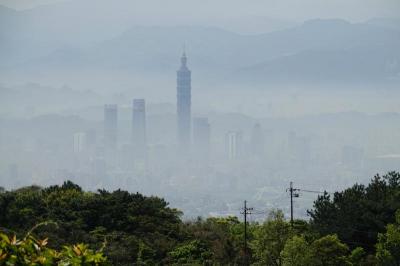
A strong continental cold air mass is to bring pollutants to Taiwan from tomorrow, the Ministry of Environment said today, as it issued an “orange” air quality alert for most of the country. All of Taiwan except for Hualien and Taitung counties is to be under an “orange” air quality alert tomorrow, indicating air quality that is unhealthy for sensitive groups. In China, areas from Shandong to Shanghai have been enveloped in haze since Saturday, the ministry said in a news release. Yesterday, hourly concentrations of PM2.5 in these areas ranged from 65 to 160 micrograms per cubic meter (mg/m³), and pollutants were
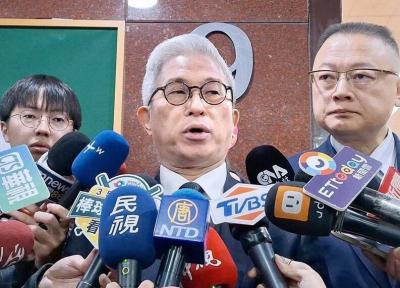
Taiwan’s armed forces have established response protocols for a wide range of sudden contingencies, including the “Wan Chun Plan” to protect the head of state, the Ministry of Defense (MND) said today. After US President Donald Trump on Saturday launched a series of airstrikes in Venezuela and kidnapped Venezuelan President Nicolas Maduro, concerns have been raised as to whether China would launch a similar “decapitation strike” on Taiwan. The armed forces regularly coordinate with relevant agencies and practice drills to ensure preparedness for a wide range of scenarios, Vice Minister of National Defense Hsu Szu-chien (徐斯儉) told reporters before a


 RSS
RSS