


Taipei Times: The renaissance of Taiwanese culture has become a major force in the search for a unique Taiwanese identity. As the secretary-general of the National Cultural Association and former chairperson of the Council for Cultural Affairs, can you tell us about the similarities and differences between the two organizations in promoting Taiwanese culture?
Tchen Yu-chiou (陳郁秀): The National Cultural Association is under the supervision of President Shui-bian (陳水扁), who is in a leading position in the country's cultural development. The association works mainly to direct cultural development by defining and refining cultural concepts and visions for the development of Taiwanese culture.
The Council for Cultural Affairs, on the other hand, is responsible for bringing cultural concepts and visions into being. It designs, promotes and carries out plans for cultural development.
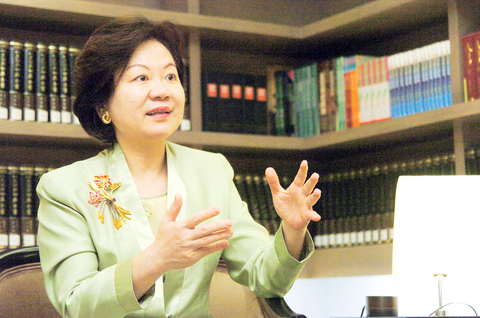
PHOTO: GEORGE TSORNG, TAIPEI TIMES
In its role to direct the nation's cultural development, the association has set up three major plans for Taiwan's cultural development, which are characterized under the themes, "Window on Taiwan," "Bringing Taiwanese Culture to the World" and "Building Taiwan's International Image."
"Window on Taiwan" is a national program designed to educate the public about the nuances of local culture when touring communities around the country, and to understand the significance of culture behind historical sites.
For example, when you go to a temple, you should pay attention to the building's structure. Look at the door god and the fish sculptures on the eaves, and understand the meaning of the 24 weather markers.
The program includes information from each county and city's historical sites or scenic spot, festival descriptions, geology, local cuisine and industry in local community encyclopedias.
Take Taipei County for example. We integrated all historical and cultural sites into 18 different groupings. Each grouping highlights a distinct type of culture, history, literature and architecture.
With this information, teachers can design lesson plans to introduce the beauty of their own towns to students. The tourism industry can use the information to design various tours. This is the job of the association -- to provide cultural concepts and useful information to people so that they can develop their own ideas and put their creative ideas into action.
People who join the "Window on Taiwan" program often said to us, "I've walked past the place over 100 times, but I didn't know that there were so many things to see." This is because they've never tried to understand and appreciate the cultural and historical background hidden behind a place.
In order to promote Taiwanese culture to the international community, we need to first understand and appreciate our own culture and the beauty of Taiwan. Therefore, we must encourage all Taiwanese people to engage in the nation's rich history.
Taiwan is a small island, but it has a rich history. Its geographical position and its ethnic and linguistic diversity make up the uniqueness of its history. For example, the 3,997m high Jade mountain is home to several animal species and subspecies endemic to subtropical, tropical and temperate climates. You will not find another place in the world with such a rich ecology in such a small area.
Taiwan is not only a condensed space with rich culture, history and ecology, but also changed itself within a very short period of time. This country was transformed from an agricultural society into a modern technological society very quickly compared with other countries. Its diverse culture, history and ecology, combined with its rapid industrialization, has turned Taiwan into a sparkling diamond of diversity.
The "diamond" that is Taiwan has various angles, and each has its own character and beauty. Yet not many people know much about Taiwan's diversity, so not many people appreciate the diamond. So we need to introduce the "Diamond Taiwan" to the international community through the development of cultural and creative industries.
To better promote Taiwanese culture to the world, we need to build the country's international image and let the international community get to know us. When I traveled abroad and told people that I was from Taiwan, some people said, "Where? Thailand?" I believe many Taiwanese have shared the same frustration, a frustration that people around the world do not know about our country. One of the major responsibilities of the association, therefore, is to build up Taiwan's international image.
TT: Can you talk more on the concept of "Diamond Taiwan?"
Tchen: As I said, Taiwan is a country with rich cultural, ecological, ethnic and linguistic diversity. This diversity developed in a condensed time and space and has made Taiwan into a sparkling diamond. Our task is to sell this diamond to the world -- to present the beauty of Taiwan to the international community.
I think one way to successfully promote the "Diamond Taiwan" idea is through the cultural and creative industries. I've always encouraged the younger generation to add a piece of Taiwan into their works of art. For example, two Taiwanese costume designers, who are in their 30s, came back to Taiwan from New York in search of new inspiration for their work. I took them to see traditional temples and other historical sites. The realization of Taiwanese culture inspired them to put the essence of Taiwan into their costume designs. They have since become the first Asians to create costume designs for the Miss France beauty pageant.
Another example of successfully bringing "Diamond Taiwan" to the world is the famous Kai Xi Oolong Tea brand. When the company was planning to expand into Europe, I advised them to add some cultural essences into the design of their products. So the Kai Xi Oolong Tea became "Lao Zi Says," referring to the famous Chinese philosopher.
The company also adopted the color I called "Taiwan Red" as the background decorations in their press conference at a big shopping mall in France. It was received with wild popularity in the country.
"Taiwan Red" is the color of traditional snacks, such as red turtle cakes, red eggs. It is the color used as wrapping paper to cover lanterns and incense. "Taiwan Red" is a festive color which represents the enthusiasm, hospitality and vitality of Taiwanese people. This is another example of how the association provided inspiration for people to draw upon when introducing Taiwan to the world.
People living in Taiwan are increasingly interested in the culture that surrounds them, and people all over the world are also curious about Taiwan. I am glad to see that more people are beginning to appreciate "Diamond Taiwan."
We will continue to promote more refined ideas to inspire people to look at the geographical environment, people and periods of time which make up the fundamental elements of Taiwanese culture.
TT: With the rise of so-called Taiwanese consciousness, the localization movement is beginning to grow. How do you promote localization to the younger generation, especially to young artists, many of whom were heavily influenced by Western culture?
Tchen: The localization movement in Taiwan should not be viewed in a narrow scope. It is true that we need to learn how to look inside the country and find out what it truly is. However, I tell our young people that localization does not equal regionalization. Localization does not mean to confine oneself to Taiwan and not to appreciate the culture and history in other countries. On the contrary, I think young people should go out and explore the world, while remembering their roots are in Taiwan.
The environment one grows up in plays an important role in a person's aesthetic perspective. For example, an artist who grew up in Pingtung County may think a farmer's dark skin and muscles are beautiful, whereas a New York designer may prefer skinny figures with fashionable costumes.
The uniqueness of the cultural, historical and environmental influences in each country is what distinguishes an artist in the world. So I think an artist must internalize the knowledge he or she acquired both in the local community and around the world, and then create something that possesses both modern and traditional characteristics.
The internalization of local and international culture, and the representation of the spirit extracted from internalization can help Taiwan show its uniqueness and promote its culture on the world stage. Therefore, it is important for the younger generations to ask themselves, "What is something I have that other people don't have?" That way they can find a uniqueness that will be competitive in the international community.
As I mentioned earlier, localization does not mean that Taiwanese should only look inward. I encourage young people to travel and explore the world. For example, you can go to France to experience its wine culture and how they enjoy their cuisine. Then you can compare their culinary culture to Taiwan's. There is no good or bad culture. Each culture has its uniqueness and we can learn from one another. This is why we hope to educate the younger generations about the core values in Taiwanese culture through the program "Walk on Taiwan."
TT: Earlier this month, a Taiwanese team at a cultural festival in Berlin was was confused by some as representing China and Chinese culture when they performed a dragon dance. How can we promote Taiwanese culture to the world stage and distinguish itself from Chinese culture?
Tchen: The association has been trying to build up Taiwan's international image. Currently we are working on promoting Taiwan's image in Europe. The two artists I mentioned earlier will hold their fashion show in Paris in October. Last year they used "Taiwan Red" as the theme of their costume designs. The theme for this year's show will be Taiwanese Aboriginal art. In addition, museums will display Taiwanese cultural and historical artifacts in the Czech Republic. We will seize every opportunity to encourage young artists to include Taiwan themes in their artwork and hold more national or international exhibitions to introduce Taiwan to the international community.
Based on the popularity of Kai Xi Oolong Tea and Taiwanese costume designers in Europe, we can see that European countries have embraced and appreciate Taiwanese culture. Sometimes it is our own people who don't appreciate the beauty of Taiwanese culture, and that's a shame. Therefore, I think it is very important to promote the concept of "Diamond Taiwan" and encourage Taiwanese people to know more about our own country through the "Window on Taiwan" program.
I think the confusion at the Berlin cultural exhibition shows that Taiwanese people still don't know how to highlight their unique culture on the world stage.
Chinese culture has had a great impact on Taiwan, but we can still find many differences between the two cultures. For example, the unique Mazu Pilgrim Tour is a part of Taiwan's traditional culture. Although Mazu was actually a girl called Lin Mu-niang (林默娘) from Meizhou Bay in China, in Taiwan, the young woman was transformed into a mother figure named Mazu and she became the goddess of the sea in traditional folklore. The Mazu Pilgrim Tour, therefore, became a uniquely Taiwanese cultural event.
Traditional folk arts, such as puppet shows and Taiwanese opera all distinguish Taiwan from other countries, including China. But you need to learn all the various shades of Taiwanese culture to know the differences, in order to share our uniqueness with the world.
While it is crucial for Taiwan to develop its own cultural identity and build a unique international image, I think it is unnecessary to deny the influence of China's culture on Taiwan. There is nothing wrong with Taiwanese culture having its roots in China. Japanese culture comes from China too, but the country took advantage of the influence to develop a very distinct culture of its own.
All the talk about erasing the influence of Chinese culture is nothing but a cynical political attack on our own culture. Should we keep the National Palace Museum because it preserves artifacts from China? Of course we should. Taiwan has no reason to give up the opportunity to develop its own unique culture by standing on a giant's shoulder.
TT: So you think the concept of "de-sinicization" should not be applied to the cultural sphere?
Tchen: The notion of "de-sinicization" may carry political significance, but is meaningless in the cultural sphere. Culture necessarily evolves by including new things. Addition enriches a culture, and multiplication makes it travel around the world. I think there is no subtraction in the cultural sphere. If you want to erase Chinese influence culturally, which part should be deleted? chopsticks or clothes?
Let's think about the rich culture developed in the Tang Dynasty. The secret to the success of the empire lies in its addition of all cultures from around the world. So the idea of "de-sinicization" should never be applied to culture. What's important now is finding out how to create a unique culture and identity.

FUKUOKA SITUATION: Japanese media reported that the pathogen is expected to be identified by the summer, while the CDC downplayed the idea that it was hMPV A “mysterious cold-like illness” reported in Japan’s Fukuoka Prefecture does not seem to be a new disease, but Japanese authorities have been asked about the situation, the Centers for Disease Control (CDC) said yesterday. The Fukuoka Prefectural Medical Association on Wednesday told a news conference that a “mystery cold” that has become a hot topic on social media is “highly likely to be caused by some kind of viral infection,” Japan’s KBC News reported. “Many people are experiencing symptoms starting with a sore throat, followed by a runny nose, phlegm and a severe cough,” KBC News reported, citing association officials. Health authorities are

Nvidia Corp CEO Jensen Huang (黃仁勳) arrived in Taiwan yesterday ahead of upcoming AI and technology events, saying he plans to meet with clients and Taiwan Semiconductor Manufacturing Co Chairman C.C. Wei (魏哲家) during his visit. After landing at Taipei Songshan Airport, Huang posed for photos with fans and handed out Yakult drinks to reporters and supporters waiting at the scene, saying he has “a lot to do” during the trip. Asked about reports that Nvidia’s planned headquarters site in Taipei’s Beitou Shilin Technology Park could break ground on May 27, Huang said that if the company holds an event, he would

The Ministry of Finance this afternoon announced the winning numbers for the March-April uniform invoice lottery. The winning number for the NT$10 million (US$318,060) special prize is 19531471, and the winning number for the NT$2 million grand prize is 85941329. Three numbers were drawn for the NT$200,000 first prize: 07225810, 20231230 and 83518781. Those with receipts matching the last seven digits of any of the first-prize numbers will win the NT$40,000 second prize, while those matching the last six digits will win the NT$10,000 third prize. Those whose receipts match the last five digits of the first-prize numbers can claim the NT$4,000 fourth prize,
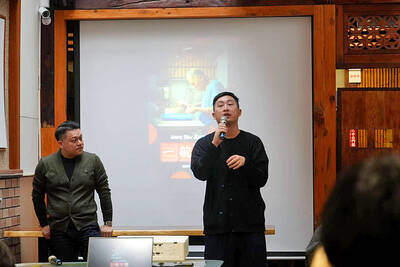
Taiwan Travelogue (臺灣漫遊錄), which earlier this week became the first Taiwanese novel to win the International Booker Prize, is to be adapted into a television series through a Taiwan-Japan coproduction, producer Chang Chen-yu (張辰漁) said yesterday. Chang, a producer at World Softest Production Film Co, wrote on Facebook that the company had been searching for projects with international appeal that retain a strong Taiwanese identity after colleagues and Japanese partners strongly recommended the novel. After reading the book, Chang said he immediately decided to pursue the screen rights. “A great story has the power to transcend time and borders, and connect countless people,”


 RSS
RSS