


After several years of research, the opportunistic and unusual feeding behavior of a shallow-water crab that lives off Kueishan Island has been explained by scientists from Taiwan and Singapore, Academia Sinica said yesterday. The findings were published in the world-class science journal Nature on Thursday.
The scientists discovered that crabs of diverse sizes feed on vast numbers of zooplankton that are killed by toxic sulphurous plumes emitted from underwater vents.
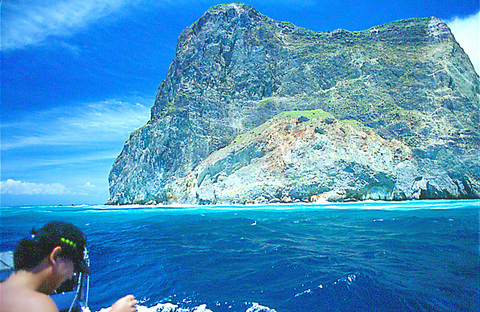
PHOTO: INSTITUTE OF ZOOLOGY OF ACADEMIA SINICA.
"Food for the crabs rains down like marine snow," Jeng Ming-shiou (鄭明修), a zoologist from Academia Sinica's Institute of Zoology and author of the report, said yesterday at a press conference.
Since 1999, Jeng has observed the behavior of the hydrothermal vent crab, Xenograpsus testudinatus, off the island located some 10km east of Toucheng Township, Ilan County. It's also known as Turtle Island due to its shape, which is said to resemble a turtle emerging from the surface of the sea.
According to Jeng, little was previously known about the ecology of hydrothermal vent crabs. A similar crab species has been observed feeding on the ocean floor using its pincers but its exact diet remains unknown. Most researchers have focused on deep sea crabs and rarely focus on crabs living in water less than 200m deep.
The Kueishan Island is part of the Okinawa arc. Showing the press an underwater videotape, Jeng said that in periods of calm water, they observed thousands of crabs swarm out in a feeding frenzy on the sea floor over an area of a few square meters.
Jeng said in the unusual system, the vent discharges are sulphur-rich and highly acidic, with pH levels between 1.75 and 4.60. Temperatures at nine vents were measured at between 65?C to 116?C.
However, it is estimated the population density of the crab exceeds 364 per square meters in waters ranging from 3m to 30m deep.
The unusually massive, dense crab population was what first motivated the research.
"We were very curious about how the ecosystem can support such a substantial crab population," Jeng said. "What are the crabs feeding on?"
Jeng explained motives of the research that he carried out jointly with other scientists from the University of Singapore.
Having spent five years observing the crabs underwater, and dissection of such crab specimens revealed that their guts were full of zooplankton.
Jeng and his teammates finally concluded that millions of crabs were feeding on zooplankton.
"The swarming behavior is seen only during periods of calm water, when the mass of descending zooplankton has the appearance of falling snow," Jeng said.
In his article, Jeng writes that the crabs time their foraging to coincide with these marine "snowfalls" in order to maximize their efficiency in harvesting the plankton.
To confirm the findings, Jeng now plans to look into zooplankton's tolerance of toxicity.
The species is the only dominant creature there. Shao Kwang-tsao (邵廣昭), a zoologist at Academia Sinica's Research Center for Biodiversity, said that the uniqueness of the simple food chain in this ecological system deserved further study.
Scientists presume that crabs take food twice a day due to the difficulty in oberving the species' behavior at night, the assumption need to be further confirmed.
Shao agrees that the adoption of high-tech instruments and communication technologies could be a possible way to enhance scientists' observation of unusual ecological systems such that around the shallow water vents at Kueishan Island.

Trips for more than 100,000 international and domestic air travelers could be disrupted as China launches a military exercise around Taiwan today, Taiwan’s Civil Aviation Administration (CAA) said yesterday. The exercise could affect nearly 900 flights scheduled to enter the Taipei Flight Information Region (FIR) during the exercise window, it added. A notice issued by the Chinese Civil Aviation Administration showed there would be seven temporary zones around the Taiwan Strait which would be used for live-fire exercises, lasting from 8am to 6pm today. All aircraft are prohibited from entering during exercise, it says. Taipei FIR has 14 international air routes and
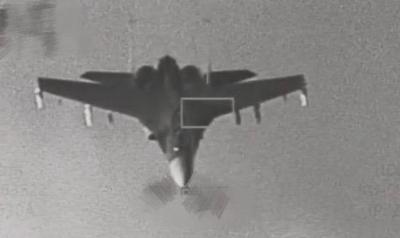
The Ministry of National Defense (MND) today released images of the military tracking China’s People's Liberation Army (PLA) movements during the latest round of Chinese drills around Taiwan. The PLA began "Justice Mission 2025" drills today, carrying out live-fire drills, simulated strikes on land and maritime targets, and exercises to blockade the nation's main ports. The exercises are to continue tomorrow, with the PLA announcing sea and air space restrictions for five zones around Taiwan for 10 hours starting from 8:30am. The ministry today released images showing a Chinese J-16 fighter jet tracked by a F-16V Block 20 jet and the

Snow fell on Yushan (Jade Mountain, 玉山) yesterday morning as a continental cold air mass sent temperatures below freezing on Taiwan’s tallest peak, the Central Weather Administration (CWA) said. Snowflakes were seen on Yushan’s north peak from 6:28am to 6:38am, but they did not fully cover the ground and no accumulation was recorded, the CWA said. As of 7:42am, the lowest temperature recorded across Taiwan was minus-5.5°C at Yushan’s Fengkou observatory and minus-4.7°C at the Yushan observatory, CWA data showed. On Hehuanshan (合歡山) in Nantou County, a low of 1.3°C was recorded at 6:39pm, when ice pellets fell at Songsyue Lodge (松雪樓), a

City buses in Taipei and New Taipei City, as well as the Taipei MRT, would on Saturday begin accepting QR code payments from five electronic payment providers, the Taipei Department of Transportation said yesterday. The new option would allow passengers to use the “transportation QR code” feature from EasyWallet, iPass Money, iCash Pay, Jkopay or PXPay Plus. Passengers should open their preferred electronic payment app, select the “transportation code” — not the regular payment code — unlock it, and scan the code at ticket readers or gates, General Planning Division Director-General Liu Kuo-chu (劉國著) said. People should move through the


 RSS
RSS