


President Chen Shui-bian (
Chen made the vow during a campaign rally held in Kaohsiung City last night.
During the rally, Chen once again said that it was imperative that the pan-greens are successful in the legislative elections, adding that the pan-blues have exploited their majority in the legislature while attempting to paralyze the government over the past three years.
Chen said, when he took over the office of Taipei Mayor in 1998, he told Taipei's citizens that he would improve Taipei's notorious traffic situation within two years. After his determined efforts, the traffic situation was improved.
"I believed that if people of Taiwan could give us a chance and support the pan-green camp to win a majority in the legislature -- only give us two years and I promise that I will do a good job as a president and lead the country to become a great, normal and complete country," Chen said. "Otherwise, I am willing to step down as president."
Chen added that Kaohsiung City Government, which is supported by a pan-green controlled City Council, provides an example of a government that can really do something good for citizens.
Chen also promised that if the pan-greens win a majority in the legislature, the government will pass a National Pension Law (
Legislation governing the Resolution Trust Cooperation (
The Democratic Progressive Party (DPP) yesterday held a campaign rally in northern Kaohsiung City to boost its legislative candidates Kuan Pi-ling (
Noticeably, the five candidates did not boast about themselves. Instead, they showered praise on their fellow candidates, showing that the united pan-green campaign strategy and vote allocation plan is working.
Kaohsiung Mayor Frank Hsieh (
Meanwhile, early in the day before attending the rally in Kaohsiung City, President Chen Shui-bian (
There he called on people of different ethnic groups to get along with each other and stressed that only if Taiwan's people unite can the country face threats from outside.
"It is undeniable that Taiwan has different ethnic groups. But everyone has to know we only have one country," Chen said. "I believe that Taiwan has no ethnic problem, but only a problem of national identification."
In his speech, Chen redefined the "five ethnic groups" proposed by Sun Yat-sen (孫中山), pointing out that the five ethnic groups who reside in Taiwan are Hoklo, Hakka, Aborigine, Mainlanders and foreigners -- including brides from Southeast Asian countries and China.
"It is unnecessary for a small number of ethnic groups to bear historical burdens," Chen said. "Under the principle of the DPP's Resolution on Ethnic Diversity and National Unity, there was no oppressor and victim. Everyone is equal and everyone is the owner of the land."
Chen once again stressed that "Taiwan is the Republic of China, the Republic of China is Taiwan," asking people not to hold on to fantasies about the country's territory and to acknowledge the nation's reality.

UPGRADE: The Kang Ding-class frigate is replacing its Chaparall missiles with Tien Chien II and Hua Yang VLS, which would provide it with long-range, 360° air defense Taiwan plans to produce 1,200 to 1,376 Hai Chien II missiles (海劍二, Sea Sword II) — also known as TC-2N — to serve as the standard air defense system of the navy’s surface combatant fleet, a source said yesterday. Last week, the Hai Chien II, the naval version of the Tien Kung II missile (天劍二, Sky Sword II), completed a live-fire test in waters off the National Chungshan Institute of Science and Technology’s Jiupeng facility (九鵬) in Pingtung County’s Manjhou Township (滿州). The MIM72 Chaparral and other dated air defense missiles that currently arm Taiwanese ships have inadequate range to combat Chinese

REASONS FOR TRAVEL: An assistant professor said that proposed amendments to penalize drivers if they used drugs overseas would not deter people from traveling People who operate a motor vehicle under the influence of marijuana would have their driver’s license revoked, even if they used the substance while overseas, the Ministry of Transportation and Communications said yesterday, citing proposed amendments to the Road Traffic Management and Penalty Act (道路交通管理處罰條例). The amendments would also authorize the government to revoke the licenses of people determined to have used Category 1 or Category 2 narcotics, even if they were not operating a vehicle while under the influence of drugs, as well as ban them from taking the license test for three years, the ministry said. People aged 18 or

HEAVY WEATHER: Typhoon Jangmi is due to crash straight into the Ryukyus as airlines look to shift flights to larger aircraft or cancel flights to Okinawa entirely Taiwan’s international air carriers announced flight adjustments over the weekend as Typhoon Jangmi is forecast to hit the Ryukyu Islands today and tomorrow. The Central Weather Administration (CWA) upgraded Jangmi from a tropical storm to a typhoon at 8am yesterday, with the eye located 580km south of Naha city. It was moving north at 19kph. Today, China Airlines’ CI-120, CI-121, CI-122 and CI-123 flights between Taoyuan and Naha, Okinawa, have been canceled as well as CI-132 and CI-133 between Kaohsiung and Naha. EVA Air’s BR-112, BR-113, BR-186 and BR-185 flights between Taoyuan and Naha are also canceled. Low-cost carrier Tigerair Taiwan canceled IT-230,
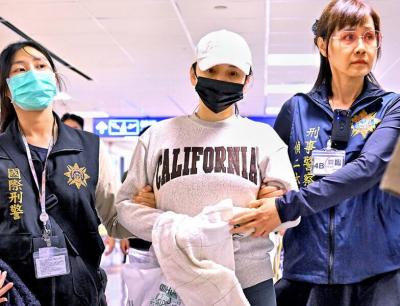
Johanne Liou (劉喬安), a Taiwanese woman who shot to unwanted fame during the Sunflower movement protests in 2014, returned to Taiwan last night after being deported from the US. She is to stand trial in Taiwan for charges involving embezzlement, fraud and drug crimes. The Criminal Investigation Bureau (CIB) said it took her into custody at Taiwan Taoyuan International Airport and would first question her before transferring her to the New Taipei District Prosecutors’ Office. She was arrested upon disembarking a flight from San Francisco that landed shortly before 7pm. Liou absconded to the US in 2019 after jumping bail


 RSS
RSS