


In anticipation of the delivery of the first bullet trains from their Japan-ese manufacturer at the end of the month, high-speed railway authorities yesterday reiterated that construction was on schedule and that the service would be inaugurated by October of next year, as promised.
"Since we signed a contract with the government in July 1998, we've had to overcome many difficulties, but I trust that we will continue doing just that," said Nita Ing (殷琪), chairwoman of the Taiwan High Speed Railway Corp (THSRC).
According to THSRC officials, the first batch of bullet trains, 700T models manufactured by Japanese Kawasaki Heavy Industries, will be shipped from the factory in Kobe on May 18. The train cars are scheduled to arrive at Kaohsiung harbor on May 25, and to be transported to THSRC's main workshop in Kaohsiung to be assembled on May 29.
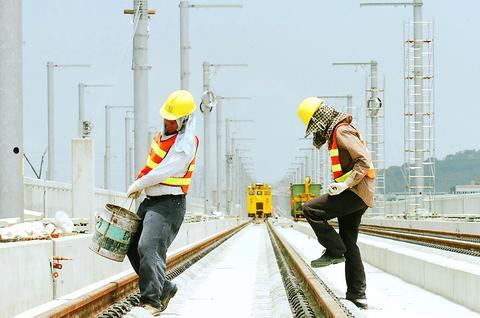
PHOTO: CHIEN JUNG-FENG, TAIPEI TIMES
Testing of the 12 cars will begin in September on tracks between the Tainan and Kaohsiung stations, a distance of roughly 60km.
However, the THSRC's fundraising woes have often raised questions as to whether the bullet-train service would be delayed. Ing said yesterday that in terms of funding, THSRC's five major shareholders still needed to put up another NT$14.5 billion before completion of the project. However, of the NT$7.5 needed before July, only NT$2.1 billion has been raised.
THSRC spokesman Edward Lin (林天送) said that the company had incurred additional costs unaccounted for in the original contract. He said the total cost of construction amounted to NT$464.8 billion for THSRC's account. Of that amount, NT$323.3 billion will be covered through bank loans and another NT$133.2 billion as free capital from stock sales. The remaining NT$9.3 billion, however, are additional costs that must be covered through selling shares.
Ing said that the company planned to hold a roadshow abroad at the beginning of next year in a bid to attract overseas investors.
In addition the company must also deal with an International Chamber of Commerce ruling last month which ordered it to pay US$73 million in compensation to a European business group.
However, the THSRC's plans go beyond the construction of trains and stations -- developing the areas around the stations is another component of a 50-year contract signed with the government.
"We are planning a total of five new towns, working with an area of about 1,500 hectares," said Charles Hseuh (
The land surrounding key stations, including Tainan, Hsinchu and Taoyuan, are to be transformed into new "town centers." The new towns will be geared towards increasing development in the area and will feature luxury hotels, shopping malls, Club Taiwan and even science parks.
The Hsinchu station will be the first to begin development of town centers, starting the bidding process for land use at the end of this year.
"It will take about 10 to 15 years for the development of these towns, and another 20 to 30 years for them to reach maturity," Hseuh said.
The bullet-train system runs north-south for 345km between Taipei and Kaohsiung. Running at a speed of up to 300kph, the trains will reduce travel time between the two cities to just 80 minutes.

NATIONAL SECURITY: Authorities are working to confirm the identities of the military personnel involved and investigating possible illegal conduct and regulatory violations Authorities are probing possible national security implications after Kinmen police and immigration officers on Sunday found a Chinese woman allegedly posing as a tourist while engaging in prostitution involving more than 10 military personnel. The woman, surnamed Chen (陳), has since been deported, authorities said, adding that investigators are still working to confirm the identities of those implicated, as the records only listed code names and aliases. The case stemmed from a report received by the Kinmen District Prosecutors’ Office on Friday last week from the Jinhu Precinct of the Kinmen County Police Bureau. On Sunday, police, along with the National Immigration

GLOBALGIVING: ‘ Caving to external pressure is not acceptable for an organization that has cultivated justice reform and human rights for 30 years,’ one NGO said A slew of non-government organizations (NGOs) have withdrawn from the GlobalGiving fundraising platform after it announced it would use “Chinese Taipei” instead of “Taiwan” from next month. The Taiwan Good Rice Association wrote on Facebook on Friday that it was informed on April 28 via a teleconference call of the change, which was made because the platform wanted to operate in China. Taiwan Good Rice is to terminate all cooperative relationships with GlobalGiving in response to the platform’s “unilateral and non-negotiable” decision to remove references to Taiwan, the NGO said. “Taiwan is in the official name of Taiwan Good Rice Association and the

HEAVY WEATHER: Typhoon Jangmi is due to crash straight into the Ryukyus as airlines look to shift flights to larger aircraft or cancel flights to Okinawa entirely Taiwan’s international air carriers announced flight adjustments over the weekend as Typhoon Jangmi is forecast to hit the Ryukyu Islands today and tomorrow. The Central Weather Administration (CWA) upgraded Jangmi from a tropical storm to a typhoon at 8am yesterday, with the eye located 580km south of Naha city. It was moving north at 19kph. Today, China Airlines’ CI-120, CI-121, CI-122 and CI-123 flights between Taoyuan and Naha, Okinawa, have been canceled as well as CI-132 and CI-133 between Kaohsiung and Naha. EVA Air’s BR-112, BR-113, BR-186 and BR-185 flights between Taoyuan and Naha are also canceled. Low-cost carrier Tigerair Taiwan canceled IT-230,
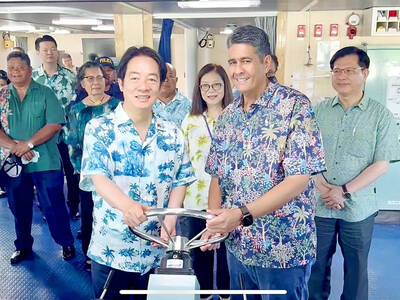
MULTIPRONGED APPROACH: China has sought to pressure Palau across a number of fronts, but the island nation has staunchly resisted overtures to ditch Taiwan Palau has been firm in backing Taiwan despite Chinese pressure that uses tourism economics, cyberattacks and criminal infiltration as tools to threaten the Pacific ally into renouncing its recognition of Taiwan as a sovereign state. The Presidential Office yesterday announced that Vice President Hsiao Bi-khim (蕭美琴) would visit Palau from Saturday to Wednesday next week at the invitation of Palauan President Surangel Whipps Jr. Whipps in April said in an interview that China had outspokenly asked Palau to “denounce Taiwan.” “And we have said: ‘We have no enemies, but nobody tells us who our friends are,’” he said. Whipps has told reporters multiple times


 RSS
RSS