


Calling Taiwan the Republic of Confusion rather than the Republic of China (ROC), the Presbyterian Church in Taiwan yesterday set forth its pro-independence position on the upcoming presidential elections but came just shy of actually specifying its support for Chen Shui-bian (陳水扁).
"We advocate principles and ideals," said church General Secretary Reverend William J.K. Lo (羅榮光). "People can think for themselves and decide which presidential candidate they believe draws closest to the principles we uphold."
The church yesterday issued a statement in support of a presidential candidate who upholds the "one country on each side" of the Taiwan Strait principle, advocates approving a new constitution via a referendum and demonstrates integrity.
"No candidate is perfect, but the national leader is a symbol for the country. A leader should not use public funds for personal benefit or condone domestic violence," said Lo, referring to People First Party Chairman James Soong's (宋楚瑜) involvement in the Chung Hsing Bills Finance scandal and allegations that Chinese Nationalist Party (KMT) Chairman Lien Chan (連戰) physically abuses his wife.
In addition, Lo also said that Taiwan's future should be decided by Taiwanese citizens via a referendum.
"There shouldn't be any external influences. Both the US and China have to respect Taiwan's autonomy. Launching missiles at Taiwan to influence election results stands in the way of world peace. Conducting a referendum is the most peaceful tactic," Lo said.
"Taiwan's national status is up in the air right now -- it's floating in the `blue' sky. Taiwan needs to come down to earth -- the `green' earth," said Lo, explaining that the pan-blue camp's interpretations of Taiwan's national status led only to confusion.
"It's important to note that the [church's ] statement uses the term `Taiwan's president.' The president of Taiwan has no right to oppose Taiwan's independence -- that would be like Bush opposing US independence or Chinese President Hu Jintao (
The church also called for the promotion of Aboriginal self-rule and rights for minority groups in the rewritten constitution. The church statement pointed to the need for economic justice, calling for the sharing of resources and narrowing of the income gap.
The 230,000-strong Presbyterian Church in Taiwan has traditionally been deeply involved in national politics, particularly with the Taiwan independence movement, but yesterday clarified that it would not be establishing a campaign support group for Chen.
"The upcoming elections are crucial in determining Taiwan's sovereignty. People are torn between the two presidential nominees. As Christians, it's not enough to just worship and sing hymns. The church needs to express concern for society, the economy, politics and culture," said Lin Chung-cheng (林宗正), deputy general secretary of the church.
Lo also remarked that historically the church and state have engaged each other in dialogue and interaction, calling an absolute separation of religion and politics a myth.
"What value is there in a church that does not engage the world but focuses only on the church itself?" Lo asked.
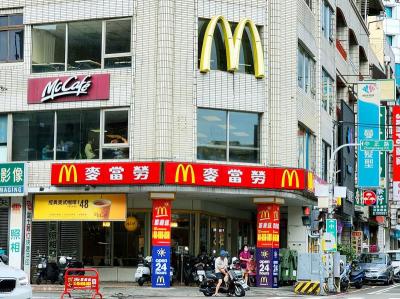
Fast food chain McDonald's is to raise prices by up to NT$5 on some products at its restaurants across Taiwan, starting on Wednesday next week, the company announced today. The prices of all extra value meals and sharing boxes are to increase by NT$5, while breakfast combos and creamy corn soup would go up by NT$3, the company said in a statement. The price of the main items of those meals, if ordered individually, would remain the same. Meanwhile, the price of a medium-sized lemon iced tea and hot cappuccino would rise by NT$3, extra dipping sauces for chicken nuggets would go up

Nvidia Corp CEO Jensen Huang (黃仁勳) arrived in Taiwan yesterday ahead of upcoming AI and technology events, saying he plans to meet with clients and Taiwan Semiconductor Manufacturing Co Chairman C.C. Wei (魏哲家) during his visit. After landing at Taipei Songshan Airport, Huang posed for photos with fans and handed out Yakult drinks to reporters and supporters waiting at the scene, saying he has “a lot to do” during the trip. Asked about reports that Nvidia’s planned headquarters site in Taipei’s Beitou Shilin Technology Park could break ground on May 27, Huang said that if the company holds an event, he would

Carrefour Taiwan is to begin using a new name from the start of July, but it cannot divulge the name until then, the chairman of the supermarket chain's parent company said today. President Chain Store Co chairman Lo Chih-hsien (羅智先) was asked by reporters after a shareholders' meeting to confirm whether the company has settled on a new name for the supermarket brand. In March, the government-registered name of two Carrefour Taiwan branches was quietly changed to "Le Chia Kang" (樂家康) in Chinese, raising speculation that has been selected as the name. Lo said that because of local regulations and contractual obligations, the

FUKUOKA SITUATION: Japanese media reported that the pathogen is expected to be identified by the summer, while the CDC downplayed the idea that it was hMPV A “mysterious cold-like illness” reported in Japan’s Fukuoka Prefecture does not seem to be a new disease, but Japanese authorities have been asked about the situation, the Centers for Disease Control (CDC) said yesterday. The Fukuoka Prefectural Medical Association on Wednesday told a news conference that a “mystery cold” that has become a hot topic on social media is “highly likely to be caused by some kind of viral infection,” Japan’s KBC News reported. “Many people are experiencing symptoms starting with a sore throat, followed by a runny nose, phlegm and a severe cough,” KBC News reported, citing association officials. Health authorities are


 RSS
RSS