


Newly appointed Cabinet spokesman Lin Chia-lung (
Describing Lin as a "handsome and photogenic" young man, Premier Yu Shyi-kun said that Lin is qualified for the job because of his impressive educational and political background.
Lin, 38, holds a doctorate in politics from Yale University. He also obtained masters degrees in politics and philosophy from Yale.
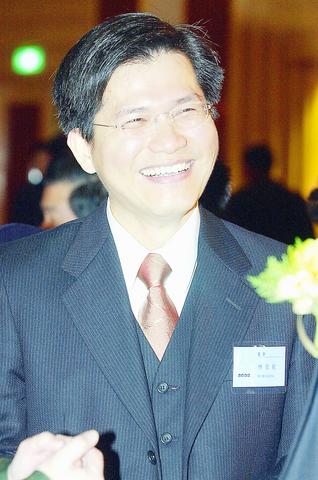
TAIPEI TIMES FILE PHOTO
He has been teaching politics at National Chung Cheng University since he returned to Taiwan from the US in 1998. He was appointed senior adviser to the National Security Council in May 2000 when the DPP came into to power.
Director-General of the Government Information Office Arthur Iap (葉國興), who was assigned by the premier to screen potential candidates for the position, praised Lin as someone who is composed and possesses great interpersonal skills.
"He's one of the few candidates who met the four criteria set down by the premier," he said.
The four criteria are: impressive educational background, extensive experience in the civil sector, familiarity with the media and a calm demeanor.
In addition to his good looks and impressive educational background, Lin is known for his negotiating skills and eloquence.
As a leader of the student movement during his university years, Lin was under surveillance and banned from taking leave during his two-year compulsory military service between 1988 and 1990.
He was able to persuade his supervisor to let him take a few days off to participate in a student demonstration taking place at the Chiang Kai-shek Memorial Hall in 1989.
He also played a significant role in persuading Academia Sinica President Lee Yuan-tseh (
As a Nobel laureate in science, Lee was capable of tipping the scales in the presidential election. Although Lee eventually turned down Chen's offer to assume the post of premier, Lee did help garner support from undecided voters.
DPP Legislator Lee Wen-chung (
"A perfect example is the establishment of the Taiwan Thinktank," Lee said. "I remember when he was at school, he was a member of the school's China Study Association. In addition to keeping close contact with association members while he was in school, he got them together after graduation and after they had returned to Taiwan. That's how the Taiwan Thinktank came about."
Established in December 2001, the Taiwan Thinktank is regarded as an influential resource for Chen's administration. Lin also chairs the think tank's Asia Pacific Forum, which holds irregular closed-door meetings to solicit opinions from academics and politicians.
Lee went to the same university as Lin and chaired the China Study Association. He was expelled by the school three times because of his pro-independence views. He was eventually kicked out in 1986 when Lin began his studies at the same school.
Chung Cha-pin (
"He's a smart, low-key and careful person who doesn't easily make his stance known until the very last minute," he said.
Chung went to the same university and joined the same school association with Lin when Lin was the association chair. Chung was also Lin's assistant when Lin was senior adviser to the National Security Council.
According to Chung, Lin knew exactly what he wanted to do when he was a university student -- that is, go to graduate school and become an academic.
His dream came true when he was admitted to the graduate school of National Taiwan University in 1986 to pursue studies in political science. He went on to pursue another master's degree in philosophy at Yale University in 1992 and in political science at Yale in 1993.
He returned to Taiwan in 1998 after obtaining his doctorate in political science from Yale.
According to Chung, Lin's sophistication and extensive political connections have a lot to do with his becoming chairman of the school's China Study Association and a student of Hu Fu (
"In the 1980s, the association was considered a pro-unification group because it received funding from the KMT and association members could get access to the ruling party's high-ranking officials and sensitive government information," Chung said.
As the chairman of the highly political association, Chung said, Lin was walking a fine line between keeping the party funding coming in and embracing left-wing thinking.
"He had to be very careful and skillful in terms of mingling with the school and pro-independence student groups," Chung said.
Despite the potential headaches, school authorities were fond of Lin because he was a brilliant young man and did well at school.
"The association is a rebellious group," Chung said.
Thanks to Hu's extensive academic and political connections, Lin got to know many outstanding academics including Mainland Affairs Council Vice Chairman Chen Ming-tong (

FUKUOKA SITUATION: Japanese media reported that the pathogen is expected to be identified by the summer, while the CDC downplayed the idea that it was hMPV A “mysterious cold-like illness” reported in Japan’s Fukuoka Prefecture does not seem to be a new disease, but Japanese authorities have been asked about the situation, the Centers for Disease Control (CDC) said yesterday. The Fukuoka Prefectural Medical Association on Wednesday told a news conference that a “mystery cold” that has become a hot topic on social media is “highly likely to be caused by some kind of viral infection,” Japan’s KBC News reported. “Many people are experiencing symptoms starting with a sore throat, followed by a runny nose, phlegm and a severe cough,” KBC News reported, citing association officials. Health authorities are

Nvidia Corp CEO Jensen Huang (黃仁勳) arrived in Taiwan yesterday ahead of upcoming AI and technology events, saying he plans to meet with clients and Taiwan Semiconductor Manufacturing Co Chairman C.C. Wei (魏哲家) during his visit. After landing at Taipei Songshan Airport, Huang posed for photos with fans and handed out Yakult drinks to reporters and supporters waiting at the scene, saying he has “a lot to do” during the trip. Asked about reports that Nvidia’s planned headquarters site in Taipei’s Beitou Shilin Technology Park could break ground on May 27, Huang said that if the company holds an event, he would

The Ministry of Finance this afternoon announced the winning numbers for the March-April uniform invoice lottery. The winning number for the NT$10 million (US$318,060) special prize is 19531471, and the winning number for the NT$2 million grand prize is 85941329. Three numbers were drawn for the NT$200,000 first prize: 07225810, 20231230 and 83518781. Those with receipts matching the last seven digits of any of the first-prize numbers will win the NT$40,000 second prize, while those matching the last six digits will win the NT$10,000 third prize. Those whose receipts match the last five digits of the first-prize numbers can claim the NT$4,000 fourth prize,
Taiwan Travelogue (臺灣漫遊錄), which earlier this week became the first Taiwanese novel to win the International Booker Prize, is to be adapted into a television series through a Taiwan-Japan coproduction, producer Chang Chen-yu (張辰漁) said yesterday. Chang, a producer at World Softest Production Film Co, wrote on Facebook that the company had been searching for projects with international appeal that retain a strong Taiwanese identity after colleagues and Japanese partners strongly recommended the novel. After reading the book, Chang said he immediately decided to pursue the screen rights. “A great story has the power to transcend time and borders, and connect countless people,”


 RSS
RSS