


An international consortium of researchers from 10 countries, including Taiwan, have decoded the rice genome, paving the way for the production of strains resistant to insects and diseases, scientists announced yesterday in Tokyo and Taipei.
The International Rice Genome Sequencing Project (IRGSP), established by Japan in 1998, involved public laboratories in Japan, Taiwan, the US, China, France, India, South Korea, Brazil, Thailand and Britain.
The consortium decoded a total of about 430 million bases of the rice genome.
At a press conference hosted by Academia Sinica President Lee Yuan-tseh (李遠哲) yesterday, Taiwanese scientists reported their achievement on completing the sequencing of chromosome number 5, one of the 12 rice chromosomes.
"The international scientific circles were very surprised by our impressive performance because Taiwan is such a small country," said Shaw Jei-Fu (
Shaw said rice had been chosen as the first crop for the genome-sequencing project because it is an important crop, the size of the rice genome is the smallest among crops and because rice shares a co-linear gene organization with other cereal grasses.
Shaw said the 10-year project had been finished ahead of time due to the extraordinary efforts of teammates.
Taiwan was one of five countries that deciphered more than one chromosome.
Taiwan's share in the decoding process was 8 percent. Japan had the lion's share of 50 percent while the US had 22 percent, China 10 percent and France 7 percent.
Shaw said the information in the genome research is revolutionary because results make it possible for rice to grow in new environments, helping food production keep pace with the planet's growing population and declining arable land area.
It has been estimated that half the world's population subsists wholly or partially on rice. Ninety percent of the world rice crop is grown and consumed in Asia.
Shaw said other advantages of controlling the growth of rice include the improvement of disease resistance in rice. He said rice could also become a healthier food if scientists use genetic engineering to change functions of genes.
"For example, people might become immune to Enterovirus-related diseases by eating rice, if we modify rice's genes," Shaw said.
Shaw said it might be possible for people to reduce weight and whiten skin by eating genetically-altered rice in the future.
Scientists would further identify functions of genes in order to improve breeds of rice and results would be protected by patents, Shaw said.
Japan launched the rice genome research program in 1991 and set up the international project in 1998. Tokyo contributed some ?40 billion (US$325 million) over 12 years, with ?16 billion coming from the state treasury.
Japan's National Institute of Agrobiological Sciences (NIAS) led the consortium and played a major role in the project, sequencing nearly 60 percent of the genome of japonica rice
The IRGSP is the first to release the complete results of precise deciphering of the rice genome.
The IRGSP's announcement came eight months after a Swiss company and Chinese scientists published a draft sequence of the rice genome.
In April, a team of researchers at the Beijing Genomics Institute in China and the University of Washington in Seattle cooperated with a team at Swiss agrochemical company Syngenta AG to release the two draft sequences.
Japanese officials said the achievement by the company had spurred discussions over whether the international consortium should continue the genome project.
But eventually they decided to keep going, as they were confident that their data was more accurate than the draft sequencing of the rice genome declared by other groups.
The IRGSP has combined results from earlier studies from US firm Monsanto, which completed a draft of the genome in 2000, and Syngenta, which provided its data free of charge to the IRGSP in May.
The IRGSP team said it had set aside for future analysis 8 percent of some 400 million base pairs of the genome found in their specimen, a japonica variety called "Nippon Bare," as these require more sophisticated techniques.

FUKUOKA SITUATION: Japanese media reported that the pathogen is expected to be identified by the summer, while the CDC downplayed the idea that it was hMPV A “mysterious cold-like illness” reported in Japan’s Fukuoka Prefecture does not seem to be a new disease, but Japanese authorities have been asked about the situation, the Centers for Disease Control (CDC) said yesterday. The Fukuoka Prefectural Medical Association on Wednesday told a news conference that a “mystery cold” that has become a hot topic on social media is “highly likely to be caused by some kind of viral infection,” Japan’s KBC News reported. “Many people are experiencing symptoms starting with a sore throat, followed by a runny nose, phlegm and a severe cough,” KBC News reported, citing association officials. Health authorities are

Nvidia Corp CEO Jensen Huang (黃仁勳) arrived in Taiwan yesterday ahead of upcoming AI and technology events, saying he plans to meet with clients and Taiwan Semiconductor Manufacturing Co Chairman C.C. Wei (魏哲家) during his visit. After landing at Taipei Songshan Airport, Huang posed for photos with fans and handed out Yakult drinks to reporters and supporters waiting at the scene, saying he has “a lot to do” during the trip. Asked about reports that Nvidia’s planned headquarters site in Taipei’s Beitou Shilin Technology Park could break ground on May 27, Huang said that if the company holds an event, he would

The Ministry of Finance this afternoon announced the winning numbers for the March-April uniform invoice lottery. The winning number for the NT$10 million (US$318,060) special prize is 19531471, and the winning number for the NT$2 million grand prize is 85941329. Three numbers were drawn for the NT$200,000 first prize: 07225810, 20231230 and 83518781. Those with receipts matching the last seven digits of any of the first-prize numbers will win the NT$40,000 second prize, while those matching the last six digits will win the NT$10,000 third prize. Those whose receipts match the last five digits of the first-prize numbers can claim the NT$4,000 fourth prize,
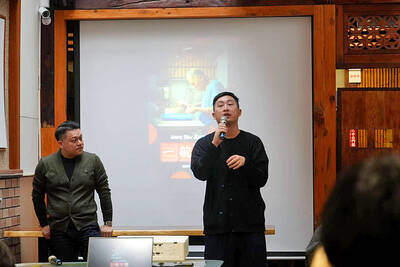
Taiwan Travelogue (臺灣漫遊錄), which earlier this week became the first Taiwanese novel to win the International Booker Prize, is to be adapted into a television series through a Taiwan-Japan coproduction, producer Chang Chen-yu (張辰漁) said yesterday. Chang, a producer at World Softest Production Film Co, wrote on Facebook that the company had been searching for projects with international appeal that retain a strong Taiwanese identity after colleagues and Japanese partners strongly recommended the novel. After reading the book, Chang said he immediately decided to pursue the screen rights. “A great story has the power to transcend time and borders, and connect countless people,”


 RSS
RSS