


Slightly more than two years after taking power, the DPP will embark on yet another bold reform today when President Chen Shui-bian (陳水扁) assumes the party's chairmanship.
Taking its cue from its European counterparts, the party has also appointed seven lawmakers to top executive posts to shore up communication between its headquarters and legislative caucus.
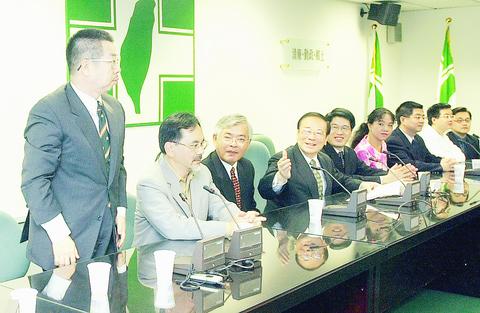
PHOTO: FANG PIN-CHAO, TAIPEI TIMES
Through this and other changes, the DPP hopes to restore its dynamism and gear up for the mayoral elections in Taipei and Kaohsiung in December and the presidential race in 2004.
Lawmakers Luo Wen-jia (羅文嘉), Lin Cho-shui (林濁水) and Hsiao Bi-khim (蕭美琴), who will head the party's departments of information, policy, and international affairs, respectively, are expected to play key roles.
Top gun returns
Dynamic, idealistic and articulate, Luo has always been ready to serve Chen.
Though a freshman lawmaker, he is no novice in playing the party's spokesman.
Luo, 36, held the same post between July 1999 and March 2000 and succeeded in helping Chen win the presidency.
He was director of the Information Department under Taipei City Government when Chen was mayor. Luo attributes his appointment to the party's wish to internalize in line with the legislature's rising importance in national politics.
"The party's main duty is to help the government make and execute policies," he said. "My department will strive to act as a nexus between the party, the government and the people so the latter may recognize the efforts the DPP has put in to promote their welfare."
Luo said he expected his job to be more challenging this time as the public will expect more of the party now that it is in power.
He did not deny that the series of reforms are related to the year-end mayoral race and the 2004 presidential elections.
"We must make preparations way ahead" to avoid being voted out in light of the sharp competition between the ruling and opposition camps, Luo said.
He is also a key member of the campaign team for Lee Ying-yuan (
The lawmaker said he had intended to focus on one thing at a time, but the party's lack of talent prodded him to accept his new appointment.
"It is time the party introduced new blood and allow younger people to shoulder greater responsibilities," he said, explaining why he hired a vice spokesman.
Luo jokingly added that when he agreed to take up the post, the president knew he would have to put up again with his meticulous style of doing business that borders on nitpicking.
Pro-independence theorist
Dubbed a pro-independence theorist, Lin Cho-shui has recently been named to lead the DPP's Policy, Research and Coordinating Committee.
Analysts have linked his appointment to Chen's wish to consolidate traditional DPP supporters.
The four-term lawmaker said he will seek to establish a platform of communication between the Cabinet and the legislature by strengthening the function of his committee.
To that end, Lin suggests providing the committee members with staffers so they may enhance their policy-making ability.
The committee is composed of 12 DPP conveners from the legislature's 12 standing committees. They are responsible for contacting their Cabinet liaisons.
"While in opposition, the DPP did a better job of setting the nation's political agenda," Lin said. "The committee will try to restore the dynamism without compromising political stability."
Under his stewardship, the committee will also help downsize the government, saying that as lawmakers, they do not have to worry about resistance within the Cabinet, he said.
The Cabinet has said it will cut the number of ministries and departments by one-third before 2004 in a bid to make the government smaller and more efficient.
Lin is also a prolific writer. He has written eight books chronicling his views on the country's political and economic policies.
A heavyweight of the party's New Tide faction, known for its staunch pro-independence stance, the lawmaker said he will try his best to help the party realize its long-cherished goals.
Brainy beauty
Time and again, Hsiao Bi-khim, the incoming director of the DPP International Affairs Department, has to beg the press to focus its attention on her professional performance rather than her appearance.
It will be the third time Hsiao, 31, is taking charge of the party's international affairs, a field to which she has devoted herself over the past decade.
"Before coming to power, the DPP sought to reverse the world opinion of the party being radical," she said. "Now the department will place more emphasis on joining international organizations."
Born to a Taiwanese father and American mother, Hsiao was born in Japan, grew up in southern Taiwan and studied in the US after completing junior high school here.
She first dabbled in international affairs during a trip to Taiwan in 1991. Though a college student, Hsiao wrote Annette Lu (
Later she worked as the party's US-based activity organizer.
With a bachelor's degree in East Asian studies, she was soon promoted to the head of the International Affairs Department when Hsu Hsin-liang (
After the transfer of power, the president made her an English assistant. Widely recognized as one of the most beautiful female politicians in Taiwan, Hsiao has been plagued by romantic scandals.
In November 2000, the Journalist magazine quoted Lu as saying she was involved in a romantic relationship with Chen. Though the rumor proved to be false, Hsiao left the Presidential Office and threw herself into the legislative elections last year.
"I wish the media could shift their attention away from my private life and focus on my professional performance," she said.

NATIONAL SECURITY: Authorities are working to confirm the identities of the military personnel involved and investigating possible illegal conduct and regulatory violations Authorities are probing possible national security implications after Kinmen police and immigration officers on Sunday found a Chinese woman allegedly posing as a tourist while engaging in prostitution involving more than 10 military personnel. The woman, surnamed Chen (陳), has since been deported, authorities said, adding that investigators are still working to confirm the identities of those implicated, as the records only listed code names and aliases. The case stemmed from a report received by the Kinmen District Prosecutors’ Office on Friday last week from the Jinhu Precinct of the Kinmen County Police Bureau. On Sunday, police, along with the National Immigration

GLOBALGIVING: ‘ Caving to external pressure is not acceptable for an organization that has cultivated justice reform and human rights for 30 years,’ one NGO said A slew of non-government organizations (NGOs) have withdrawn from the GlobalGiving fundraising platform after it announced it would use “Chinese Taipei” instead of “Taiwan” from next month. The Taiwan Good Rice Association wrote on Facebook on Friday that it was informed on April 28 via a teleconference call of the change, which was made because the platform wanted to operate in China. Taiwan Good Rice is to terminate all cooperative relationships with GlobalGiving in response to the platform’s “unilateral and non-negotiable” decision to remove references to Taiwan, the NGO said. “Taiwan is in the official name of Taiwan Good Rice Association and the

HEAVY WEATHER: Typhoon Jangmi is due to crash straight into the Ryukyus as airlines look to shift flights to larger aircraft or cancel flights to Okinawa entirely Taiwan’s international air carriers announced flight adjustments over the weekend as Typhoon Jangmi is forecast to hit the Ryukyu Islands today and tomorrow. The Central Weather Administration (CWA) upgraded Jangmi from a tropical storm to a typhoon at 8am yesterday, with the eye located 580km south of Naha city. It was moving north at 19kph. Today, China Airlines’ CI-120, CI-121, CI-122 and CI-123 flights between Taoyuan and Naha, Okinawa, have been canceled as well as CI-132 and CI-133 between Kaohsiung and Naha. EVA Air’s BR-112, BR-113, BR-186 and BR-185 flights between Taoyuan and Naha are also canceled. Low-cost carrier Tigerair Taiwan canceled IT-230,
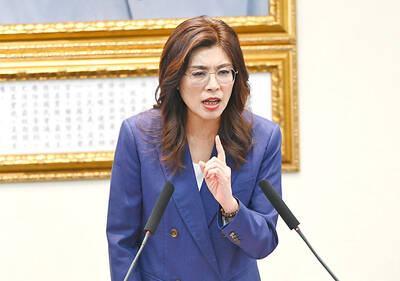
Chinese Nationalist Party (KMT) Chairwoman Cheng Li-wun (鄭麗文) yesterday briefed her party’s Central Standing Committee regarding her scheduled visit to the US between Monday next week and June 16, saying that her purpose would be to persuade the US that the Republic of China (ROC) Constitution was a “one China” constitution that would foster stable and peaceful cross-strait relations. The ROC Constitution is the most important defense for all Taiwanese citizens, as it upholds our democracy and has contributed to our robust economy, which aligns with international and US interests, she said. “We would not be troublemakers and drag the US under,”


 RSS
RSS