


Alex Zanardi, the Italian Formula One driver who became a Paralympic champion after losing both legs in an accident, has died aged 59, his family announced on Saturday.
Zanardi was one of his country’s most loved and respected sportspeople, credited with helping transform the perception of disability in Italy.
In a statement issued through the charity he founded, Obiettivo3, his family said he died “suddenly” on Friday evening, without giving any further details.
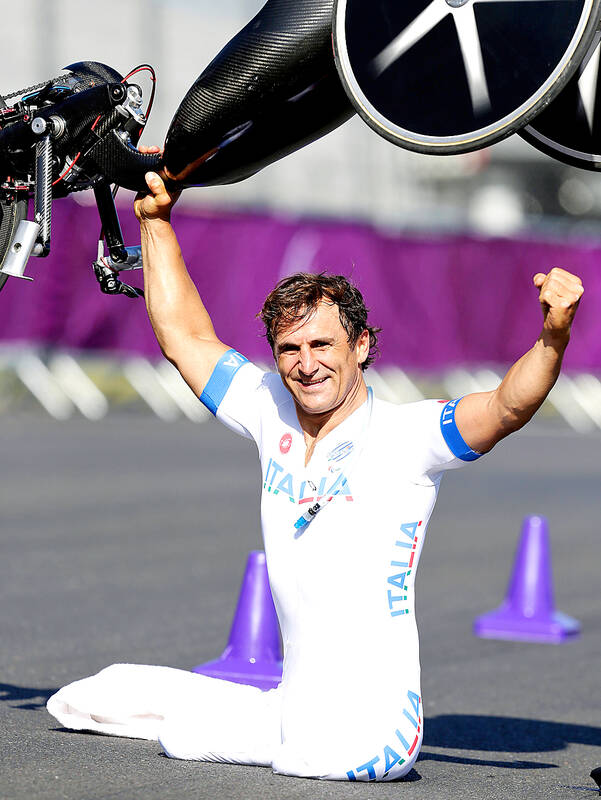
Photo: AP
However, they said he died “peacefully, surrounded by the love of his family and friends.”
Zanardi had both his legs amputated in a motor racing accident in 2001, but went on to become a Paralympic champion with his handbike, wining four gold medals.
He had been out of the public eye since a second horror crash in June 2020, when his handbike crashed into an oncoming truck during a race in Tuscany, Italy.
Zanardi, who was married and had a son, sustained serious head injuries and only returned home 18 months later.
“Alex was a pioneer, icon and legend of the Paralympic Movement,” a spokesman for the International Paralympic Committee said. “His performances were truly out of this world, engaged new fans to the Games, and showed the world that anything is possible.”
“The iconic picture of him raising his handcycle above his head in victory at London 2012 will go down in history as one of the great sporting images,” they said. “He will be remembered forever.”
Zanardi raced for Jordan, Minardi and Lotus in F1 in the early 1990s before switching to the CART championship in the US where he was series champion in 1997 and 1998.
He returned to F1 with Williams in 1999 before heading back to CART.
However, then came the horrific accident in 2001 at the Lausitzring track in Germany. His car stalled in the middle of the track after a spin and was struck by another car at a speed of over 300kph.
The impact tore off his two legs and Zanardi lost a lot of blood, with a chaplain giving him the last rites.
His heart stopped beating several times, and he underwent 15 operations in a Berlin hospital.
“When I woke up, I didn’t think about my legs. I thought about the half of me that remained,” Zanardi said.
Just three months later, the Italian made his first public appearance in his hometown of Bologna during an award ceremony.
“What emotion, my legs are trembling,” he said.
After a few years driving in specially-adapted cars, Zanardi went on to become an icon for disabled athletes competing on his handbike.
He won two gold medals at the London 2012 Paralympic Games and two more in Rio de Janeiro, four years later.
He also won the Rome marathon in 2010 and New York the following year, relying on what he described as his “five-seconds rule.”
“When you have given everything, go on for five seconds. This is where the others can’t do it anymore,” he said.
He wrote several books, presented television shows and performed a voiceover for the Italian version of animated film Cars. Through his charity and his advocacy work, Zanardi encouraged countless other disabled athletes.
The International Automobile Federation said he was “an enduring symbol of courage and determination.”
Italian Cycling Federation president Cordiano Dagnoni said he “transformed the culture of our country, bringing joy and happiness to those fortunate enough to know him, and hope to so many in Italy and around the world.”
He said a minute’s silence would be observed at this weekend’s races in tribute.
Italian Prime Minister Giorgia Meloni hailed Zanardi on social media as “a great champion and an extraordinary man, capable of turning every trial of life into a lesson in courage, strength and dignity.”

Greek swimmer Kristian Gkolomeev was the only athlete to “beat” a world record on Sunday at the Enhanced Games, winning the men’s 50m freestyle at the divisive competition where athletes were free to take performance-enhancing substances. His time of 20.81 seconds — which is not considered official — came in the final event of the night in Las Vegas, sparing the blushes of organizers who made claims that multiple world records would be surpassed due to a sophisticated doping regime. Gkolomeev, who was wearing a synthetic “supersuit” long banned at events such as the Olympics, outpaced Australia’s Cameron McEvoy’s 20.88 set in
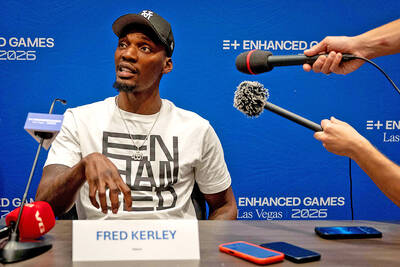
Fred Kerley is competing unaugmented against drug-fuelled athletes at this weekend’s Enhanced Games and still hopes to race in the 2028 Olympics, the suspended former 100m world champion said on Friday. Arguably the biggest name at the divisive event in Las Vegas, where doping is permitted, the US sprinter said he had chosen not to take any of the banned substances including testosterone and steroids that his competitors have been using. “I don’t need it. God gave me fast feet for a reason. And I’m here to showcase my talent,” Kerley said. Kerley last September became the first US competitor and first track

The manager of the Yomiuri Giants, one of Japan’s most popular baseball teams, resigned yesterday after he was arrested for allegedly physically attacking his teenage daughter. Shinnosuke Abe allegedly grabbed the 18-year-old and forced her to the floor at their home in central Tokyo on Monday evening, reported national broadcaster NHK and Kyodo News, citing unnamed police sources. “Leaving like this really means I’m causing you a lot of trouble, and I feel truly sorry about that,” Abe told a hastily arranged news conference, his eyes red with tears. The former star catcher, who is among baseball-obsessed Japan’s most recognized sports figures,
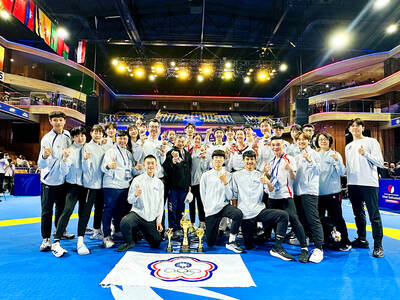
VICTORY ABROAD: The team took home a fistful of medals and secured spots for the autumn’s Asian Games, scheduled for September in Nagoya Taiwan’s women’s team captured the overall title at the Asian Taekwondo Championships in Mongolia on Sunday, finishing with two golds, one silver and one bronze medal. The strong showing, led by gold medalists Wang Chieh-ling and Chang Jui-en secured the full quota of available spots for Taiwan at the Asian Games in Nagoya, Japan, in September. Wang opened Taiwan’s medal run by winning gold in the women’s under-46kg class on Thursday, the first day of competition. Liu Yu-yun later earned a silver in the under-49kg class. On the final day on Sunday, Chang won Taiwan’s second gold medal in the under-62kg event, and


 RSS
RSS