


At the foot of an active volcano in northern Japan, shouts rang out, competitors sized each other up and snowballs whistled through the air in a serious game of yukigassen — a sport with Olympic dreams.
The competition over the weekend has been held every year in Sobetsu, a town on the main northern island of Hokkaido, where the game — essentially a snowball fight — became a sport 37 years ago.
On the field, brute strength is not enough. Japan’s yukigassen federation emphasizes the “mental challenge” posed by the game, in which players on both teams pelt their opponents while taking cover behind shelters.
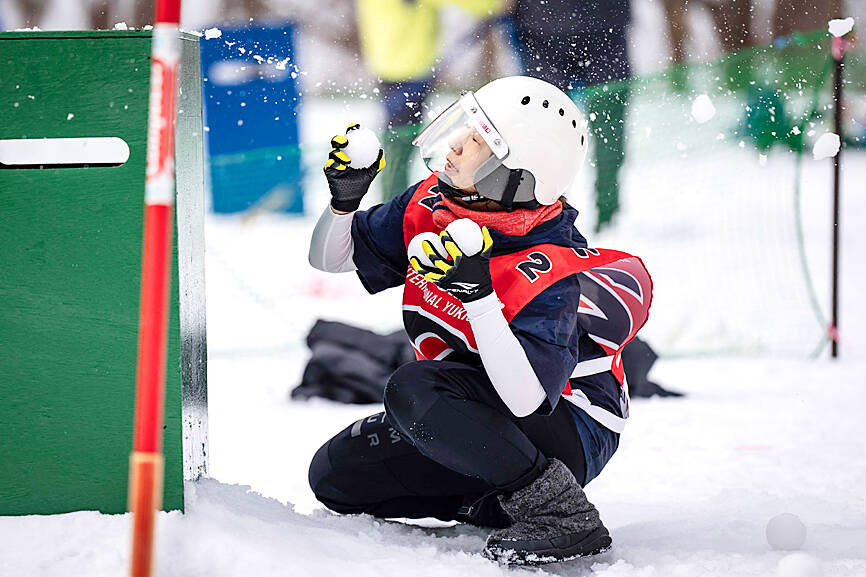
Photo: AFP
The goal: Hit all seven players on the opposing team using perfectly spherical snowballs made with a special machine, or capture their flag.
“When you get hit, it hurts, but it’s mostly your pride that takes the blow,” said Toshihiro Takahashi, a 48-year-old civil servant dripping with sweat after his match.
The idea of turning yukigassen into a sport was born out of a crisis in Sobetsu.
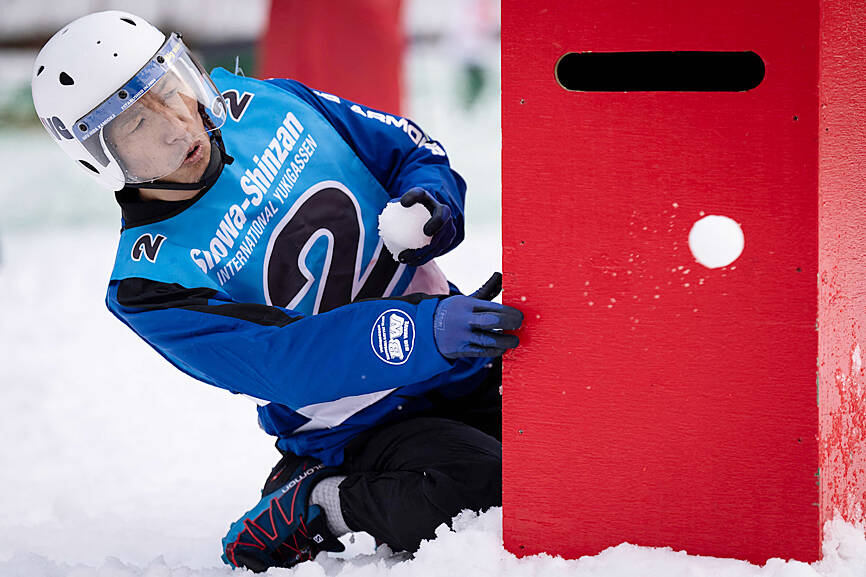
Photo: AFP
While visitors once flocked to the town to enjoy its hot springs, the eruption of Mount Usu in 1977 brought tourism in the area to an abrupt halt.
Residents, looking for ways to put their town back on the map, had a flash of inspiration when they saw a group of tourists having fun during a snowball fight and thought: What if this children’s game could save the town?
“It’s a primitive sport, almost instinctive for human beings,” said Yuji Ano, president of the tournament’s organizing committee.
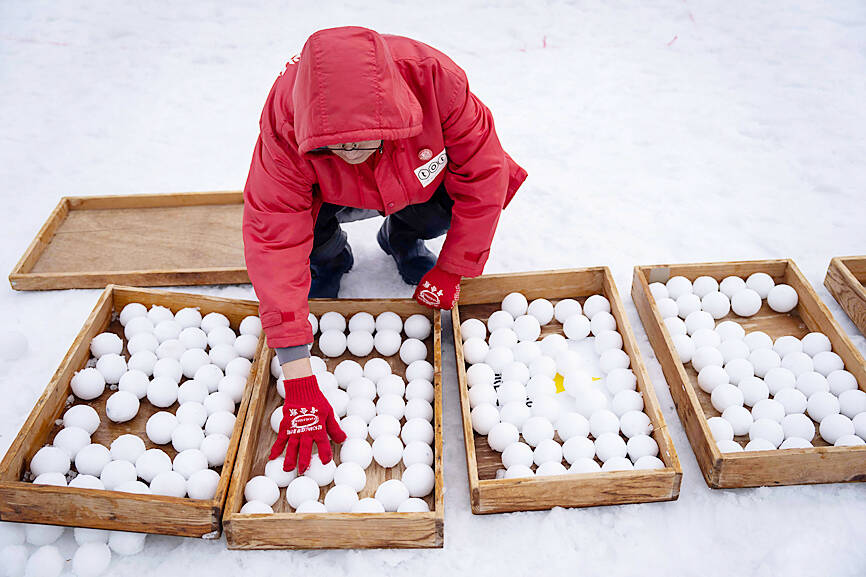
Photo: AFP
“Our ancestors were surely doing the same thing. It’s the oldest winter sport in human history: Long before skating or skiing, humans were already throwing snowballs at each other. That’s its biggest appeal,” Ano said.
All that remained was to put rules down on paper, develop special helmets and invent a machine to mold the snowballs.
Yukigassen — which means “snowball fight” in Japanese — was born, and the first international tournament took place in 1989.
The sport spread to Australia three years later, then to Finland, which set up a national federation in 1995.
After that it caught on elsewhere in Scandinavia, as well as in Russia and North America, and is now played in 13 countries, Ano said.
Keen to capitalize on the international expansion, officials want to turn yukigassen into an Olympic sport.
Ano said that there are few team sports at this year’s Milan-Cortina Winter Olympics, which were wrapping up yesterday.
This year, more than a thousand players came to compete in Sobetsu, but not a single foreign team is among the 118 entrants.
Atasu, a 55-year-old who has been playing yukigassen for more than 30 years and chose to give only his nickname, admitted it had become challenging to recruit players.
“The [Japanese] population is shrinking, and there are also fewer people playing. We have to promote yukigassen and try to attract people,” he said. “That’s the hardest thing right now.”
To boost the number of registered players and try to win over the International Olympic Committee, the sport has, paradoxically, had to step away from snow.
Artificial balls have been developed so it can be played in gyms or on the beach, turning a seasonal battle into a global sport playable year-round.
However, another major problem stands in the way of the Olympic dream: complex officiating that makes it difficult to train new referees, Ano said.
“Eight referees watch each match, where 180 snowballs can be flying” during a three-minute set, he said.
“Judging accurately is almost impossible. As long as we haven’t solved that issue, it will be difficult” to stake a claim for the Olympics, he said.

Fred Kerley is competing unaugmented against drug-fuelled athletes at this weekend’s Enhanced Games and still hopes to race in the 2028 Olympics, the suspended former 100m world champion said on Friday. Arguably the biggest name at the divisive event in Las Vegas, where doping is permitted, the US sprinter said he had chosen not to take any of the banned substances including testosterone and steroids that his competitors have been using. “I don’t need it. God gave me fast feet for a reason. And I’m here to showcase my talent,” Kerley said. Kerley last September became the first US competitor and first track

Taiwan’s top male badminton player, Chou Tien-chen, on Saturday bowed out in the men’s singles semi-finals at the Thailand Open after losing in straight games to Thailand’s Kunlavut Vitidsarn. The world No. 6 Chou, seeded fourth at the Super 500 tournament, lost to the world No. 2 Thai 21-7, 21-19 in 53 minutes. The victory improved Vitidsarn’s head-to-head record against Chou to 3-5. Chou, 36, trailed throughout the opening game after the score was tied 2-2. His relatively passive approach allowed the 25-year-old Thai to capitalize on Chou’s defensive clears with powerful smashes while committing few unforced errors. The Taiwanese

FRUSTRATION: Gauff smacked herself on the head with her racket before storming down the tunnel, emerging afterward to have a heated discussion with her coach Elina Svitolina on Saturday won the Italian Open after beating Coco Gauff 6-4, 6-7 (3/7), 6-2 to claim her third Rome title, while Jannik Sinner set a date with Casper Ruud in the men’s final. Ukraine’s Svitolina had not claimed a WTA 1000 title since her last victory at the Foro Italico eight years ago, but prevailed over the ever-erratic Gauff to claim her 20th tournament triumph. Saturday’s win over Gauff was her third in a row against a player in the top four of the world rankings — including Iga Swiatek and Elena Rybakina — ahead of the French

MLB is experiencing an epidemic of guys being dudes. At ballparks all across the US, groups consisting of mostly young men are joining in on the “Tarps Off” trend that is loud, goofy, infectious and new to the baseball world. Joining in on the fun is simple: Go to the section where the party is happening, take off your shirt and start twirling it above your head. Soccer-like chants or singing usually follow — injecting a jolt of energy for a sport that is occasionally chided for its lack of energy inside the stadium. After getting its start in St Louis, Missouri, on


 RSS
RSS