


Paramount Skydance Corp on Monday launched a hostile takeover offer for Warner Bros Discovery Inc, initiating a potentially bruising battle with rival bidder Netflix Inc to buy the company behind HBO, CNN and a famed movie studio along with the power to reshape much of the US’ entertainment landscape.
Emerging just days after top Warner managers agreed to Netflix’s US$72 billion purchase, the Paramount bid seeks to go over the heads of those leaders by appealing directly to Warner shareholders with more money — US$74.4 billion — and a plan to buy all of Warner’s business, including the cable business that Netflix does not want.
Paramount said its decision to go hostile came after it made several earlier offers that Warner management “never engaged meaningfully” with following the company’s October announcement that it was open to selling itself.

Photo: EPA
In its appeal to shareholders, Paramount said its offer also contains more cash than Netflix’s bid — US$18 billion more — and argued that it is more likely to pass scrutiny from US President Donald Trump’s administration, a big concern given his habit of injecting himself in US business decisions.
Over the weekend, Trump said the Netflix-Warner combo “could be a problem” because of the size of the combined market share and that he planned to review the deal personally.
Netflix said it is confident Warner would reject the Paramount bid and that regulators, and Trump, would back its deal, citing multiple conversations that co-CEO Ted Sarandos has had with him about the streaming company’s expansion and hiring.
“I think the president’s interest in this is the same as ours, which is to create and protect jobs,” Sarandos said on Monday at an investor conference.
Paramount, run by David Ellison, whose family is closely allied with Trump, said it had submitted six proposals to Warner over a 12-week period before the latest offer.
“We believe our offer will create a stronger Hollywood. It is in the best interests of the creative community, consumers and the movie theater industry,” Ellison said in a statement.
He added that his deal would lead to more competition in the industry, not less, and more movies in theaters.
A regulatory document released on Monday suggested another possible Paramount advantage to win over Trump: An investment firm run by Trump’s son-in-law, Jared Kushner, would be investing in the deal, too.
Also participating would be funds controlled by the governments of three unnamed Persian Gulf countries, widely reported as Saudi Arabia, the United Arab Emirates and Qatar. Trump’s family company has struck deals this year for buildings and resorts that bear his name in Saudi Arabia and Qatar, partnering in the former with a company closely tied to the government and in the latter with the government fund itself.
The US federal government has the authority to kill any big media deals if it has antitrust concerns, but such matters are usually left to experts at the US Department of Justice.
In his decision to get involved personally, Trump has decided, as he has with other government norms, to make a sharp break with precedent.
Shares of Paramount surged 9 percent on Monday while Netflix fell 3.4 percent, and Warner Bros closed up 4.4 percent.
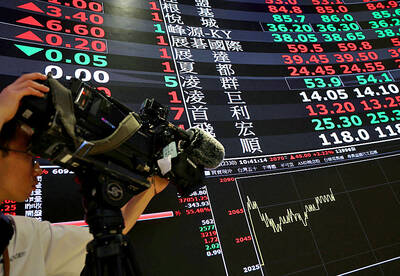
After several years flying high as Asia’s best Nvidia Corp proxy, Taiwan Semiconductor Manufacturing Co (TSMC, 台積電) is increasingly vying with other artificial intelligence (AI) stocks for investor attention. Stock traders are chasing a wider array of beneficiaries as mainstream usage of AI creates demand for hardware beyond the most-advanced chips TSMC makes for Nvidia. Subthemes from the deepening memory crunch to advances in robotics are also luring bids. At the same time, investment caps on single stocks are pushing funds to diversify, while retail investors long familiar with TSMC through its US depositary receipts are being offered a broader set of

UNDER MICROSCOPE: Taiwan detained three people who allegedly conspired to buy servers in Taiwan and export them using fraudulent documentation, prosecutors said Nvidia Corp chief executive officer Jensen Huang (黃仁勳) on Saturday urged Super Micro Computer Inc to tighten up on compliance after Taiwan detained three people this week for allegedly making fraudulent declarations about artificial intelligence (AI) servers made by its US partner. The development marked the nation’s first crackdown on semiconductor smuggling, which grew after the US slapped restrictions on exports of high-end chips such as Nvidia AI accelerators to China. Nvidia is “rigorous” in explaining regulations to all of its partners, Huang told reporters after arriving in Taipei. “Ultimately Super Micro has to run their own company,” he said in response to

Netherlands-based semiconductor equipment supplier ASML Holding NV yesterday said that it is planning to hire an additional 1,000 people in Taiwan this year in response to growing demand from clients. ASML had previously planned to recruit 600 people this year, but that the plan has been adjusted upward, ASML vice president and ASML Taiwan general manager Grace Wang (汪佳慧) told reporters. ASML has a workforce of more than 4,500 in Taiwan, accounting for about 10 percent of its global total, Wang said. This year’s recruitment campaign would focus on adding people in the customer support, manufacturing and supply chain domains to assist ASML

TECH RELIANCE: Growth is increasingly reflecting an unequal K-shaped distribution, where technology sectors outperform and other industries struggle, an expert said Standard Chartered Bank has significantly raised its forecast for Taiwan’s economic growth to 9.5 percent this year, up from 7.6 percent previously, citing surging artificial intelligence (AI) demand driving exports, semiconductor production and investment. The upgrade reflects a sustained AI supercycle that continues to fuel demand for advanced chips and technology infrastructure, which form the backbone of Taiwan’s exports, the bank said in a report this week. “We raise our 2026 growth forecast to reflect a much stronger-than-expected first-quarter GDP figure,” Standard Chartered senior economist for greater China and Asia Tommy Wu (胡東安) said in the report. Driven largely by a 35.3 percent


 RSS
RSS