


With his team’s 5-1 win over Spain, Hector Sanchez could truly say he was an international soccer champion — although not in the way he dreamed of as a child.
Diagnosed with a liver disease in his youth, the Chilean automobile salesman had long had doctors urging him not to take to the field.
Then, two liver transplant operations later and with a squad of 20 other organ donor recipients, Sanchez was victorious at September’s Transplant Football World Cup.
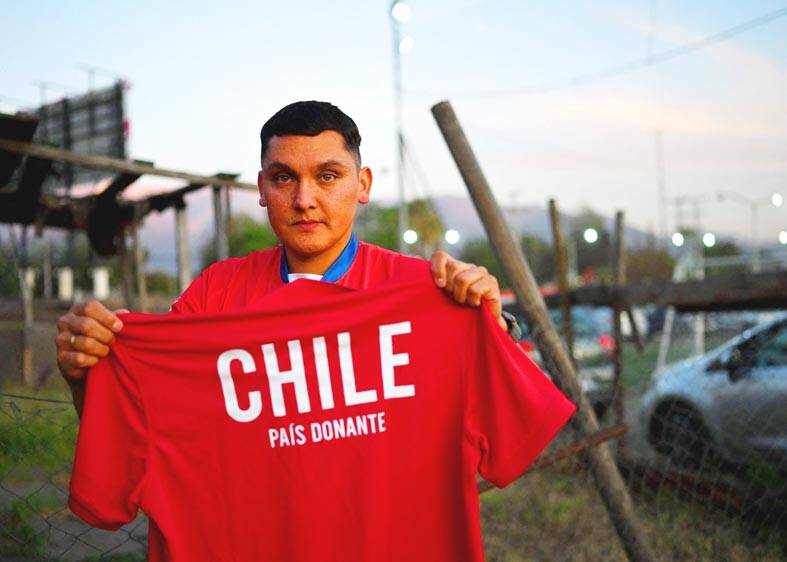
Photo: AFP
“If it weren’t for the transplant, I might not be here,” he said after a recent charity match in the Chilean capital Santiago.
It is an opportunity he wants to extend to others, and while the Chilean squad was victorious at the Transplant World Cup, the situation at home is tough for others in their position. Organ donation rates lag despite progressive legislation on the issue.
For Sanchez, 31, promoting organ donation through sports is the way to pay forward his “second chance at life.”
Reforms in 2010 aimed at promoting organ donation changed the law to consider all adults as presumed donors, unless they actively opt out.
Yet many people still refuse — to the point where Chile’s transplant rate, 10 per 1 million people, is about half of regional leader Uruguay (19.7 per million).
The EU has a donor rate of 20.9 per million, with world leader Spain at 48.9.
Part of the problem is the law: Chile only considers people who are brain-dead as eligible donors, unlike in Spain, where organ donations can be taken from recently deceased people, such as those who die suddenly from a heart attack.
Another part of the puzzle is cultural, with families often refusing to let doctors harvest viable organs for transplants from their deceased loved ones.
“There are many people who believe that [the corpse] will have its eyes gouged out,” leaving the body desecrated, said Ruth Leiva, head of the transplant unit at San Jose Hospital.
About 2,200 people are on the waiting list for an organ transplant in Chile today — and for years, Sanchez was one of them.
He faced liver complications from birth, and needed a transplant by the time he reached his teens — but was only able to get one aged 24.
“You begin to be born again, it is your second chance. For me it was like that, physically and emotionally,” he said.
On the field, the only things that distinguish his amateur team from other players are the scars hidden beneath their jerseys.
They do not use any special protection, or need any special rules.
“When you step onto the field, you forget everything. I’m a normal person, I’m the happiest person,” Sanchez said.


“I don’t remember the moment, but ever since I was a kid, that’s the first thing I loved,” two-time NBA All-Star Isaiah Thomas said of his lifelong romance with basketball. However, that journey unfolded against the limitations of his size in a game where height often dictates opportunity — a reality he confronted throughout his career. At 175cm, Thomas is less than 2cm taller than the average Taiwanese adult male, while NBA players during his career stood at about 200cm on average. Compared with the NBA’s average career length of less than five years, Thomas’ 13-season career stands out as

Dakar and Rabat have longstanding ties, but relations have been strained since the Africa Cup of Nations (AFCON) final, which Senegal won in mid-January before being stripped of the title, which was transferred to Morocco. Now, the AFCON trophy is something of a thorn in the two countries’ sides. On Rue Mohamed V, the street where Moroccan vendors are based in the Senegalese capital, a police van is parked. “The police have been on high alert since the Confederation of African Football [CAF] decided to award the title to Morocco, but there have been no incidents,” a local resident said.

Top seeded Jessica Pegula on Friday once again fought back from a set down to reach the WTA Charleston Open semi-finals with a 3-6, 6-3, 6-2 win against Russia’s Diana Shnaider. Defending champion Pegula has lost the first set in all three of her matches at the tournament so far, but again dug deep to maintain her hopes of retaining the title. The world No. 5 from the US took 2 hours, 10 minutes to defeat 19th-ranked Shnaider, relying on a formidable service game that included eight aces. Shnaider battled well in the first two sets and broke early for a 2-0 lead

Cambridge on Saturday made it four wins in a row as they comprehensively defeated Oxford in the 171st University Boat Race on London’s River Thames. It was Cambridge’s seventh win in the past eight years of a rowing race between England’s two oldest universities first staged in 1829. A world-class Cambridge crew were heavy favorites for victory. However, four minutes into the race, the crews came close to a clash of oars which could have caused severe disruption, with Oxford repeatedly warned as both team chased faster conditions in the middle of the river. For the first time in the


 RSS
RSS