


Kelvin Kiptum would not be slowed or curtailed in intense training, his coach, Gervais Hakizimana, said, even though it might shorten the career of the new men’s marathon world record-holder.
Kiptum, a 23-year-old Kenyan, on Sunday set the world record of 2 hours, 35 seconds to win the Chicago Marathon, his third career victory in as many starts after wins last year at Valencia and last April at London.
“He’s very strong. He does all the training properly. He’s in his best years, but at some point I’m afraid he’ll get injured,” Hakizimana said.
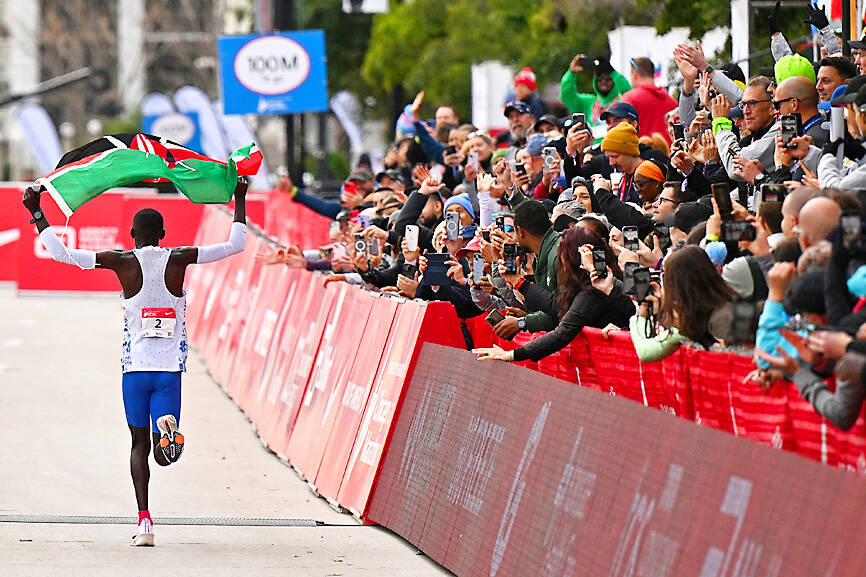
Photo: Jamie Sabau-USA TODAY
“He’s training a lot. At this rate he is in danger of breaking, I offered him to slow down the pace, but he doesn’t want to,” he said. “I told him that in five years he’d be done, that he needs to calm down to last in athletics.”
Kiptum shattered the old world record of 2:01:09 set by Kenya’s Eliud Kipchoge at last year’s Berlin Marathon.
He smashes barriers in training as well, sometimes running more than 300km a week, Hakizimana said.
“Every week, Eliud Kipchoge does between 180[km] and 220km. Kelvin Kiptum is more between 250[km] and 280[km], sometimes more than 300km,” Hakizimana said. “It’s an adventure.”
“During the preparation for London, we spent three weeks at more than 300km. It has a very large volume. He works a lot on endurance. When he’s training, he’s strong,” he said.
Hakizimana said that the marathon program is planned over four months, starting with strength training at 900km running in the first month.
“The second month between 280[km] and 300km per week,” he said. “In the fourth month, we gradually reduce the volume, so that we can rest before the race.”
“There’s no weekly rest. We rest when he gets tired. If he doesn’t show signs of fatigue or pain for a month, we continue,” he said. “All he does is run, eat, sleep.”
Hakizimana said he is insisting on a month’s shutdown after Chicago. That message is getting through.
“Kelvin is a guy who likes to communicate, who listens a lot,” he said. “We speak in Swahili, a little bit in English. Now he understands me a little bit in Rwandan or French.”
Hakizimana, who is from Rwanda, was a runner who trained for years in Kenya, where he met Kiptum in the youth’s village of Chepkorio.
Ten years ago, barely a teen, Kiptum herded goats and sheep then began following Hakizimana and other runners as they trained.
By 2019, Kiptum ran two half-marathons in two weeks, going 60:48 in Copenhagen and 59:53 in Belfort, France, and began training with Hakizimana, who stayed in Kenya when the COVID-19 pandemic struck.
“I stayed there for a year and I trained him,” Hakizimana said. “We were stuck there. We trained in the forest. I’d run with him. We started a marathon program in 2021.”
Sifan Hassan of the Netherlands on Sunday also took advantage of cool and cloudy weather that is considered ideal for a marathon to win the women’s race in Chicago in 2:13:44 — the second-fastest ever for a woman.
Additional reporting by AP

After letting another big lead slip with an error-strewn performance at the French Open on Wednesday, top-ranked Aryna Sabalenka felt like getting as far away from the courts as possible. “Just want to quit tennis right now,” Sabalenka said after wasting a lead of a set and two breaks in a 3-6, 7-5, 6-0 loss to Diana Shnaider in the women’s singles quarter-finals. “We’ll see in few days. Hopefully I’ll get back on track mentally.” Sabalenka’s wait for a first French Open title continues despite the four-time major winner leading 4-1 in the second set and being two points from victory while

BIG NAMES GONE: Zverev is the clear favorite for a maiden Grand Slam title, reaching semi-finals for the fifth time in six years and finishing second on three occasions Alexander Zverev on Tuesday breezed past Rafael Jodar to stay on course for an elusive Grand Slam title at the French Open, while Jakub Mensik halted Joao Fonseca’s scintillating run in the quarter-finals. Zverev, the highest-ranked player left in the men’s draw, put an end to Spanish teenager Jodar’s impressive Roland Garros debut, easing into the semi-finals with a 7-6, (7/3), 6-1, 6-3 win. The 29-year-old Zverev is the clear favorite for a maiden Grand Slam title. He has finished runner-up on three occasions, including at the 2024 French Open. “I want to win the matches that are ahead of
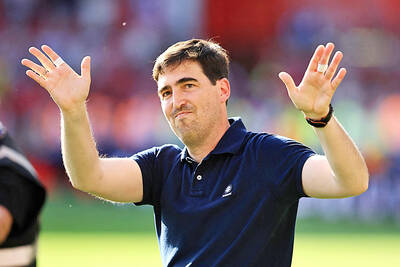
Liverpool are in advanced talks with former AFC Bournemouth manager Andoni Iraola as they seek a replacement for Arne Slot, reports said on Tuesday. Iraola has emerged as Liverpool’s top target to replace Slot, who was sacked on Saturday last week after a turbulent second season in charge. Liverpool have reportedly agreed a deal in principle to bring the Spaniard, who left Bournemouth at the end of this season, to Anfield. Sporting director Richard Hughes was heavily involved in hiring Iraola during his time at Bournemouth and is again spearheading the recruitment of the highly rated coach. The Reds are

KNICKS TAKE LEAD: San Antonio put on a 9-0 run to be up 95-94 with just over 2 minutes to play, but the rest of the game belonged to the New York Knicks It was past five minutes through the third quarter of Game 1 of the NBA Finals on Wednesday and the New York Knicks’ 11-game winning streak was in major jeopardy. The Knicks missed nine of their first 10 shots in the early part of the period and trailed the San Antonio Spurs by 14 points. They were floundering. Then something crazy happened. The Knicks found new life from an unlikely source: The Spurs. New York rallied to tie the game by the end of the period, gave up the lead briefly late in the fourth quarter, and pulled away late for a 105-95


 RSS
RSS