


Breakdancing on Monday cleared its final hurdle to feature in the 2024 Paris Olympic Games, bringing the wholly original, electric art form to sport’s biggest stage.
Considered one of the pillars of hip-hop culture, breaking, as participants prefer to call it, originated in New York in the 1970s and has spread globally, enjoying enormous popularity beyond the US and particularly across Europe and Asia.
A 2019 Olympic Programme Commission report estimated that there were about 1 million participants in breaking worldwide and last year’s Red Bull BC One World Final in Mumbai racked up more than 50 million views across streaming platforms including Facebook and YouTube.
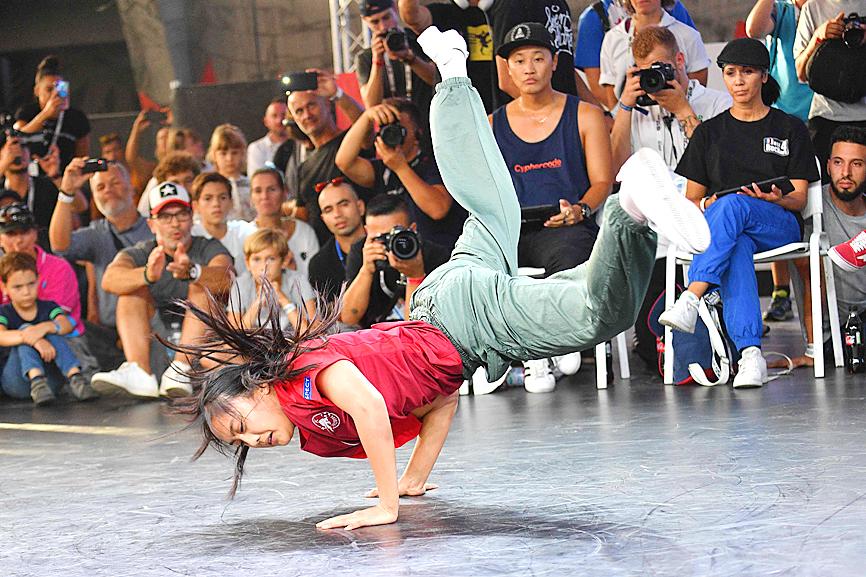
Photo: AFP
“It can resonate with a lot of people because hip-hop culture resonates with a lot of people, hip-hop music resonates with a lot of people,” said Logan Edra, a 17-year-old US dancer who goes by the performance name Logistx.
Breaking is not the first artistic movement to be counted as an Olympic sport, but its inclusion in the Paris Games has prompted soul-searching among many dancers, including Edra, a former gymnast who aspires to win the Olympic gold.
“It being in the Olympics, it makes sense that people would refer to it as [a sport], but I think one thing for the breaking community is we want to make sure that it’s not known as just a sport, but an art, a sport, a culture,” said Edra, who won the 2018 Silverback Open Championships b-girl solo competition.
Key elements in breaking include top rocks — typically a competitor’s introductory dance moves — footwork, power moves and freezes. Power moves are explosive displays such as spins, while freezes are when a performer sticks a pose.
In a blend of artistry and athleticism, competitors — known as b-boys and b-girls — are evaluated not only on technical skill, but also creativity and style, with strength, speed, rhythm and agility providing an edge.
“The biggest part is your stage presence and character, and your rhythm, whether or not you’re really feeling it,” said Ronnie Abaldonado, a competitive breaker since 2004 who won the international Red Bull BC One competition in 2007.
“People can hit the moves, but if you’re not feeling what they’re doing then you just kind of look robotic and that’s what kind of separates it being a sport to it being an art form,” Abaldonado said.
Richard “Crazy Legs” Colon, one of the pioneers during his upbringing in the Bronx in the 1970s, said he applauded breaking’s inclusion in the Olympics but wanted to ensure its cultural core remained intact.
“This is true folk art from the music to the dance, to the DJ to the rapper,” said Colon, who appeared in dance films of the 1980s including Beat Street and Flashdance.
“We’ve already legitimized ourselves so we’re not looking to the Olympics for legitimacy,” he added.
LUKASHENKO BAN
Meanwhile, the IOC on Monday suspended Belarusian President Alexander Lukashenko, from all Olympic activities, including the Tokyo Games next year.
Lukashenko, who has led the Belarus Olympic Committee for 23 years, claimed a sixth presidential term after an election in August widely viewed as rigged.
Belarus has since been in turmoil amid protests and a crackdown by security forces, and the IOC has investigated complaints from athletes that they faced reprisals and intimidation.
Bach said that the Belarus Olympic body’s leadership “has not appropriately protected Belarus athletes from political discrimination.”
“This is contrary to the fundamental principles of the Olympic Charter and therefore seriously affects the reputation of the Olympic movement,” Bach said.
Suspending Lukashenko does not affect Belarusian athletes, nor their right to compete in Tokyo as a recognized national team.
Additional reporting by AP

When Paddy Dwyer arrived in China in 1976, crowds jostled to catch a glimpse of him and his companions — the first Western soccer team to play in the country. China was emerging from the chaos of the Cultural Revolution, and on the brink of market reforms that would take the country from economic stagnation to explosive growth. “All we could see was lines of people running beside our bus, trying to look in the windows, to see their first visual of a white person,” he said. “It was all bicycles,” he said. “There were very few cars to be seen.” Dwyer,
Jannik Sinner continued his quest to become the first man in history to win five Masters 1000 tournaments in a row with a 6-2, 6-3 victory over Danish qualifier Elmer Moller at the Madrid Open on Sunday. The world leader extended his winning streak to 19 matches, a run that began early March in Indian Wells, and he has captured 24 consecutive victories at the Masters 1000 level, dating back to the Paris Masters last October. Searching for a maiden title at this level on clay, Sinner advanced to the round of 16 at the Caja Magica with a 77-minute performance against
Tennis players are facing an unexpected opponent at the Madrid Open. A stomach virus or food poisoning has affected Iga Swiatek, Coco Gauff, Marin Cilic and others, raising concerns. World No. 1 Aryna Sabalenka avoided an upset by Naomi Osaka on the court on Monday and said she is trying to avoid illness by sticking to a diet of chicken breasts, rice and salad. The rumor among the players was bad shrimp tacos were to blame. Sabalenka knocked on wood for luck and said, “So far, so good. I heard that I have to avoid those tacos,” she laughed, adding “I stick to the

Some of Clearlake Capital Group’s largest investors are growing increasingly concerned about how much time the company’s co-founders are spending on sports investments as they have struggled to complete the fundraising for the private equity firm’s latest flagship fund. One of Clearlake’s co-founders, Behdad Eghbali, has been spending what some investors described as a disproportionate amount of time on the firm’s investment in Chelsea Football Club in recent months. Now, co-founder Jose E. Feliciano and his wife, Kwanza Jones, are nearing a record US$3.9 billion deal to acquire the San Diego Padres. That personal investment by Feliciano has set off the latest


 RSS
RSS