


Mike Bryan panicked a bit, understandably, when he received a telephone call about the burglar alarm sounding at his home back in the US while he was at the French Open.
“The first thing I thought about is: ‘Where’s the gold medal? I don’t think my wife hid it in the sock drawer,’” half of the most successful doubles team in tennis history recounted with a laugh. “And it was still there. Thank God. If the house burned down, I’d probably try to save some pictures, but otherwise, the gold is the first thing you’d run for. Can’t replace that.”
For all of his duo’s records — 16 Grand Slam doubles championships, more than 100 tournament titles, more than 435 weeks at No. 1 — there is nothing Bryan cherishes more than the gold medal he and twin brother Bob won at the 2012 London Olympics. Which is why he would never miss a chance for a medal, something six of the top 25 men in the ATP singles rankings will do by sitting out the Rio de Janeiro Games.
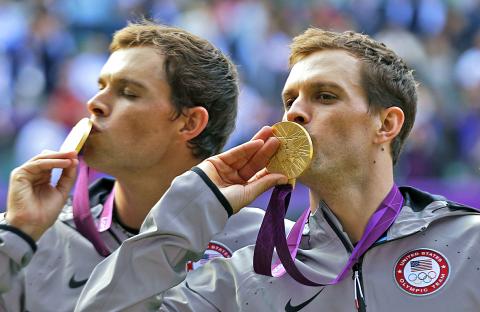
Photo: AP
“It’s playing for your country. It’s playing for the glory of the Olympics,” Bryan said. “I’m a little surprised there are some big names skipping it.”
He was not talking about two-time NBA MVP Stephen Curry or Rory McIlroy, the four-time major golf champion who on Wednesday said that he would not go to Rio because of the Zika virus.
No one of their level of stardom withdrew from the Olympic tennis event, but there is a growing group of absentees, including Dominic Thiem, a 19-year-old rising star from Austria who is ranked No. 8, reached his first major semi-final at Roland Garros this month, and beat Roger Federer on grass just last week. Also staying away: the top US man, John Isner, who is ranked 17th; Australia’s two best players, No. 18 Nick Kyrgios and No. 19 Bernard Tomic; No. 21 Feliciano Lopez of Spain; and No. 24 Kevin Anderson of South Africa.
“I would say [it has been] 70 to 80 percent, probably, negative feedback I have received. The other 20 percent ... recognized my feelings on it,” said Isner, who competed at the 2012 Games. “I have been told [it is] ‘unpatriotic.’”
Saying that the field is not finalized, WTA CEO Steve Simon on Wednesday said he is not aware of any female tennis players pulling out of Rio.
“We haven’t heard it yet,” Simon said. “To be open and honest, we could hear that from some players.”
Isner wants tennis players to earn ranking points at the Olympics; indeed, he thought the points offered in London four years ago were not enough. Novak Djokovic and others agreed.
However, unlike at the past four Summer Games, players will not get boosts to their ranking in Rio, the way they can at tournaments happening elsewhere at the same time (Isner, for example, will be in Atlanta).
“Players are independent contractors and they’re free to set their own schedules,” ATP executive chairman Chris Kermode said. “The ranking points are a valuable currency to us. It’s sort of what the tour is about. And the Olympics does create some additional challenges for us in terms of scheduling.”
Kermode said the ATP and the International Tennis Federation (ITF) — which oversees the sport’s participation at the Olympics — discussed whether to include points.
“The overall consensus from both players and [ATP] tournaments was not to have points,” Kermode said. “The ethos of the Olympics is about playing for your country. It’s about playing for the gold medal.”
ITF president David Haggerty said he would be open to returning to a points system for the 2020 Olympics.
“I can argue it both ways,” Haggerty said. “But I think the most important thing is that we really are open — and listening — to what the players want.”
Other tennis-specific explanations for bypassing Brazil include the chance to collect appearance money at other events, and the difficult prospect of earning a medal when the field features the No. 1-ranked Djokovic, defending gold medalist Andy Murray, 17-time major champion Federer and, if he recovers from a left-wrist injury, 2008 gold medalist Rafael Nadal.
To some in tennis, none of those considerations matter.
The Olympics are the Olympics, and they say there is no way they would pass up a chance to go.
As 26th-ranked Jack Sock of the US put it: “That’s kind of [on] the bucket list when you’re a kid.”

NO HARD FEELINGS: Taiwan’s Lin Hsiang-ti and Indonesia’s Dhinda Amartya Pratiwi embraced after fighting to a tense and rare 30-29 final game in their Uber Cup match The Taiwanese men’s team on Wednesday fought back from the brink of elimination to defeat Denmark in Group C and advance to the quarter-finals of the Thomas Cup, while the women’s team were to face South Korea after press time last night in the Uber Cup quarter-finals in Horsens, Denmark. In the first match, Taiwan’s top shuttler Chou Tien-chen faced a familiar opponent in world No. 3 Anders Antonsen. It was their 16th head-to-head matchup, with the Dane taking his fourth victory in a row against former world No. 2 Chou, winning 21-14, 13-21, 21-15 in 1 hour, 22 minutes. The
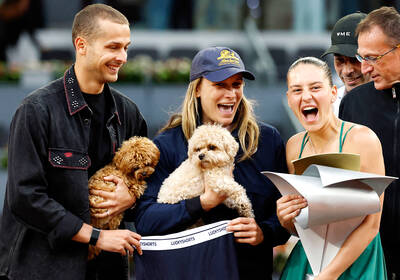
Marta Kostyuk’s maiden WTA 1000 title in Madrid came on Saturday thanks to her power, poise and a pair of unexpected lucky shorts. The world No. 23 beat eighth-ranked Mirra Andreeva 6-3, 7-5 in under 90 minutes to secure the most prestigious trophy of her career, her third professional singles title and second in less than a month after Rouen. Yet as the 23-year-old Ukrainian posed for photographs at the Caja Magica, it was not just the silverware that caught the eye. Held alongside her team and her two dogs, Kostyuk showed off a piece of black men’s underwear, prompting

Throwing more than US$5 billion at a divisive new tour and walking away after five seasons does not look like good business, but LIV Golf was not all bad news for Saudi Arabia. Oil-funded LIV, which poached top stars and sent golf’s establishment into a tailspin, helped push the conservative kingdom into global view — one of its key aims, experts said. The exit, confirmed on Thursday after weeks of speculation, does not signal a flight of Saudi money from sport, even after the Middle East war that sparked Iranian attacks around the Gulf, they said. “Saudi Arabia is not
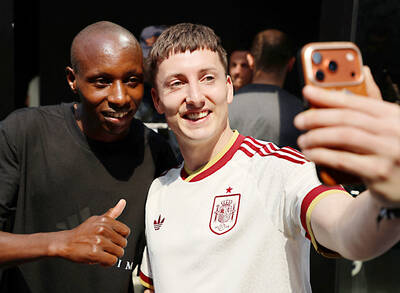
Kite-surfing fabrics, car tires and shortened shoelaces helped Kenyan Sabastian Sawe and Adidas crack the two-hour marathon barrier. When Sawe on Sunday shattered one of athletics’ most elusive barriers in storming to victory at the London Marathon in 1 hour, 59 minutes, 30 seconds, it did not come from just physiology and grit, but from design choices drawn from far beyond the course. Sawe debuted Adidas’ lightest-ever racing shoe, the Adizero Adios Pro Evo 3. “It starts with the mentality of the athlete, the coach, and the team behind the product, which is: What can we do better? What is the 1 percent


 RSS
RSS