


Throwing more than US$5 billion at a divisive new tour and walking away after five seasons does not look like good business, but LIV Golf was not all bad news for Saudi Arabia.
Oil-funded LIV, which poached top stars and sent golf’s establishment into a tailspin, helped push the conservative kingdom into global view — one of its key aims, experts said.
The exit, confirmed on Thursday after weeks of speculation, does not signal a flight of Saudi money from sport, even after the Middle East war that sparked Iranian attacks around the Gulf, they said.
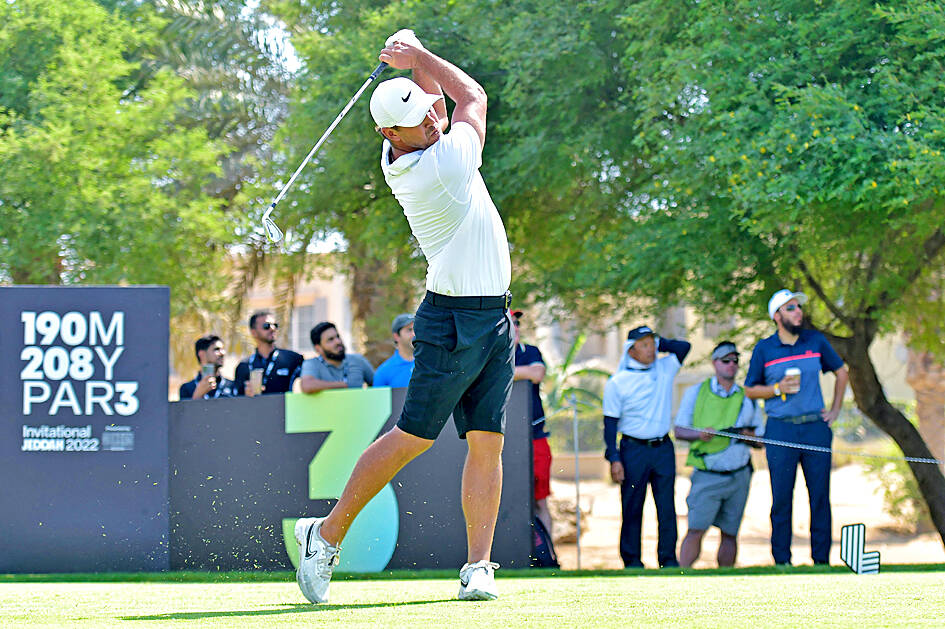
Photo: AFP
“Saudi Arabia is not going cold on sport,” said Simon Chadwick, professor of Afro-Eurasian sport at the Emlyon Business School in Shanghai.
“It is evaluating the work that has thus far been done, what remains to be delivered, and what has worked. The trajectory remains the same,” Chadwick said.
The kingdom’s US$900 billion Public Investment Fund (PIF) has spent big on sport to raise Saudi’s profile, luring superstar soccer players such as Cristiano Ronaldo. Saudi Arabia later secured hosting rights for the FIFA 2034 World Cup.
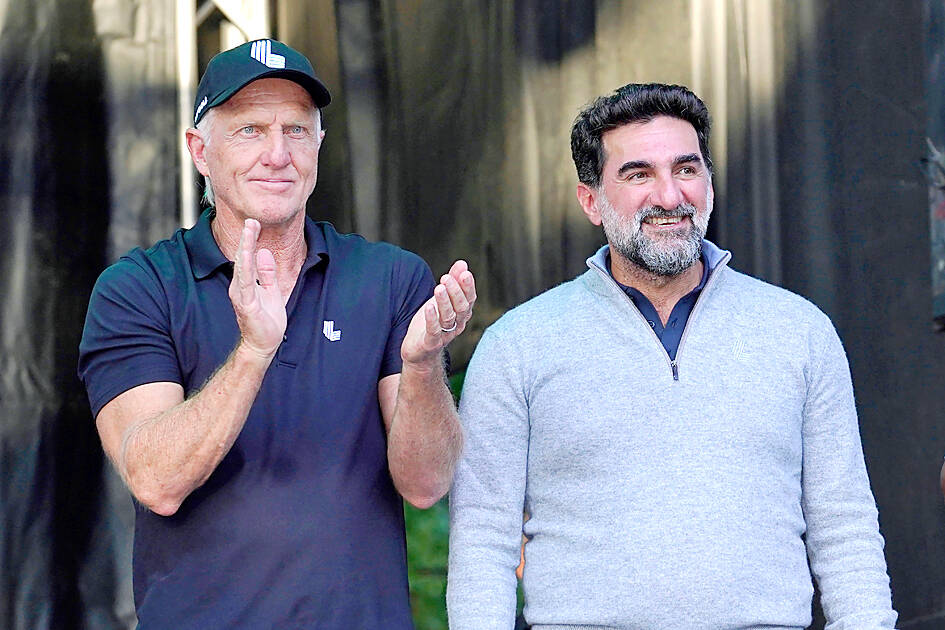
Photo: AP
The desert monarchy and world’s biggest crude exporter, deploying its oil wealth via the PIF, aims to diversify its economic portfolio by encouraging tourism, business and domestic spending, to shield it from an expected slump in demand for fossil fuels.
“Perhaps Saudi plans were rather too grandiose to begin with, but equally the grifters and opportunists of global sport have been seeking to take advantage of the country’s sports spending,” Chadwick said.
PIF-funded LIV (“54” in Roman numerals), promised to reshape golf when it debuted in 2022 with 54 holes, shotgun starts, dance music on the course and stars such as Dustin Johnson and Phil Mickelson on reported nine-figure deals.
A dispute with the US PGA Tour was headed for the courts until the two rivals announced surprise merger talks which dragged on for years without resolution. In the meantime, LIV failed to land a major broadcast deal or build a significant fanbase. Saudi sport investments — sometimes criticized as “sportswashing,” or an attempt to divert attention from human rights — have grown since LIV was announced in October 2021.
PIF acquired English soccer club Newcastle United around the same time, the F1 Saudi Grand Prix began two months later, and Ronaldo arrived to huge fanfare in January 2023.
“That phase was primarily about visibility and positioning Saudi Arabia as a major global player,” said Amro Elserty, a France-based Middle East affairs sports analyst. “What has changed is not that this objective disappeared, but that the marginal value of continuing to spend at the same level on a single project like LIV has declined.”
The new phase includes cuts beyond LIV. The Saudi Pro League, once a blank cheque for veteran soccer players, has pulled back from major signings, and the PIF sold a majority stake in Al Hilal, one of the top Saudi clubs, last month.
PIF “stated from the beginning that financial support for the Saudi league would not be sustainable,” Egyptian soccer analyst Amir Abdelhalim said.
Meanwhile, the WTA Finals women’s tennis tournament would complete a three-year run this year, and the Saudi Arabia Snooker Masters, one of the sport’s richest events, was scrapped last month, two years into a scheduled 10-edition deal. The sports slowdown is consistent with cuts to other projects, such as tourism resorts and Neom, a futuristic new city priced at US$500 billion, as Saudi Arabia winds back its more extravagant ventures. Elserty said leaving LIV, the brainchild of PIF governor and golf fan Yasir al-Rumayyan, carries “reputational impact... But it is unlikely to be seen internally as a significant setback.”
“Within the logic of PIF’s strategy, this is better understood as a controlled exit from an experimental phase rather than a failure in the conventional sense,” Elserty said.
“Observers and critics are the people who have turned the supposed sports divestment into a melodrama,” Chadwick said.

NO HARD FEELINGS: Taiwan’s Lin Hsiang-ti and Indonesia’s Dhinda Amartya Pratiwi embraced after fighting to a tense and rare 30-29 final game in their Uber Cup match The Taiwanese men’s team on Wednesday fought back from the brink of elimination to defeat Denmark in Group C and advance to the quarter-finals of the Thomas Cup, while the women’s team were to face South Korea after press time last night in the Uber Cup quarter-finals in Horsens, Denmark. In the first match, Taiwan’s top shuttler Chou Tien-chen faced a familiar opponent in world No. 3 Anders Antonsen. It was their 16th head-to-head matchup, with the Dane taking his fourth victory in a row against former world No. 2 Chou, winning 21-14, 13-21, 21-15 in 1 hour, 22 minutes. The
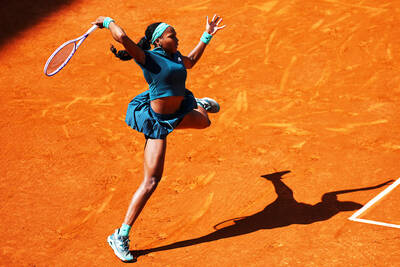
Jannik Sinner continued his quest to become the first man in history to win five Masters 1000 tournaments in a row with a 6-2, 6-3 victory over Danish qualifier Elmer Moller at the Madrid Open on Sunday. The world leader extended his winning streak to 19 matches, a run that began early March in Indian Wells, and he has captured 24 consecutive victories at the Masters 1000 level, dating back to the Paris Masters last October. Searching for a maiden title at this level on clay, Sinner advanced to the round of 16 at the Caja Magica with a 77-minute performance against
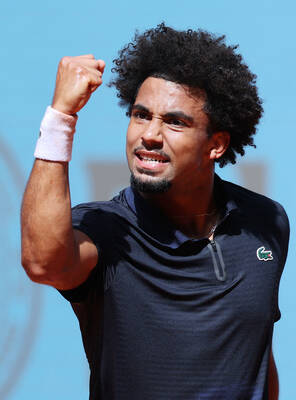
Tennis players are facing an unexpected opponent at the Madrid Open. A stomach virus or food poisoning has affected Iga Swiatek, Coco Gauff, Marin Cilic and others, raising concerns. World No. 1 Aryna Sabalenka avoided an upset by Naomi Osaka on the court on Monday and said she is trying to avoid illness by sticking to a diet of chicken breasts, rice and salad. The rumor among the players was bad shrimp tacos were to blame. Sabalenka knocked on wood for luck and said, “So far, so good. I heard that I have to avoid those tacos,” she laughed, adding “I stick to the
Kite-surfing fabrics, car tires and shortened shoelaces helped Kenyan Sabastian Sawe and Adidas crack the two-hour marathon barrier. When Sawe on Sunday shattered one of athletics’ most elusive barriers in storming to victory at the London Marathon in 1 hour, 59 minutes, 30 seconds, it did not come from just physiology and grit, but from design choices drawn from far beyond the course. Sawe debuted Adidas’ lightest-ever racing shoe, the Adizero Adios Pro Evo 3. “It starts with the mentality of the athlete, the coach, and the team behind the product, which is: What can we do better? What is the 1 percent


 RSS
RSS