


Olympic organizers on Tuesday promised to introduce viral testing in the polluted waters in Rio de Janeiro, where about 1,400 athletes are to compete in next year’s Games.
The International Olympic Committee and Brazilian organizers had repeatedly insisted that only bacterial testing was required despite an independent five-month analysis by The Associated Press showing dangerously high levels of viruses from human sewage at all Rio Olympic aquatic venues.
Acknowledging that viral water testing was now necessary, local organizing committee head Carlos Nuzman told reporters that his team was still studying how best to carry out the analysis and what pathogens to search for.
“The viral tests, we will do and we will repeat this, because the most important [thing] for us is the health of the athletes,” Nuzman said in an interview in London. “We are working with our medical department and looking for this.”
If the tests come back positive for viruses, organizers will assess the best way of cleaning up the water rather than abandoning any venues, such as Guanabara Bay, which is the venue scheduled to hold sailing and wind surfing.
Nuzman said he did not know when organizers would be ready to start the testing, but indicated it could be by the end of the year.
“We are working daily, on a daily basis to create the test,” he said.
Nuzman’s comments came as a German sailor who fell ill after competing in a pre-Olympic test event in the filthy waters off Rio said he was recovering from his skin infections.
Erik Heil believes he was infected while competing in a regatta in Marina da Gloria, where he said untreated sewage is allowed to flow into the water.
Heil needed daily hospital treatment for multiple infections on his legs and hip. The Berlin hospital where he was treated said he had contracted MRSA, a type of bacteria resistant to many antibiotics.
Rio organizers now face a challenge of finding a lab with the equipment and trained professionals who can carry out viral testing of water. Fewer than five such labs exist in Brazil, including just one in Rio de Janeiro at the Brazilian Ministry of Health’s Oswald Cruz Foundation research center.
The AP’s viral testing is being carried out by scientist Fernando Spilki, a board member of the Brazilian Society for Virology and editor of its scientific journal, who is the coordinator of the environmental quality program at Feevale University in southern Brazil.
The AP’s testing includes measuring the levels of human adenovirus types 2, 5 and 41 — which are considered “markers” for human sewage pollution of water in Brazil, because they are the types most typically found in wastewater in the tropical nation.
The AP is also testing for rotavirus — globally, the biggest cause of gastroenteritis — and enterovirus, the most common cause of upper respiratory infections globally. Additionally, the AP tests include bacterial testing for fecal coliforms.
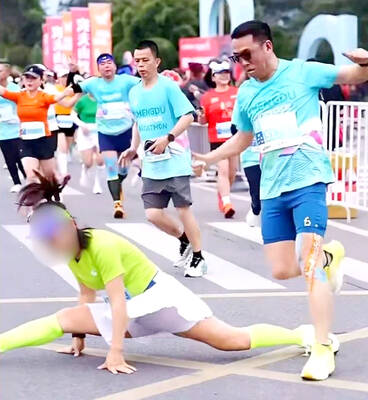
A runner who stopped during a marathon in China to pose doing the splits and another who hoarded energy gels have been banned for two years, the local athletics association said yesterday. The incidents happened during Sunday’s marathon in Sichuan Province’s Chengdu and were widely shared online. Videos showed a female runner stopping suddenly and dropping to the ground in the splits position, holding up her arms in a heart shape as she apparently posed for a photograph. She “committed obstructive fouls during the race, affecting the safe participation of other runners,” the Sichuan Athletics Association said in a statement, which identified

Mercedes’ Kimi Antonelli yesterday vowed to “keep raising the bar” after winning the Japanese Grand Prix to become the youngest driver in Formula One history to lead the championship standings. The 19-year-old Italian took advantage of a mid-race safety car to jump into the lead after a dreadful start from pole position, crossing the line ahead of McLaren’s Oscar Piastri and Ferrari’s Charles Leclerc. Antonelli’s Suzuka victory came two weeks after the first grand prix win of his career in China, and sent him top of the championship standings after three races, nine points ahead of team-mate George Russell. Mercedes are struggling to

Teng Kai-wei, the only Taiwanese player on an opening-day roster in this year’s Major League Baseball (MLB) season, took his first win of the year with the Houston Astros in his season debut. Teng entered in relief in the top of the fifth inning against the Los Angeles Angels on Saturday, with the Astros trailing 5-0. He pitched 2-1/3 scoreless innings with two strikeouts, as Houston scored 11 runs during his outing to snatch an 11-9 comeback victory. The win is the Astros’ first of the season and the third of Teng’s MLB career. “It’s my first time pitching for the Astros, so

Workers are hammering, cranes are swinging and seats are being bolted into place — but the clock is ticking. Mexico City’s famous Azteca stadium, reborn as Estadio Banorte, is in a frantic race to be ready for its grand reopening on Saturday. Drone footage showed crews installing seats and attaching the new stadium name to the facade, with cranes looming overhead 48 hours before the gates are due to open for a high-profile friendly between Mexico and Portugal. For residents, the breakneck pace of construction has done little to inspire confidence. “I know they are working practically seven days a week, 24 hours


 RSS
RSS