


As the sun rises over Tokyo, six men, naked apart from loincloths, stand on sand and stamp their feet repeatedly. Six trunk-like thighs are heaved into the air, pausing for a second before crashing down, the topknots on each wrestler’s head wobbling with the impact.
Monotonous it may be, but no one ever said training to be a sumo supremo was supposed to be fun.
“Shift your weight! Don’t raise your hips too fast!” shouts a retired wrestler now working as a caretaker and coach.
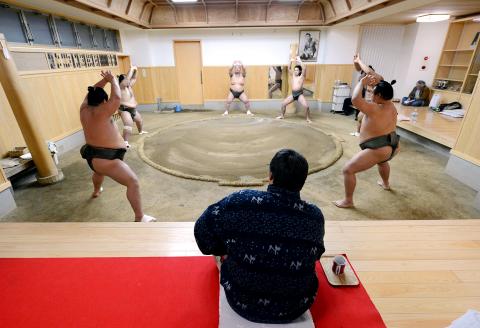
Photo: AFP
The routine, called shiko, builds strength and bulk in the lower body and lasts half an hour on sand-covered clay in the gym of a stable in downtown Tokyo.
Three hours of exercises, including leg splits and an elaborate foot-shuffling routine, culminate in one-on-one clashes in a circular combat ring, a tradition-steeped form of wrestling practiced in Japan for hundreds of years.
Man-mountains grapple and thrust against each other, trying to throw down or force their opponent out of the ring, watched over from a raised wooden platform by stablemaster Tadahiro Otake, who sits cross-legged in front of a small altar.
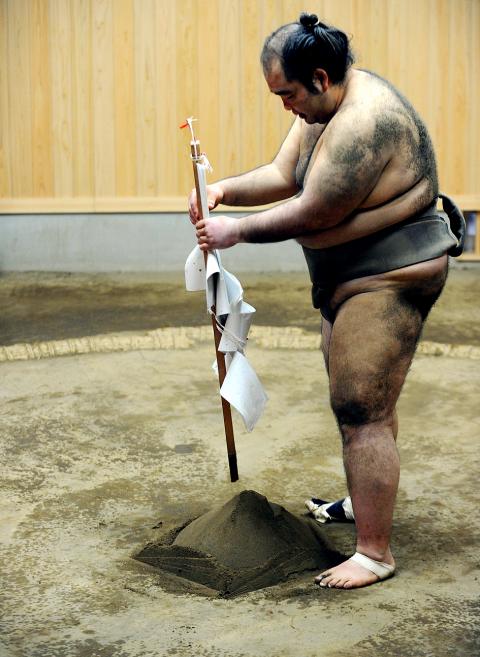
Photo: AFP
The sand is raked by bamboo brooms, sprayed with water and sprinkled with salt for purification, while the combatants wipe sweat from their bulging bodies.
A few weeks earlier, the wrestlers had performed their daily exercises in front of the body of stable founder Koki Naya — better known by his ring name of “Taiho” (Great Phoenix) — after his death on Jan. 19.
The former yokozuna (grand champion) established the stable in 1971 on his retirement from the ring.
A similar morning training regimen was taking place at Japan’s 43 other professional sumo stables, as wrestlers geared up for the next bimonthly tournament, opening on Sunday in Osaka.
The caretaker coach, Masataka Yuho, said the practice had not changed in the four decades since he joined the stable, even as it struggled through some of the scandals that have savaged the sport in recent years — marijuana use and illegal betting.
“The atmosphere is totally different, though,” said Yuho, 56, noting a rule change that allowed live-in wrestlers to own electronic gadgets. “We were banned from owning even a transistor radio when I started.”
Most of the 610 wrestlers who come under the aegis of the venerable Japan Sumo Association are lodged in stables like this one; living, eating and sleeping together in facilities that allow for little personal space.
Privacy, like respect, must be earned.
Only the 70 wrestlers in the top two divisions are permitted to live by themselves.
Japan’s declining birthrate and the growing popularity of other better-paid sports in Japan, such as baseball, have made it increasingly difficult to recruit wrestlers.
Fewer young Japanese want to endure the privations of a whole way of life to earn ¥150,000 (US$1,608) every other month, half of what new high-school graduates earn.
It is different for those at the top of a sport dominated by foreigners. Mongolian grand champion Hakuho was estimated to have earned more than ¥150 million last year in monthly wages, special allowances, sponsors’ prize money and endorsements.
“Every part of sumo life is very tough,” said Egyptian Abdelrahman Ahmed Shaalan, the highest-ranked among Otake’s eight wrestlers, who needs to climb 23 ranks to crack into the second division.
“The only joy I have is the feeling that I’m coming close to my dream” of being yokozuna, the 21-year-old said, the first professional sumo wrestler from either Africa or the Arab world.
With the ring name of “Osunaarashi” (Great Sandstorm), Shaalan — 1.89m and 145kg — has lost only five of his 35 regular matches since his debut in March last year.
After their morning workout, the wrestlers bathe and eat their first meal of the day. As in many areas of Japanese life, the younger wrestlers must wait for the older ones.
The men, aged between 19 and 32, with careers ranging from less than 12 months to 17 years, are served a heavy stew, called chankonabe, as they sit on the floor around a small table in the dining room kitchen.
On the day spent with the stable, the stew was a calorie-packed mix of chicken, vegetables and deep-fried tofu.
“We have been using more chicken since Osunaarashi joined,” the caretaker said, laughing. As a Muslim, Shaalan avoids pork and alcohol.
After lunch, wrestlers not assigned to cook or clean — each person in the stable must take his turn to do chores — are permitted to nap. Shaalan uses the time to pray.
Otake says the life of a sumo wrestler is necessarily one of austerity, all the more so after a turbulent few years that saw one young wrestler — at a different stable — die in a hazing incident.
The stable was established in 1974 when Taiho retired from the ring. He served as stablemaster until retirement in 2004, when he entrusted it to a former high-ranking wrestler who married one of his daughters.
Five of the men who passed through the stable made it into the top division, the last of which, a Russian wrestler, quit the sport in disgrace in 2008 after testing positive for marijuana.
Two years later, the then-stable master was discharged after becoming embroiled in a vast scandal involving illegal betting, which snared dozens of sumo wrestlers and elders.
Otake, one of Taiho’s disciples, became the stable’s third master.
“I have traveled across the country to apologize for the misconduct of the past,” he said.
He knows he is carrying a torch for a sport that some say has lost its way.
However, Otake says, sumo has the power to overcome these challenges because it is more than just a sport; it is a way of life.
“Wrestlers used to train themselves just to become strong, but I am telling them to become examples to people as well,” Otake said.

Fred Kerley is competing unaugmented against drug-fuelled athletes at this weekend’s Enhanced Games and still hopes to race in the 2028 Olympics, the suspended former 100m world champion said on Friday. Arguably the biggest name at the divisive event in Las Vegas, where doping is permitted, the US sprinter said he had chosen not to take any of the banned substances including testosterone and steroids that his competitors have been using. “I don’t need it. God gave me fast feet for a reason. And I’m here to showcase my talent,” Kerley said. Kerley last September became the first US competitor and first track
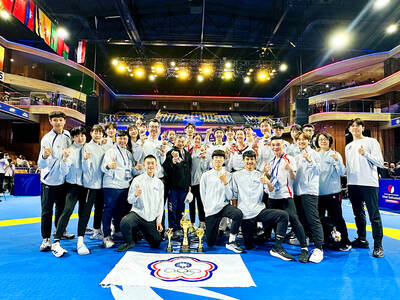
VICTORY ABROAD: The team took home a fistful of medals and secured spots for the autumn’s Asian Games, scheduled for September in Nagoya Taiwan’s women’s team captured the overall title at the Asian Taekwondo Championships in Mongolia on Sunday, finishing with two golds, one silver and one bronze medal. The strong showing, led by gold medalists Wang Chieh-ling and Chang Jui-en secured the full quota of available spots for Taiwan at the Asian Games in Nagoya, Japan, in September. Wang opened Taiwan’s medal run by winning gold in the women’s under-46kg class on Thursday, the first day of competition. Liu Yu-yun later earned a silver in the under-49kg class. On the final day on Sunday, Chang won Taiwan’s second gold medal in the under-62kg event, and

MLB is experiencing an epidemic of guys being dudes. At ballparks all across the US, groups consisting of mostly young men are joining in on the “Tarps Off” trend that is loud, goofy, infectious and new to the baseball world. Joining in on the fun is simple: Go to the section where the party is happening, take off your shirt and start twirling it above your head. Soccer-like chants or singing usually follow — injecting a jolt of energy for a sport that is occasionally chided for its lack of energy inside the stadium. After getting its start in St Louis, Missouri, on

Hull City AFC are to play Middlesbrough for a place in the Premier League after Southampton on Wednesday failed in their appeal against expulsion from the Championship playoff final for spying on opponents. Southampton were thrown out of the final on Tuesday and handed a four-point deduction for next season after they had beaten semi-final opponents Middlesbrough. “The original sanction of expulsion ... remains in place, as does the four-point deduction to be applied to the 2026/27 Championship table and the reprimand in respect of all charges,” the English Football League said in a statement. The final is to be played at Wembley


 RSS
RSS