


The small man in the baseball cap looks like any other customer as he watches Euro 2012 in the busy coffee shop. It’s not until he turns and offers a wager that his real intention is revealed.
He is a “runner” for an illegal bookmaker, one of hundreds in Singapore, a foot-soldier in a loose criminal network which rakes in millions of dollars a day across Asia — and is at the root of a global epidemic of match-fixing.
“We just sit there and pretend like we’re watching the match, but actually we’re taking bets,” the runner, who does not want to be identified, said at a quiet, undisclosed location.
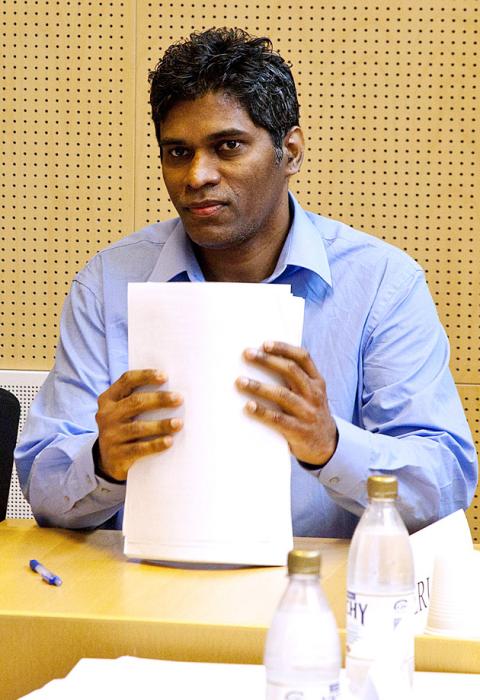
Photo: AFP
For him, big soccer events like Euro 2012 are lucrative enough to risk Singapore’s strict penalties of jail and the dreaded cane, which flays flesh from the buttocks and leaves prisoners unable to sit down.
He said there are hundreds of illegal betting operations across Singapore, each employing several runners who persuade punters to place bets, and then pay out winnings and chase up debts.
“Many [illegal bookmakers] fly by the night. So they open for a week, after that they close, take a break and then come back again,” he said. “Because it’s really illegal here — you get caught, it’s caning and jail.”
These are small-time hustlers, but from them, the money trail does not travel far before it is funding match-fixing in Asia, Africa, the Middle East, South America and Europe — including Italy’s Calcioscommesse scandal — which has all been linked to Singapore.
When Singapore’s Wilson Raj Perumal, a virtuoso fixer whose schemes extended to organizing, and then rigging, international friendlies, was arrested last year in Finland, it exposed a web which is still being untangled.
On the eve of Euro 2012, SS Lazio captain Stefano Mauri was arrested and defender Domenico Criscito was axed from Italy’s squad over the Calcioscommesse scandal, which has been tied to Perumal’s alleged boss in Singapore.
Former Italy striker Giuseppe Signori was among those arrested last year. More arrests have been made in Hungary, where Perumal is now being held after his jail term for match-fixing in Finland.
Last year, Chris Eaton, then FIFA’s head of security, said Perumal had graduated from an “academy” of match-fixing in Singapore, where criminals closely linked to the illegal bookmakers learn their trade locally, before spreading further afield.
“Wilson Raj Perumal is not alone. There are others like him [in Singapore]. Singapore seems to feature a great deal in these [match-fixing] allegations,” the former Interpol officer told Singapore’s New Paper.
Fueled by a boom in online gambling, which means customers anywhere can bet on obscure games all over the world, match-fixing has now been uncovered in dozens of countries.
For bookmakers, it’s clear when a match is fixed, because of its unusual odds. These games are usually in smaller leagues, where low-paid players and referees are susceptible to bribes.
“The most important thing is to buy the referee. Once you get the referee on your side, you can instruct him what to do, for example with penalties and free-kicks,” the Singaporean runner explained.
Match-fixing in Italy is at the top of the illegal betting tree. At its base are Singapore’s runners, who work in groups of two or three, and report by phone to a shadowy bookmaker they never meet.
Every week, after collecting their debts, runners destroy their papers, books and all other evidence, get a new temporary mobile phone number and start afresh.
“I don’t know who my boss is. I only know his voice, that’s it. The numbers change every day,” the source said.
Each bookmaker employs five or six runners and reports to a “ringleader,” who controls several bookies and their winnings, and has connections to big-time organized crime across Southeast Asia and China.
“This guy is rich. He gets money from every place — and we’re not the only umbrella, he’s got a lot of umbrellas. This ringleader is involved in a bigger organization,” the runner said.
In one well-known cafe in the city’s west, up to six groups of runners can be working at any one time, taking S$12,000 to S$13,000 (US$9,400 to US$10,200) per head, for a personal cut of S$2,000 to S$3,000 a day.
However, this face-to-face operation is nothing compared to the business done by phone and the Internet, favored by a younger, more technologically adept clientele, which is thriving in clandestine call-centers across Asia.
In Singapore these betting sweatshops, featuring computers and people taking calls, are small and temporary, employing only about four people at a time — to make it “easy to run.”
Elsewhere, the operations are more brazen.
Across the border in Malaysia, police in April raided a group of five luxury bungalows guarded by closed-circuit security cameras and arrested more than 100 people. Just days into Euro 2012, three smaller operations were busted.
“In Malaysia it’s no holds barred. Even the government officers can be bribed there, not in Singapore,” the Singaporean runner said.
Scott Ferguson, author of the “Sport is made for betting” blog and former head of education at Betfair, said stories abound of betting kingpins in Indonesia who occupy entire fortified islands, complete with girls to entertain guests and accessible only by private boat.
With their mobility and flexibility the betting networks are hard to contain and, without extensive cross-border cooperation and witness protection schemes, they’re almost impossible to stamp out, Ferguson said.
“It’s like drugs. They might have taken a couple of kingpins, but I don’t think it’s going to be a huge deterrent,” he said, referring to the demise of Perumal and his associates.
Singapore has stiff penalties for illegal bookmaking and has introduced its own state-run soccer betting.
“But the odds are terrible,” said the runner, who laughs when asked if authorities are getting a grip on the problem.
He can bear the thought of the cane and prison, and the weekly risk of being punched by a reluctant debtor. Of greater concern is getting on the wrong side of the betting underworld.
“If they find out I’m a snitch, I’m putting my family at risk. You won’t see killings or anything, but it’s more like threats,” he said. “If you’re living in a house and every day you’re being threatened by phone, they’re calling you and saying your son, your whole family’s going to die, it’s psychologically scary.”
And although he is happy to talk, even boastful about his activities, any discussion of Perumal’s alleged Singapore boss is strictly off-limits.
“We can’t talk much about that because we know one way or another, there’s definitely a link,” he said.

A runner who stopped during a marathon in China to pose doing the splits and another who hoarded energy gels have been banned for two years, the local athletics association said yesterday. The incidents happened during Sunday’s marathon in Sichuan Province’s Chengdu and were widely shared online. Videos showed a female runner stopping suddenly and dropping to the ground in the splits position, holding up her arms in a heart shape as she apparently posed for a photograph. She “committed obstructive fouls during the race, affecting the safe participation of other runners,” the Sichuan Athletics Association said in a statement, which identified
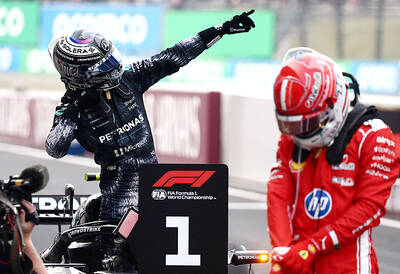
Mercedes’ Kimi Antonelli yesterday vowed to “keep raising the bar” after winning the Japanese Grand Prix to become the youngest driver in Formula One history to lead the championship standings. The 19-year-old Italian took advantage of a mid-race safety car to jump into the lead after a dreadful start from pole position, crossing the line ahead of McLaren’s Oscar Piastri and Ferrari’s Charles Leclerc. Antonelli’s Suzuka victory came two weeks after the first grand prix win of his career in China, and sent him top of the championship standings after three races, nine points ahead of team-mate George Russell. Mercedes are struggling to

Yu Yao-hsing on Tuesday nabbed Taiwan’s only goal in the final round of qualifiers for the 2027 AFC Asian Cup, as they fell 3-1 to Sri Lanka at Taipei Municipal Stadium. Early goals from Sri Lanka in the first half left Taiwan struggling to get on the board, and Christopher Tiao’s own goal at 53 minutes sealed the team’s fate in the third round of qualifiers. While acknowledging that the defeat, Taiwan’s sixth in Group D, was disappointing, head coach Matt Ross said he saw reasons to stay positive about the team’s development. “There were lots of positive signs in terms of the

INDIGESTION: Italy failed to qualify for the World Cup for a third consecutive time after a 4-1 defeat to Bosnia on penalties in a loss Gattuso said was ‘difficult to digest’ Coach Graham Arnold on Tuesday challenged his players to “shock the world” after Iraq became the 48th and final team to qualify for the FIFA World Cup with a nerve-shredding 2-1 win over Bolivia in an intercontinental playoff in Mexico, as Bosnia and Herzegovina, Turkey, the Czech Republic, Sweden and the Democratic Republic of the Congo (DRC) also secured their places at the finals. Iraq, whose preparations were disrupted by the war in the Middle East, sealed their first appearance at the finals in 40 years and are to play in Group I against France, Senegal and Norway. Goals from Ali al-Hamadi


 RSS
RSS