


Samantha Stosur outplayed three-time champion Serena Williams 6-2, 6-3 to win the US Open on Sunday, claiming the first Grand Slam title of her career in a stormy final.
Stosur kept her composure as Williams erupted in anger at the chair umpire in the second set, dominating the 13-time Grand Slam champion who had reached the final without dropping a set.
She became the first Australian woman to take the title in New York since Margaret Court in 1973 and the first to win a Grand Slam since Evonne Goolagong won Wimbledon in 1980.
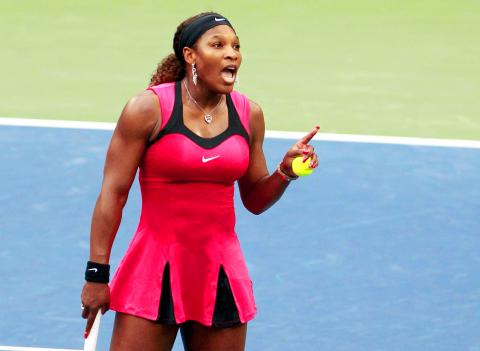
Photo: Reuters
“I had one of my best days and I’m very fortunate that I had it on this stage in New York,” Stosur said. “Ever since I started playing it was a dream of mine to be here one day.”
Williams arrived in the final after dismantling world No. 1 Caroline Wozniacki in the semi-finals on Saturday night in a match that dragged toward midnight.
“I was more tired than I expected, but I want to give all credit to Sam today ... She played really, really well. That’s what you have to do when you play a Grand Slam final,” Williams said.
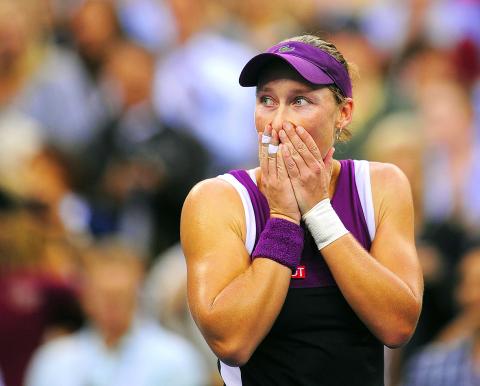
Photo: AFP
Stosur, playing her second career Grand Slam final after a runner-up finish in the French Open last year, quickly claimed the opening set, breaking Williams to lead 2-1 and winning the last 12 points of the set as Williams’ frustration grew.
Williams, whose powerful serve is a cornerstone of her game, struggled to get her first serves in and Stosur repeatedly made her pay.
“She was cracking ’em today,” Williams said of the Australian, who was still rolling in the opening game of the second frame when she gave herself a double break point with a crushing return of serve.
Williams saved one with an ace and appeared to save another for deuce, but the American’s shout of “c’mon” as soon as she unleashed her forehand came before Stosur reached the ball and umpire Eva Asderaki immediately penalized Williams for “intentional hindrance” and the point and the game went to Stosur.
“Aren’t you the one who screwed me over last time?” Williams bellowed at Asderaki. “That is totally not cool.”
The scene recalled Williams’ similar meltdown in her 2009 semi-final defeat to Kim Clijsters.
In that match, she unleashed a tirade of abuse at a lineswoman who called a foot-fault during the tense match and a penalty point sealed her fate in a 6-4, 7-5 defeat.
This time an angry Williams — backed by a suddenly energized crowd in the 22,000-seat Arthur Ashe Stadium — immediately stepped up her game, breaking Stosur for 1-1 and holding to edge ahead 2-1.
Stosur remained aloof from the dispute, but admitted the crowd response was intimidating.
“It was probably the loudest I ever felt a crowd in my whole entire life,” Stosur said. “You’re right in the middle of it. It was definitely a quite overwhelming feeling, but once I hit that next ball in the court and started playing again, I felt settled.”
Williams continued to berate Asderaki on the changeover, but Stosur stayed calm and saved two break points in the fourth game to level the set at 2-2.
Stosur said she did not really know just what was happening between Williams and the umpire.
“I was just kind of there,” Stosur said. “I do know the rule, but it’s not something I’ve ever had to deal with before.”
She gained the edge with a break for 4-3 and broke again to seal the match with yet another blistering return off a Williams second serve on her third match point.
“I don’t really know what to say,” said Stosur, whose rugged path to the final included a third-round victory over Nadia Petrova that lasted a US Open women’s record 3 hours, 16 minutes and a marathon 17-15 tiebreak loss to Maria Kirilenko, before she rallied to beat the Russian.
“Thanks to everyone back home for supporting me. All my friends, family and everyone else, thanks so much for supporting me. I look forward to coming back home,” Stosur said.
Williams had voiced her eagerness to represent the US on the 10th anniversary of the Sept. 11 attacks and she did her best to gloss over her burst of temper when it was all over.
“I was doing my best,” Williams said. “I hit a winner, but I guess it didn’t count ... But it wouldn’t have mattered anyway because she played really well.”


“I don’t remember the moment, but ever since I was a kid, that’s the first thing I loved,” two-time NBA All-Star Isaiah Thomas said of his lifelong romance with basketball. However, that journey unfolded against the limitations of his size in a game where height often dictates opportunity — a reality he confronted throughout his career. At 175cm, Thomas is less than 2cm taller than the average Taiwanese adult male, while NBA players during his career stood at about 200cm on average. Compared with the NBA’s average career length of less than five years, Thomas’ 13-season career stands out as

Dakar and Rabat have longstanding ties, but relations have been strained since the Africa Cup of Nations (AFCON) final, which Senegal won in mid-January before being stripped of the title, which was transferred to Morocco. Now, the AFCON trophy is something of a thorn in the two countries’ sides. On Rue Mohamed V, the street where Moroccan vendors are based in the Senegalese capital, a police van is parked. “The police have been on high alert since the Confederation of African Football [CAF] decided to award the title to Morocco, but there have been no incidents,” a local resident said.
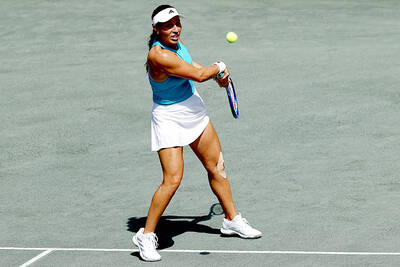
Top seeded Jessica Pegula on Friday once again fought back from a set down to reach the WTA Charleston Open semi-finals with a 3-6, 6-3, 6-2 win against Russia’s Diana Shnaider. Defending champion Pegula has lost the first set in all three of her matches at the tournament so far, but again dug deep to maintain her hopes of retaining the title. The world No. 5 from the US took 2 hours, 10 minutes to defeat 19th-ranked Shnaider, relying on a formidable service game that included eight aces. Shnaider battled well in the first two sets and broke early for a 2-0 lead

Cambridge on Saturday made it four wins in a row as they comprehensively defeated Oxford in the 171st University Boat Race on London’s River Thames. It was Cambridge’s seventh win in the past eight years of a rowing race between England’s two oldest universities first staged in 1829. A world-class Cambridge crew were heavy favorites for victory. However, four minutes into the race, the crews came close to a clash of oars which could have caused severe disruption, with Oxford repeatedly warned as both team chased faster conditions in the middle of the river. For the first time in the


 RSS
RSS