


A headline in the New York Sun on Sept. 4, 1940, captured accurately, albeit with amused condescension, the startling anomaly embodied by Conchita Cintron: “She’s a Timid Blue Eyed Girl But — She Kills Bulls Without Qualms.”
Cintron was 18 years old then and, as the headline went on to announce, had never been on a date, but she was already an international star of the bullring, a prodigy who was on her way to becoming perhaps the most celebrated torera in history. She was known as la Diosa Rubia, the “Blonde Goddess.”
“I have never had any qualms about it,” she said of her deadly skill in the article. “A qualm or a cringe before 1,200 pounds of enraged bull would be sure death.”
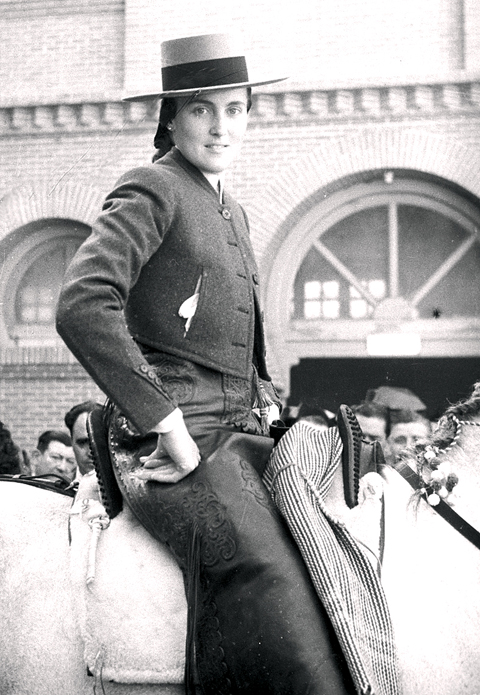
PHOTO: AP
Cintron, who retired from bullfighting after having killed as many as 750 bulls in the ring, died in Lisbon on Tuesday. She was 86.
The cause of death was a heart attack, family members told the Portuguese news agency Lusa. Her death and burial were confirmed by a funeral agency and a local church, The Associated Press (AP) reported.
“She made an indelible mark on a period of bullfighting history,” Hugo Ferro, of the Portuguese Bullfighters’ Union, said in an interview with AP.
Cintron, an expert horsewoman and a dedicated athlete who was known for her seriousness of purpose and serene manner, was unusual in that she mastered two styles of bullfighting: Spanish, in which the matador (or matadora, in her case) is on foot, and Portuguese, in which the bullfighter is on horseback and known as a rejoneador or rejoneadora. She was one of the very few — if not the only, as some reports said — who used both styles in the same fight, opposing the bull first on foot, giving it a series of cape passes; then on horseback, from which she provoked the bull with short, barbed sticks; and finally making the kill, once again on foot.
She was injured many times in the ring and seriously gored twice, once in each thigh; both times she fought on and killed the bull. She described the technique of killing a bull in an interview with AP in 1940.
“The bull to a certain extent commits suicide when he charges,” she said. “There is a little spot just forward of the shoulders which is not exposed to the matador’s sword unless the bull is charging.”
She continued: “No, it doesn’t take great strength to kill a bull. It does take a keen eye, a steady nerve and a true hand. But if the sword strikes the proper spot, it penetrates easily.”
She was born Concepcion Cintron Verrill in Antofagasta, Chile, on Aug. 9, 1922. Her parents were American. Her father, Frank Cintron, was from Puerto Rico, a graduate of West Point and for a time a career Army officer before becoming a businessman in South America. Her mother, Loyola Verrill, was from Connecticut; in 1960 she wrote a book about her daughter’s life, Goddess of the Bullring, under the name Lola Verrill.
When Cintron was still an infant, the family moved to Lima, Peru, where she grew up and where she came under the tutelage of Ruy da Camara, once a renowned rejoneador, who had just opened a riding school. He was taken with her, then age 11. She became his prize pupil, and in the early years of her international travel he was her chaperon. “My maestro,” she called him throughout her life.
Da Camara also tutored her in fighting bulls on foot — and killing them. She entered the bullring for the first time in Portugal at 13; she killed her first bull, in Tarma, Peru, at 15. When her autobiography, Memoirs of a Bullfighter, was published in 1968, an article in Vogue described how she got used to the idea of killing by practicing at a slaughterhouse, for days on end jabbing in vain at doomed oxen with a dagger.
“Day after day, sick at the gore, she went back to stab at more animals who bellowed and did not die,” the Vogue reporter, Robert Daley, wrote. “A friend told her she was closing her eyes with each stroke and thus missing the vital spinal gap behind the horns; she hated the idea of killing as much as that. She determined to kill that day’s six oxen with six strokes, keeping her eyes open, or give up bullfighting. She killed them each instantly, painlessly, and returned to Lima, singing.”
In 1949, Cintron, who had fought in Mexico, Peru, Venezuela, Colombia, Ecuador, Portugal, Spain and France, declared she would give up bullfighting to get married if she should find a suitable man, an intellectual “who can dominate me,” she said in an interview with the New York Post. “All my professional life I have been dominating bulls, and I don’t want that to happen to the man I choose to marry.”
In 1951, she married Francisco de Castelo Branco, da Camara’s nephew, a businessman and big-game hunter from a titled Portuguese family. They had a son, who survives her.
In her retirement she became an unofficial diplomat, working with the Peruvian embassy in Portugal, and a breeder of hardy Portuguese water dogs.
Her final bullfight was legendary (some sources say it was her penultimate fight). It was in Jaen, Spain, in 1949, and as the fight ended, she flouted the Spanish law that prohibited women from fighting a bull on foot. Dismounting, she allowed the bull to approach her but did not kill it, touching the bull lovingly with her hand instead as it hurtled by her. Another bullfighter completed the killing. She was immediately arrested, and then pardoned, as the crowd cheered, and she was awarded the highest honor of the ring: both of the bull’s ears and the tail. She wept as she left the arena.

Taiwan’s top male badminton player, Chou Tien-chen, on Saturday bowed out in the men’s singles semi-finals at the Thailand Open after losing in straight games to Thailand’s Kunlavut Vitidsarn. The world No. 6 Chou, seeded fourth at the Super 500 tournament, lost to the world No. 2 Thai 21-7, 21-19 in 53 minutes. The victory improved Vitidsarn’s head-to-head record against Chou to 3-5. Chou, 36, trailed throughout the opening game after the score was tied 2-2. His relatively passive approach allowed the 25-year-old Thai to capitalize on Chou’s defensive clears with powerful smashes while committing few unforced errors. The Taiwanese

FRUSTRATION: Gauff smacked herself on the head with her racket before storming down the tunnel, emerging afterward to have a heated discussion with her coach Elina Svitolina on Saturday won the Italian Open after beating Coco Gauff 6-4, 6-7 (3/7), 6-2 to claim her third Rome title, while Jannik Sinner set a date with Casper Ruud in the men’s final. Ukraine’s Svitolina had not claimed a WTA 1000 title since her last victory at the Foro Italico eight years ago, but prevailed over the ever-erratic Gauff to claim her 20th tournament triumph. Saturday’s win over Gauff was her third in a row against a player in the top four of the world rankings — including Iga Swiatek and Elena Rybakina — ahead of the French

West Ham United’s 3-1 defeat at Newcastle United on Sunday left Tottenham Hotspur realistically only needing one more point to win the battle for English Premier League survival, while Bruno Fernandes made history in Manchester United’s 3-2 win over Nottingham Forest. Spurs can avoid dropping out of the English top flight for the first time in nearly 50 years with victory at Chelsea today, but a draw would also likely suffice thanks to their much superior goal-difference over West Ham. “Overall bad performance. Too many things [went wrong], I think we gifted them the goals,” West Ham head caoch Nuno Espirito Santo

MLB is experiencing an epidemic of guys being dudes. At ballparks all across the US, groups consisting of mostly young men are joining in on the “Tarps Off” trend that is loud, goofy, infectious and new to the baseball world. Joining in on the fun is simple: Go to the section where the party is happening, take off your shirt and start twirling it above your head. Soccer-like chants or singing usually follow — injecting a jolt of energy for a sport that is occasionally chided for its lack of energy inside the stadium. After getting its start in St Louis, Missouri, on


 RSS
RSS