


A three-story factory owned by a major Taiwanese electronics company collapsed yesterday in eastern Thailand, killing at least eight workers and injuring 57 others, officials said.
Police said about 100 female night-shift staff were working at the Delta Electronics Thailand factory when it collapsed at about 4am yesterday.
Anusorn Mutahid, a company executive, said six women workers and a man were killed while three women were unaccounted for. Police Lieutenant General Pichit Kruanthechkup, who headed the rescue operation, said 57 female workers were injured.
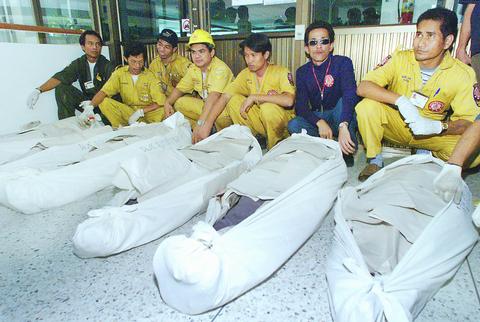
PHOTO: REUTERS
Pichit told reporters that it appears the roof of the building cracked and tore apart under the load of some 30 tonnes of air-conditioning equipment installed on it.
Hundreds of rescue workers and police burrowed into the collapsed factory as morning shift workers arrived to discover many of their colleagues trapped under ceiling mortar, iron beams and shattered air-conditioning equipment.
"I heard a loud crack and suddenly everything was falling down over our heads," Napa Nanta, 18, a worker who suffered cuts on her head, said from her hospital bed.
Delta Electronics Thailand, a listed company on the Thai stock exchange, is a subsidiary of Taiwan's Delta Electronics (
The computer-parts manufacturer is one of the few success stories in the depressed electronics industry and had jumped into the market for liquid-crystal-display screens by clinching a deal to supply flat-screen monitors to Japan's Sony Corp.
Delta was expected to earn at least US$200 million in sales of LCD monitors this year, up from US$10 million last year.
Its facilities are located in Bang Pu in Samut Prakarn province, about 30km east of Bangkok.
The 4,500m2 collapsed unit is part of a sprawling complex of five Delta factories that employ 14,000 people. Most of the factory workers are women who work in an around-the-clock operation.
Industry Minister Suriya Juengrungruangkit, who inspected the site, ordered the temporary suspension of work at the collapsed unit but said the other four units would continue to operate.
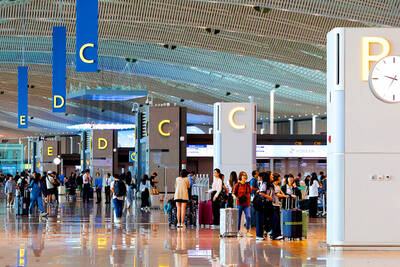
South Korea has adjusted its electronic arrival card system to no longer list Taiwan as a part of China, a move that the Ministry of Foreign Affairs said would help facilitate exchanges between the two sides. South Korea previously listed “Taiwan” as “Taiwan (China)” in the drop-down menus of its online arrival card system, where people had to fill out where they came from and their next destination. The ministry had requested South Korea make a revision and said it would change South Korea’s name on Taiwan’s online immigration system from “Republic of Korea” to “Korea (South),” should the issue not be

Tainan, Taipei and New Taipei City recorded the highest fines nationwide for illegal accommodations in the first quarter of this year, with fines issued in the three cities each exceeding NT$7 million (US$220,639), Tourism Administration data showed. Among them, Taipei had the highest number of illegal short-term rental units, with 410. There were 3,280 legally registered hotels nationwide in the first quarter, down by 14 properties, or 0.43 percent, from a year earlier, likely indicating operators exiting the market, the agency said. However, the number of unregistered properties rose to 1,174, including 314 illegal hotels and 860 illegal short-term rental
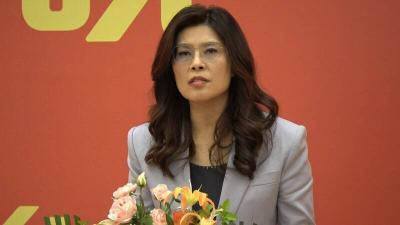
Both sides of the Taiwan Strait share a political foundation based on the “1992 consensus” and opposition to Taiwanese independence, Chinese Nationalist Party (KMT) Chairwoman Cheng Li-wun (鄭麗文) today said during her meeting with Chinese President Xi Jinping (習近平). Both sides of the Strait should plan and build institutionalized and sustainable mechanisms for dialogue and cooperation based on that foundation to make peaceful development across the Strait irreversible, she said. Peace is a shared moral value across the Strait, and both sides should move beyond political confrontation to seek institutionalized solutions to prevent war, she said. Mutually beneficial cross-strait relations are what the
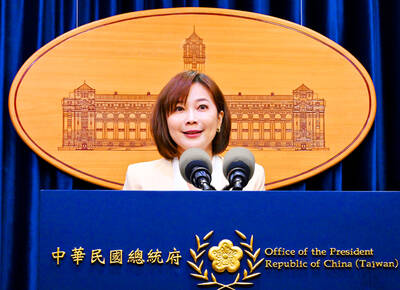
ECONOMIC COERCION: Such actions are often inconsistently applied, sometimes resumed, and sometimes just halted, the Presidential Office spokeswoman said The government backs healthy and orderly cross-strait exchanges, but such arrangements should not be made with political conditions attached and never be used as leverage for political maneuvering or partisan agendas, Presidential Office spokeswoman Karen Kuo (郭雅慧) said yesterday. Kuo made the remarks after China earlier in the day announced 10 new “incentive measures” for Taiwan, following a landmark meeting between Chinese President Xi Jinping (習近平) and Chinese Nationalist Party (KMT) Chairwoman Cheng Li-wun (鄭麗文) in Beijing on Friday. The measures, unveiled by China’s Xinhua news agency, include plans to resume individual travel by residents of Shanghai and China’s Fujian


 RSS
RSS