


The government backs healthy and orderly cross-strait exchanges, but such arrangements should not be made with political conditions attached and never be used as leverage for political maneuvering or partisan agendas, Presidential Office spokeswoman Karen Kuo (郭雅慧) said yesterday.
Kuo made the remarks after China earlier in the day announced 10 new “incentive measures” for Taiwan, following a landmark meeting between Chinese President Xi Jinping (習近平) and Chinese Nationalist Party (KMT) Chairwoman Cheng Li-wun (鄭麗文) in Beijing on Friday.
The measures, unveiled by China’s Xinhua news agency, include plans to resume individual travel by residents of Shanghai and China’s Fujian Province to Taiwan, and to push for the “full normalization” of direct cross-strait passenger flights to facilitate travel and exchanges between people on both sides of the Taiwan Strait.
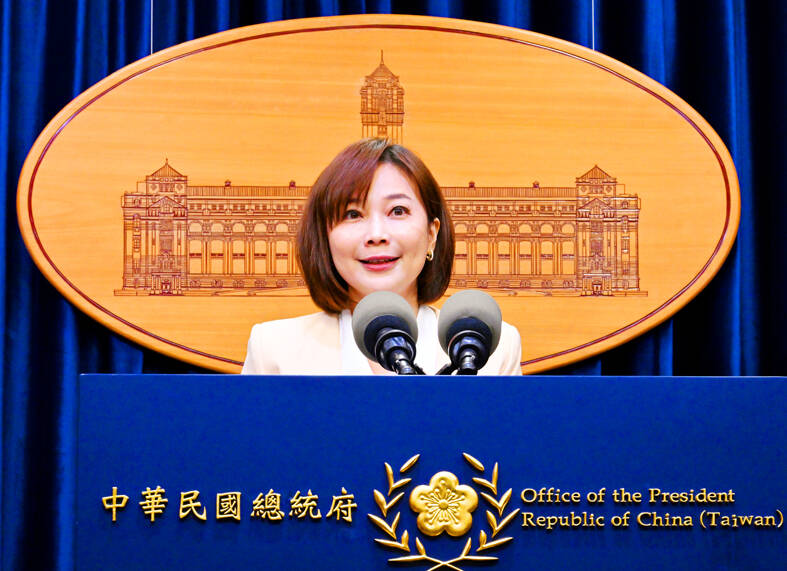
Photo: Taipei Times
China would support the resumption of flights between Taiwan and Chinese cities, such as Urumqi, Xian, Harbin, Kunming and Lanzhou, Xinhua said, adding that it would also support Kinmen County’s shared use of Xiamen Xiangan International Airport, which is still under construction.
Kinmen is an outlying county off the coast of China’s Fujian Province, with some of its islands as close as 2km from Xiamen.
Other proposals in the report included closer infrastructure links between Fujian and Kinmen and Lienchiang (Matsu) counties; easier access for Taiwanese agricultural, fishery and food products to the Chinese market; and studies on building docks and berths in certain areas to serve Taiwan’s distant-water fishing vessels and facilitate the landing of their catches.
Chinese authorities would support Taiwanese small and medium-sized enterprises in China, and allow broader access on Chinese platforms for Taiwanese television dramas, documentaries and animated works deemed to have the “correct orientation” and “healthy content,” Xinhua said.
For years, China has frequently instrumentalized and weaponized cross-strait exchanges, with its so-called “measures” marked by unpredictability, Kuo said.
Such actions are often inconsistently applied — sometimes resumed, sometimes abruptly halted, and at times opened selectively under vague justifications, she said, adding that this practice has caused significant, often unpredictable damage to Taiwan’s industries, and agricultural and fishing sectors.
The 10 measures largely mirror past actions, which have been inconsistently applied, and disregard market mechanisms and international standards, Kuo said.
As in previous instances, China has bypassed established channels for dialogue with the Taiwanese government, she added.
“The key question now is whether China will once again use cross-strait issues as a tool of economic coercion and repeat its previous tactics,” she said, adding that if China is genuinely committed to advancing these initiatives, it should engage through established communication channels and negotiate directly with Taiwanese authorities to ensure arrangements that support the healthy and orderly development of cross-strait exchanges.
Executive Yuan spokeswoman Michelle Lee (李慧芝) yesterday also criticized the measures, saying that experience has repeatedly shown that this is a form of cross-strait coercion, “where exchanges are instrumentalized, and economic and trade relations are weaponized for united front tactics.”
The Mainland Affairs Council yesterday said China’s so-called “favorable” measures for Taiwan are sugarcoated poison that would cause significant losses to Taiwan’s farmers, fishers and industries.
The so-called trade concessions, which claimed to facilitate cross-strait exchanges and cooperation, are not a genuine gift pack, as they are often unilaterally withdrawn or suspended for arbitrary reasons, the council said.
The “favorable” measures for Taiwan are no different from the past measures that could not stand the test of time, it said, calling them bait-and-switch tactics that are economic coercion designed to trick and trap Taiwanese farmers and fishers.
Beijing is bypassing Taiwan’s democratically elected government while seeking to recast cross-strait relations under a KMT-Chinese Communist Party (CCP) framework and a “one China framework,” it said.
The measures are part of the political transactions between the KMT and the CCP, with the costs borne by Taiwanese, it said.
Any cross-strait matters involving Taiwanese must be negotiated between the two sides’ governments based on equality and dignity to be effective, and to safeguard people’s rights and welfare, the council said.
Any “normalized communication mechanisms” or “exchange platforms” established by the KMT and CCP bypassing state authority must not contravene the law, it added.
Beijing has weaponized cross-strait exchanges for political ends, as such policies are marked by uncertainty and selective application to specific target groups, it said.
The government has a responsibility to ensure Taiwan’s economy and industries are not exposed to such risks and prevent such policies from being used as tools for political infiltration and election interference, it added.
While the CCP has claimed to promote resumption of direct flights, “links” for Kinmen and Lienchiang, and even floated support for Kinmen sharing the Xiamen airport, such matters require government-to-government engagement, as they involve national security and public authority, the council said.
Those are cross-border infrastructure and transport issues that involve aviation safety, customs, quarantine and the movement of people, all of which require official assessment, participation and formal negotiations between governments, it said.
Beijing should not evade negotiations with the Taiwanese government for political reasons, it said.
The government supports healthy and orderly cross-strait exchanges under the core principle of safeguarding national interests, the council said, adding that any exchanges must not carry political preconditions or serve as bargaining chips in party politics.
The opposition parties should avoid facilitating such maneuvers, especially given that past “favorable measures” have been used by Beijing as tools of economic coercion against Taiwan, it added.
The council urged Beijing to face the reality that Taiwan and the People’s Republic of China are not subordinate to each other, acknowledge the existence of the Republic of China and resume regular dialogue with Taiwan’s legitimately elected government.
This is the proper path to promoting peace and advancing people’s welfare, it said.
An official speaking on condition of anonymity said that while the measures were widely promoted as a major gift by pro-China media outlets in Taiwan, it is, at best, a part of a “turn-on, turn-off” playbook rather than a sincere offer.
The measures are not new, but rather a repetition of past tactics, they said, adding that they are part of a long-standing “united front” script aimed at integrating Taiwan and influencing its elections.
“The CCP is setting the stage for the KMT,” the official said.
This has been the pattern for the past 20 years, they said, adding that farmers, fishers and those in the tourism sector should remain cautious, and remember painful past experiences.
Taiwan should not become reliant on such recurring political maneuvers, as they pose risks to national security, individual industries and personal interests, the official said.
Additional reporting by Chen Yu-fu

DRONE CENTRAL: Taiwan aims to become Asia’s democratic hub for drones, with most exports focused on high-quality military-grade models, an official said Taiwan’s drone industry is expected to expand significantly by 2030, producing 100,000 units per month and exporting half of them, the Ministry of Economic Affairs said yesterday. Current drone production capacity is about 15,000 units per month, but the industry can quickly scale up as demand increases, Industrial Development Administration Director-General Chiou Chyou-huey (邱求慧) told a news conference in Taipei. Taiwan’s drone output grew 2.5-fold last year to NT$12.9 billion (US$408.3 million) under a government program to develop the uncrewed vehicle sector, he said. The Executive Yuan in October last year approved plans to invest NT$44.2 billion into domestic production of uncrewed aerial
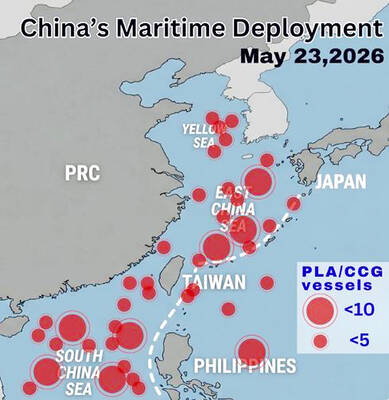
WARNING: China should stop engaging in actions that undermine regional peace and stability, as it would only build resentment among people across the Strait, the CGA said China has deployed more than 100 navy, coast guard and other vessels in waters from the Yellow Sea to the South China Sea and the western Pacific since US President Donald Trump and Chinese President Xi Jinping (習近平) met in Beijing, National Security Council Secretary-General Joseph Wu (吳釗燮) said yesterday. “In this part of the world, #China is the one & only PROBLEM wrecking the #StatusQuo & threatening regional peace & stability,” Wu wrote on X. In a separate post, he said Beijing was coercing Taiwan’s maritime domain, calling it illegal and provocative, after the Coast Guard Administration (CGA) expelled a
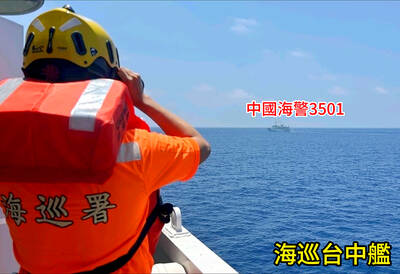
VERBOSE VESSELS: A CGA cutter and a China Coast Guard exchanged verbal barbs for more than a day in Taiwanese-controlled waters before the Chinese vessel left The Taiwanese and Chinese coast guards had a standoff near the strategically located Pratas Islands (Dongsha Islands, 東沙群島) in the north of the South China Sea, the Coast Guard Administration (CGA) said yesterday. The two sides engaged in intense radio exchanges over sovereignty claims during the 33-hour standoff. China Coast Guard vessel 3501 eventually left the restricted waters, 26.6 nautical miles (49.2km) west of the Pratas Islands, at 5pm yesterday, the CGA said. Lying approximately between southern Taiwan and Hong Kong, the Taiwan-controlled Pratas are seen by some security experts as vulnerable to Chinese attack due to their distance — more than
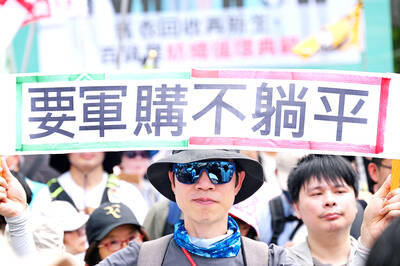
More than 8,000 people took part in a rally in Taipei yesterday to express support for more defense spending, after the opposition slashed the Cabinet’s proposed NT$1.25 trillion (US$39.6 billion) special defense budget and capped it at NT$780 billion. The demonstrators urged the Cabinet to propose another bill. Taiwan Economic Democracy Union convener Lai Chung-chiang (賴中強) said the main problem of the passed budget plan is the removal of funding for critical items, not just that the total amount is smaller. Critical budget items included purchasing or developing uncrewed vehicles, Strong Bow (強弓) missile systems, additional ammunition, artificial intelligence-powered combat systems and Taiwan-US


 RSS
RSS