


The Taiwan Association of University Professors (台灣教授協會) voiced its opposition to the establishment of casinos on Taiwan's offshore islands in a press release yesterday.
On Oct. 15 last year, the Finance Committee and the Home and Nations Committee of the Legislative Yuan passed draft amendments to the Offshore Islands Development Act (
The amendments are now awaiting review by the legislature.
"We want to impress upon legislators and parties promoting casinos on Taiwan's offshore islands that they are endorsing a policy that will have a seriously negative social impact and will have repercussions for our children and grandchildren," the press release said.
The Ministry of Justice and the Ministry of the Interior have both opposed the idea, while the legislative caucus of the ruling DPP has also made it clear that it will accept no partisan negotiations on the issue.
The press release gave four reasons for opposing casinos on the offshore islands.
First, legalized gambling will have a negative impact on Taiwan's political, economic, social and security issues, the release said.
Second, studies from the US show that the establishment of casinos has not led to economic renewal, but rather, the accompanying "replacement effects" and "swallowing effects" have led to the death of local economies, according to the release.
Third, legalized gambling will cause a widespread failure in public security, the press release said.
Quoting figures from the Las Vegas Journal, the release said Nevada was the third most dangerous US state in which to live in 1995. Crime rates in Las Vegas were also the highest in the US, according to 1996 figures from the Las Vegas Sun. Nevada also has the highest suicide rate, highest rate of convicted tax evaders, highest number of chronic gamblers, highest rate of high-school drop-outs and highest divorce rate. The release also quoted studies showing Nevada has the third-highest abortion rate, third-highest number of bankruptcies, fourth-highest percentage of children born out of wedlock, fourth-highest number of rapes, fourth-highest rate of alcohol-induced deaths and the lowest voting rate.
Fourth on the list of concerns, the gambling industry is very "politically influential," according to the release.
Atlantic City records show that four of the city's past six mayors have been accused of involvement in illegal gambling-related activities. As well, former Louisiana governor Edwin W. Edwards and his son were convicted in May 2000 for bribery and corruption related to the issuing of licences for riverboat casinos. Bribery and corruption convictions are rare in the US, but in the process of legalizing gambling, officials are frequently convicted for these crimes, said the professors' association.
Fifth, the gambling industry spreads fast, the release said.
Casinos are normally restricted at first but use political donations to influence policies to gradually relax these restrictions. In the US, only three states originally allowed gambling. Today, there are only three states that prohibit the practice. Some states originally allowed gambling only on boats that were not anchored in harbors, while gambling is now is allowed on shore.

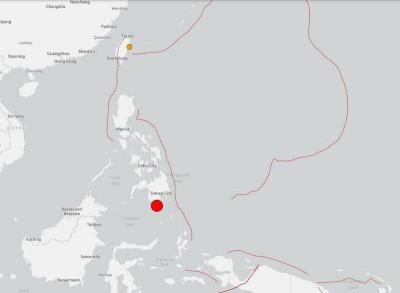
A magnitude 7.8 earthquake struck off the southern coast of Mindanao in the Philippines at 7:38am today, prompting the US Tsunami Warning System to issue an alert for neighboring countries, including Taiwan. The system issued a purple alert indicating a "tsunami threat." The potential threat zone includes Taiwan, the Philippines, Papua New Guinea, Yap and Palau. A spokesperson for Indonesia disaster mitigation agency said there were no reports of damage so far. Arlene Hollero, disaster chief of Maasim town in the Philippines' Sarangani Province, said their evacuation was underway in coastal villages and there were no reported casualties so far. DZBB radio, broadcasting from the

RESILIENCE: Taiwan plays a key role in semiconductors, energy, information infrastructure and advanced manufacturing, AIT Director Raymond Greene said Taiwan’s continued investment in deterrence and resilience remains vital, especially in uncrewed systems and other emerging technologies, American Institute in Taiwan (AIT) Director Raymond Greene said yesterday. Greene made the remarks at the annual National Strategic Summit on Supply Chain Resilience held by the Research Institute for Democracy, Society and Emerging Technology (DSET), a government-backed think tank. As Taiwan last year became the US’ fourth-largest trading partner and supply chain security is becoming more important, cooperation in emerging technologies continues to deepen between the two countries, he said. The US is committed to accelerating innovation, building key infrastructure, strengthening cooperation

The National Chungshan Institute of Science and Technology yesterday showcased its locally developed variants of the Vision 60 robotic patrol dog, which it plans to deploy on the nation’s outlying territories in the South China Sea. The variants were produced under the Joint Lab project — created by the institute and domestic companies — and assembled with domestically produced motors, lenses and artificial intelligence (AI) systems alongside licensed tech from the US, Missile and Rocket Systems Research Division deputy director Jen Kuo-kang (任國光) told the media event at a military base in Taipei’s Dazhi (大直) area. Taiwan has built up its strengths

RIGHT DIRECTION: Taiwan’s efforts to prevent forced labor include a proposal to ‘fully prohibit’ employers from withholding workers’ documents, an official said Taiwan is to establish a mechanism to restrict imports of goods linked to forced labor, the Executive Yuan said yesterday, after the US proposed imposing additional tariffs on Taiwanese goods over labor concerns. “The Ministry of Labor and the Ministry of Economic Affairs are to establish an interministerial review procedure,” Executive Yuan spokesperson Michelle Lee (李慧芝) said at a news briefing in Taipei. “The government is to use the Foreign Trade Act [貿易法] as the legal basis to restrict imports of goods produced with forced labor” and bring its supply chain governance more in line with international standards on human rights, resilience


 RSS
RSS