


In May as ties between Taiwan and Macedonia became increasingly shaky, Skopje-based Taiwanese diplomats frequently holed up in their embassy for last-hour trouble-shooting sessions, drawing grumbles from their Macedonian landlord.
"The landlord said while staffers at the adjacent French embassy finished their work around 3pm to 4pm everyday, staffers in the Taiwanese embassy did not leave the office until midnight. The landlord complained about the situation, saying the rent paid would not be enough to pay for electricity costs in the building," said a foreign ministry official.
But long-working hours are just one of many challenges faced by those who endeavor to secure Taiwan's diplomatic allies.
In the minds of most, one of their biggest difficulties is in dealing with the identity questions, adjustment problems and language barriers that frequently confront their children.
"I've heard of examples in which some of these diplomats' children will find themselves rootless" as they are forced to constantly change their environment because of the nature of their parents' work, said Nancy Du (
Alexander Yui (
"Once I went to visit the home of one of my father's colleagues. His child was born overseas and at the time spent little time in Taiwan. I went to the child's room and saw his assignment in the American School was to write about `my country.' And he wrote, `my country is Spain.' This made me have a deep stirring of emotion and I think it [the lack of a clear identity] is indeed a woeful aspect of being a diplomat's child," Yui said.
Nancy Du also said she used to hear of stories of how her counterparts married locals in the countries their fathers were posted and how these in-laws ended up being unable to communicate with their new family.
"At the end of the day, they probably felt a sense of loss for a rather long time," said the 32-year-old Du, a professional interpreter for Taiwan's delegation to APEC for the past seven years.
As it is often the case that these diplomats' children move frequently from country to country, it's difficult to maintain lasting friendships. Sometimes the question of adaptability can also create problems.
"You get to know the world. You get to know a lot of people and a lot of countries. But you don't get to know them for long. It's hard to maintain a long and steady relationship with anyone as the environment is constantly changing," Yui said.
Yui relocated frequently because of his father's work. At the age of two, Yui moved to Ecuador with his family. Two years later, they moved again to Bolivia.
At 7, he returned to Taiwan, and the next year he was transferred to Colombia where he stayed for the following three years before going to Ecuador. After a year in Ecuador, Yui returned to Taiwan for two years. Later he went to high school in Panama and then to the US for his first and second degrees.
"One is either forced to adapt fairly quickly to the new environment or face becoming self-enclosed or reserved," the 37-year-old diplomat said.
While Du said she learned to fit in quite quickly and that she gained "this great adaptability" because of her frequent moves, she said her younger brother did not fare so well.
"He was unable to adjust to new environments quickly and lacked a sense of security. Every time our surroundings changed, his self-esteem would be effected. So when he returned to Taiwan for college, he was at one point rather depressed," Du recalled.
Aside from identity issue and adjustment challenges, sometimes Taiwanese diplomats' children may lose contact with mandarin-speaking environments thus finding themselves unable to manage Chinese very well.
For example, when retired ambassador Loh I-cheng (陸以正) published his book titled If this was America: Taiwan through the Eyes of a Retired Diplomat (如果這是美國:一位退休外交官看台灣) in March, he shrugged off his wife's suggestion to send a few copies of the book to all of his children, now residing in America, given their limited reading ability in Chinese.
But when these challenges are dealt with skillfully, the chance to widely explore diverse cultures can be a great asset for diplomats' children.
The professional interpreter said that it was this "traverse of dual cultures" that enabled her to choose a career as an interpreter.
"The best part [of being a diplomat's child] is that I was able to make contact with another culture," said Du, who received 16-years of education in South Africa before returning to Taiwan for college as well as graduate school.
In Yui's case, he said it was his father that encouraged him to pursue a career as a diplomat, telling him the diplomatic "front line" was the "real battlefield" for the tug-of-war between Taipei and Beijing.
Yui said witnessing his father's endeavors as a diplomat made him believe that "it's an honorable direction to take."
"I saw how onerous my father's job was during the 1970s when Taipei and Beijing engaged in a fierce tug-of-war and when Taiwan withdrew from the United Nations ... Seeing my father's generation serve the country as diplomats when the overall environment was shabby and the salaries were poor -- I found them very admirable," said Yui, who joined the foreign ministry in 1989.
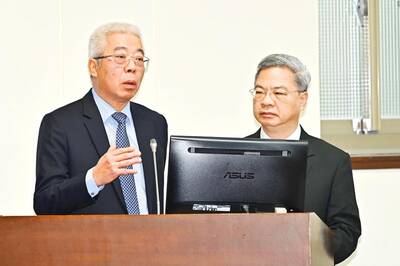
Taiwan has arranged for about 8 million barrels of crude oil, or about one-third of its monthly needs, to be shipped from the Red Sea this month to bypass the Strait of Hormuz and ease domestic supply pressures, CPC Corp, Taiwan (CPC, 台灣中油) said yesterday. The state-run oil company has worked with Middle Eastern suppliers to secure routes other than the Strait of Hormuz, through which about 20 percent of the world’s oil and liquefied natural gas typically passes, CPC chairman Fang Jeng-zen (方振仁) said at a meeting of the legislature’s Economics Committee in Taipei. Suppliers in Saudi Arabia have indicated they
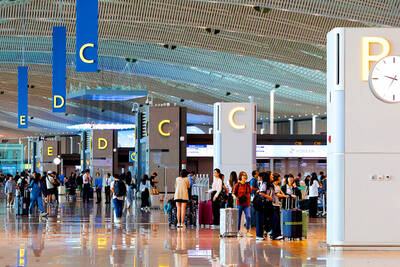
South Korea has adjusted its electronic arrival card system to no longer list Taiwan as a part of China, a move that the Ministry of Foreign Affairs said would help facilitate exchanges between the two sides. South Korea previously listed “Taiwan” as “Taiwan (China)” in the drop-down menus of its online arrival card system, where people had to fill out where they came from and their next destination. The ministry had requested South Korea make a revision and said it would change South Korea’s name on Taiwan’s online immigration system from “Republic of Korea” to “Korea (South),” should the issue not be
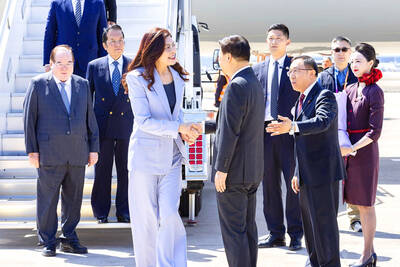
CCP ‘PAWN’? Beijing could use the KMT chairwoman’s visit to signal to the world that many people in Taiwan support the ‘one China’ principle, an academic said Chinese Nationalist Party (KMT) Chairwoman Cheng Li-wun (鄭麗文) yesterday arrived in China for a “peace” mission and potential meeting with Chinese President Xi Jinping (習近平), while a Taiwanese minister detailed the number of Chinese warships currently deployed around the nation. Cheng is visiting at a time of increased Chinese military pressure on Taiwan, as the opposition-dominated Legislative Yuan stalls a government plan for US$40 billion in extra defense spending. Speaking to reporters before going to the airport, Cheng said she was going on a “historic journey for peace,” but added that some people felt uneasy about her trip. “If you truly love Taiwan,
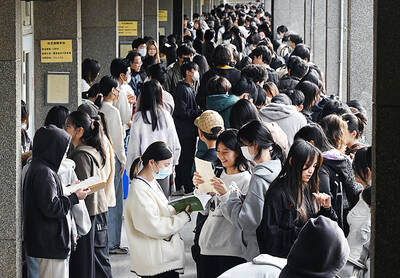
A global survey showed that 60 percent of Taiwanese had attained higher education, second only to Canada, the Ministry of the Interior said. Taiwan easily surpassed the global average of 43 percent and ranked ahead of major economies, including Japan, South Korea and the US, data from the Organisation for Economic Co-operation and Development (OECD) for 2024 showed. Taiwan has a high literacy rate, data released by the ministry showed. As of the end of last year, Taiwan had 20.617 million people aged 15 or older, accounting for 88.5 percent of the total population, with a literacy rate of 99.4 percent, the data


 RSS
RSS