


The price was hard to beat.
"For NT$80 only, all of A-mei's (
The alluring price tag was less than one third of what one could expect to pay for the pop diva's album at a music store. It probably also explains why the night market vendor had little problem drawing a crowd of customers.
But while the proprietor was counting up his receipts, he also kept a watchful eye out for police who might pull the plug on his business: The sale of pirated music.
While there are no hard numbers, there's plenty of anecdotal evidence to suggest that the market for pirated music is booming in Taiwan. At night markets around the country, it's common to see vendors hawking cheap knock offs of popular musicians' albums -- and they practically go for a song.
`FRUSTRATED'
"Sometimes you feel so frustrated by the rampant piracy that you think you are going to quit," said songwriter Chen Yu-jen (
According to the International Federation of the Phonographic Industry (IFPI) in Taiwan, album sales are an NT$10 billion business in Taiwan, but roughly 30 percent of that are pirated and counterfeit albums for which artists are not paid. The figure is about 10 percent higher than in 1997, according to the federation.
The industry estimates that 80 percent of all pirated albums distributed in Taiwan are sold at night markets, while the remainder are CDs that students produce in the MP3 format, which are either given away or sold.
There have also been reports of students at elementary and secondary schools who have been hired to distribute catalogs of pirated albums. The students earn a commission for their work.
In addition, university students -- who have the technological know-how and equipment -- have also been known to be manufacturers of pirated albums on a small scale.
But while some students traffic in pirated music as a part of an entrepreneurial endeavor, most are simply downloading MP3 music files from the Internet.
Such students were the targets of a raid earlier this month at Chengkung University, when Tainan prosecutors seized the computers of 14 students suspected of downloading copyrighted MP3 music files from the Web.
NO ANGELS
Taipei District Prosecutor Chang Shau-ping (
"As students make such a big fuss over the search at Chengkung University, they are trying to say that students never do anything wrong," Chang said. "But if one simply checks court records or news clippings, they would know that there are indeed students who are engaged in the piracy business.
"The media have shown great sympathy for the students without really thinking about whether the students did something wrong, even though the [alleged] crime is only a misdemeanor."
Meanwhile, with the outpouring of support for the 14 Chengkung students and the accompanying protests, some doubt whether Taiwan will ever take seriously the protection of intellectual property rights. Wa Wa, the songwriter, said that with the recent protests, musicians, artists and producers have little reason to believe copyrights will ever be adequately protected.
GOVERNMENT ACTION
But despite the high-profile incidents, the government has been attempting to change its image as an abuser of copyrights and a manufacturer and exporter of counterfeit goods.
This year, the government has adopted a get-tough stance, especially since the US has been threatening to put Taiwan on its "Special 301" watchlist.
"To a great extent, the country's intellectual property initiatives have been driven by the pressure from the Special 301," said Yen Da-ho (
"It has been our consistent policy to combat counterfeit goods as it relates a great deal to our relations with the US," Yen said.
But Yen acknowledges that enforcement efforts are not what they could be, due to personnel shortages and the limited skills of law enforcement agencies.
Chang, the Taipei prosecutor, also noted that many law enforcement agencies lack people who are well versed in technology as it relates to the law.
"Few agents have an adequate grasp of technology to tackle counterfeit cases," Chang said. "We do have some brilliant technology experts, but you know, most of them believe in a free cyberspace and just don't care about what the law says."
According to an April 19 report from IFPI, worldwide record sales in 2000 fell by 1.3 percent in value, and units sold fell by 1.2 percent. Jay Berman, the group's chairman and CEO, blamed the proliferation of MP3 music and the "damage being done by unauthorized CD-R copying in some major markets."
Berman also waved his finger at Taiwan, China and Philippines, saying those were markets where piracy is rampant.
But Wu Tsu-tsu (吳楚楚), chairman of the Taiwan chapter of Music Copyrights Intermediary Society, said that compared to other countries, Taiwan's laws are relatively harsh when it comes to punishment for copyright violations
And it's not just up to police to crack down on the problem, as the music industry has also shown a lack of resolve in combatting piracy, Wu said.
"There are many ways that the industry could kill piracy," Wu said. "But I think at the end of the day it's still up to how strong a determination the record companies have."

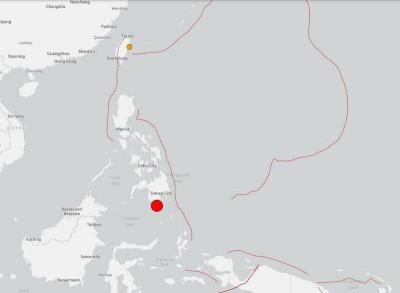
A magnitude 7.8 earthquake struck off the southern coast of Mindanao in the Philippines at 7:38am today, prompting the US Tsunami Warning System to issue an alert for neighboring countries, including Taiwan. The system issued a purple alert indicating a "tsunami threat." The potential threat zone includes Taiwan, the Philippines, Papua New Guinea, Yap and Palau. A spokesperson for Indonesia disaster mitigation agency said there were no reports of damage so far. Arlene Hollero, disaster chief of Maasim town in the Philippines' Sarangani Province, said their evacuation was underway in coastal villages and there were no reported casualties so far. DZBB radio, broadcasting from the

RESILIENCE: Taiwan plays a key role in semiconductors, energy, information infrastructure and advanced manufacturing, AIT Director Raymond Greene said Taiwan’s continued investment in deterrence and resilience remains vital, especially in uncrewed systems and other emerging technologies, American Institute in Taiwan (AIT) Director Raymond Greene said yesterday. Greene made the remarks at the annual National Strategic Summit on Supply Chain Resilience held by the Research Institute for Democracy, Society and Emerging Technology (DSET), a government-backed think tank. As Taiwan last year became the US’ fourth-largest trading partner and supply chain security is becoming more important, cooperation in emerging technologies continues to deepen between the two countries, he said. The US is committed to accelerating innovation, building key infrastructure, strengthening cooperation

The National Chungshan Institute of Science and Technology yesterday showcased its locally developed variants of the Vision 60 robotic patrol dog, which it plans to deploy on the nation’s outlying territories in the South China Sea. The variants were produced under the Joint Lab project — created by the institute and domestic companies — and assembled with domestically produced motors, lenses and artificial intelligence (AI) systems alongside licensed tech from the US, Missile and Rocket Systems Research Division deputy director Jen Kuo-kang (任國光) told the media event at a military base in Taipei’s Dazhi (大直) area. Taiwan has built up its strengths

RIGHT DIRECTION: Taiwan’s efforts to prevent forced labor include a proposal to ‘fully prohibit’ employers from withholding workers’ documents, an official said Taiwan is to establish a mechanism to restrict imports of goods linked to forced labor, the Executive Yuan said yesterday, after the US proposed imposing additional tariffs on Taiwanese goods over labor concerns. “The Ministry of Labor and the Ministry of Economic Affairs are to establish an interministerial review procedure,” Executive Yuan spokesperson Michelle Lee (李慧芝) said at a news briefing in Taipei. “The government is to use the Foreign Trade Act [貿易法] as the legal basis to restrict imports of goods produced with forced labor” and bring its supply chain governance more in line with international standards on human rights, resilience


 RSS
RSS